• Türkiye's Billions of Dollars Railway Ambition: Connecting China, Europe and the Middle East!

    Türkiye is accelerating its transformation into a major global trade and logistics hub, targeting stronger China–Europe freight connectivity by 2031 while developing strategic routes linking Central Asia, the Gulf and Europe.

    Four major transport corridors are shaping the region's future:

    Middle Corridor: Connects China to Europe through Central Asia, the Caspian Sea, Azerbaijan, Georgia and Türkiye.

    Zangezur Corridor: Aims to strengthen connections between Türkiye, Azerbaijan and Central Asia through a new strategic transport link.

    Iraq Development Road: A planned railway and highway network connecting Iraq's Grand Faw Port to Türkiye and European markets.

    Modern Hijaz Railway: A proposed revival and expansion connecting Türkiye through Syria and Jordan toward Saudi Arabia, with longer-term ambitions to reach Oman.

    Faster and more diversified international trade routes
    Stronger access between Asian and European markets
    New investment opportunities in railways, ports and logistics
    Greater economic integration across the Middle East and Central Asia

    The bigger picture: Türkiye aims to become a central crossroads of Eurasian trade, linking multiple regional freight networks into a more connected transport system.

    Could these corridors reshape global trade routes over the next decade?
    Türkiye's Billions of Dollars Railway Ambition: Connecting China, Europe and the Middle East! Türkiye is accelerating its transformation into a major global trade and logistics hub, targeting stronger China–Europe freight connectivity by 2031 while developing strategic routes linking Central Asia, the Gulf and Europe. Four major transport corridors are shaping the region's future: ๐Ÿšž Middle Corridor: Connects China to Europe through Central Asia, the Caspian Sea, Azerbaijan, Georgia and Türkiye. ๐Ÿš„ Zangezur Corridor: Aims to strengthen connections between Türkiye, Azerbaijan and Central Asia through a new strategic transport link. ๐Ÿš† Iraq Development Road: A planned railway and highway network connecting Iraq's Grand Faw Port to Türkiye and European markets. ๐Ÿš‚ Modern Hijaz Railway: A proposed revival and expansion connecting Türkiye through Syria and Jordan toward Saudi Arabia, with longer-term ambitions to reach Oman. โœ… Faster and more diversified international trade routes โœ… Stronger access between Asian and European markets โœ… New investment opportunities in railways, ports and logistics โœ… Greater economic integration across the Middle East and Central Asia ๐ŸŒ The bigger picture: Türkiye aims to become a central crossroads of Eurasian trade, linking multiple regional freight networks into a more connected transport system. ๐Ÿ’ฌ Could these corridors reshape global trade routes over the next decade?
    0 Comments 0 Shares
  • IN 1890, A JAPANESE FISHING VILLAGE SAVED 69 TURKISH SAILORS. 95 YEARS LATER, TURKEY PAID IT BACK

    September 1890. An Ottoman warship called the Ertugrul was heading home from Japan when a typhoon threw it onto the rocks near Kushimoto, at the southern tip of Japan's main island.

    More than 500 sailors died.

    The people of the small island nearby ran down to the water in the storm and pulled survivors out. By many accounts, they had very little food themselves, and gave the sailors what they had. 69 men survived. Japan sent them home on two of its own warships.

    Japan mostly forgot. Turkey didn't. Generations of Turkish kids learned the story at school.

    March 1985. War between Iran and Iraq. Iraq announced it would shoot down any plane over Iran after a deadline. More than 200 Japanese were stuck in Tehran, and under Japan's laws at the time, its own military planes could not go and get them.

    Turkey sent two Turkish Airlines planes. They flew 215 Japanese out before the deadline.

    When people later asked why, the answer from Turkey kept coming back to one word. Ertugrul.

    Today, Kushimoto still holds a memorial for the sailors, and Turkey still sends people to stand there.
    IN 1890, A JAPANESE FISHING VILLAGE SAVED 69 TURKISH SAILORS. 95 YEARS LATER, TURKEY PAID IT BACK ๐Ÿ‡ฏ๐Ÿ‡ต๐Ÿ‡น๐Ÿ‡ท September 1890. An Ottoman warship called the Ertugrul was heading home from Japan when a typhoon threw it onto the rocks near Kushimoto, at the southern tip of Japan's main island. More than 500 sailors died. The people of the small island nearby ran down to the water in the storm and pulled survivors out. By many accounts, they had very little food themselves, and gave the sailors what they had. 69 men survived. Japan sent them home on two of its own warships. Japan mostly forgot. Turkey didn't. Generations of Turkish kids learned the story at school. March 1985. War between Iran and Iraq. Iraq announced it would shoot down any plane over Iran after a deadline. More than 200 Japanese were stuck in Tehran, and under Japan's laws at the time, its own military planes could not go and get them. Turkey sent two Turkish Airlines planes. They flew 215 Japanese out before the deadline. When people later asked why, the answer from Turkey kept coming back to one word. Ertugrul. Today, Kushimoto still holds a memorial for the sailors, and Turkey still sends people to stand there.
    0 Comments 0 Shares
  • The Ottoman Empire at Its Greatest Extent

    At its height, the Ottoman Empire was one of the most powerful states in world history, spanning large parts of Southeastern Europe, Western Asia, and North Africa.

    A Transcontinental Empire

    The empire controlled territories surrounding much of the Mediterranean, Black Sea, and Red Sea, creating a strategic bridge between Europe, Asia, and Africa.

    Major Regions Under Ottoman Rule

    Anatolia — the Ottoman heartland
    The Balkans — extensive territories across Southeastern Europe
    Greece — much of the region was incorporated into the empire at different periods
    The Levant — including Syria and surrounding territories
    Mesopotamia — major Ottoman territories in present-day Iraq
    Egypt — an important economic and strategic province
    North Africa — Ottoman territories along much of the southern Mediterranean
    The Arabian Peninsula — including the Hejaz and other regions
    The Caucasus — areas contested and controlled at different times

    Key Facts

    Istanbul (Constantinople) became the imperial capital after the Ottoman conquest of 1453.
    At its height, the empire controlled territories across three continents.
    The Mediterranean Sea, Black Sea, Red Sea, and major land routes were strategically important to Ottoman power.
    The empire ruled over a remarkable diversity of peoples, languages, religions, and cultures.
    Ottoman influence lasted for more than six centuries, from its foundation around the end of the 13th century until its dissolution in the early 20th century.

    From a Frontier State to a Global Power

    What began as a small Anatolian principality developed into a vast empire that became a major political and military power between Europe, Asia, and Africa.

    The Ottoman Empire was not simply a European or Asian empire—it was a truly transcontinental power.

    #OttomanEmpire #OttomanHistory #History #Geography #WorldHistory
    ๐Ÿ•Œ The Ottoman Empire at Its Greatest Extent At its height, the Ottoman Empire was one of the most powerful states in world history, spanning large parts of Southeastern Europe, Western Asia, and North Africa. ๐ŸŒ A Transcontinental Empire The empire controlled territories surrounding much of the Mediterranean, Black Sea, and Red Sea, creating a strategic bridge between Europe, Asia, and Africa. ๐Ÿ—บ๏ธ Major Regions Under Ottoman Rule ๐Ÿ‡น๐Ÿ‡ท Anatolia — the Ottoman heartland ๐ŸŒ The Balkans — extensive territories across Southeastern Europe ๐Ÿ‡ฌ๐Ÿ‡ท Greece — much of the region was incorporated into the empire at different periods ๐Ÿ‡ธ๐Ÿ‡พ The Levant — including Syria and surrounding territories ๐Ÿ‡ฎ๐Ÿ‡ถ Mesopotamia — major Ottoman territories in present-day Iraq ๐Ÿ‡ช๐Ÿ‡ฌ Egypt — an important economic and strategic province ๐ŸŒ North Africa — Ottoman territories along much of the southern Mediterranean ๐Ÿ•Œ The Arabian Peninsula — including the Hejaz and other regions โ›ฐ๏ธ The Caucasus — areas contested and controlled at different times โš”๏ธ Key Facts ๐Ÿ”น Istanbul (Constantinople) became the imperial capital after the Ottoman conquest of 1453. ๐Ÿ”น At its height, the empire controlled territories across three continents. ๐Ÿ”น The Mediterranean Sea, Black Sea, Red Sea, and major land routes were strategically important to Ottoman power. ๐Ÿ”น The empire ruled over a remarkable diversity of peoples, languages, religions, and cultures. ๐Ÿ”น Ottoman influence lasted for more than six centuries, from its foundation around the end of the 13th century until its dissolution in the early 20th century. ๐Ÿ›๏ธ From a Frontier State to a Global Power What began as a small Anatolian principality developed into a vast empire that became a major political and military power between Europe, Asia, and Africa. The Ottoman Empire was not simply a European or Asian empire—it was a truly transcontinental power. #OttomanEmpire #OttomanHistory #History #Geography #WorldHistory
    0 Comments 0 Shares
  • TURKEY: A COUNTRY CONNECTING EUROPE AND ASIA

    Turkey occupies a strategic position between Europe and Asia, with coastlines along the Black Sea, Aegean Sea, and Mediterranean Sea.

    It shares land borders with 8 countries, stretching from the Balkans to the Caucasus and the Middle East.

    Turkey’s Land Borders:

    Syria — 911 km
    Iran — 534 km
    Iraq — 367 km
    Armenia — 328 km
    Georgia — 273 km
    Bulgaria — 259 km
    Greece — 206 km
    Azerbaijan — ~17 km via Nakhchivan

    Key Facts

    Capital: Ankara
    Area: ~783,562 km²
    Population: ~86 million
    Official language: Turkish
    Currency: Turkish lira
    Highest peak: Mount Ararat — 5,137 m
    Government: Presidential republic
    Location: Europe & Asia
    Seas: Black Sea, Aegean Sea & Mediterranean Sea

    Did you know Turkey shares land borders with 8 countries?

    #Turkey #Geography #WorldMap #Europe #Asia
    ๐Ÿ‡น๐Ÿ‡ท TURKEY: A COUNTRY CONNECTING EUROPE AND ASIA ๐ŸŒ Turkey occupies a strategic position between Europe and Asia, with coastlines along the Black Sea, Aegean Sea, and Mediterranean Sea. It shares land borders with 8 countries, stretching from the Balkans to the Caucasus and the Middle East. ๐Ÿ—บ๏ธ Turkey’s Land Borders: ๐Ÿ‡ธ๐Ÿ‡พ Syria — 911 km ๐Ÿ‡ฎ๐Ÿ‡ท Iran — 534 km ๐Ÿ‡ฎ๐Ÿ‡ถ Iraq — 367 km ๐Ÿ‡ฆ๐Ÿ‡ฒ Armenia — 328 km ๐Ÿ‡ฌ๐Ÿ‡ช Georgia — 273 km ๐Ÿ‡ง๐Ÿ‡ฌ Bulgaria — 259 km ๐Ÿ‡ฌ๐Ÿ‡ท Greece — 206 km ๐Ÿ‡ฆ๐Ÿ‡ฟ Azerbaijan — ~17 km via Nakhchivan ๐Ÿ“Œ Key Facts ๐Ÿ™๏ธ Capital: Ankara ๐Ÿ“ Area: ~783,562 km² ๐Ÿ‘ฅ Population: ~86 million ๐Ÿ—ฃ๏ธ Official language: Turkish ๐Ÿ’ฐ Currency: Turkish lira โ›ฐ๏ธ Highest peak: Mount Ararat — 5,137 m ๐Ÿ›๏ธ Government: Presidential republic ๐ŸŒ Location: Europe & Asia ๐ŸŒŠ Seas: Black Sea, Aegean Sea & Mediterranean Sea ๐Ÿ’ฌ Did you know Turkey shares land borders with 8 countries? #Turkey #Geography #WorldMap #Europe #Asia
    0 Comments 0 Shares
  • Seljuk Empire
    1037–1194
    One of the major Turkic empires of the medieval Islamic world, the Seljuks ruled vast territories across Anatolia, Persia, Iraq and Central Asia.
    Estimated maximum area: ~3.9 million km²
    Duration: 1037–1194
    Which historical empire should I map next?
    #SeljukEmpire #Seljuks #History #IslamicHistory #WorldHistory #HistoryMap #Empire #HistoricalMaps
    Seljuk Empire ๐Ÿน 1037–1194 One of the major Turkic empires of the medieval Islamic world, the Seljuks ruled vast territories across Anatolia, Persia, Iraq and Central Asia. ๐Ÿ“ Estimated maximum area: ~3.9 million km² โณ Duration: 1037–1194 Which historical empire should I map next? ๐Ÿ‘‡ #SeljukEmpire #Seljuks #History #IslamicHistory #WorldHistory #HistoryMap #Empire #HistoricalMaps
    0 Comments 0 Shares
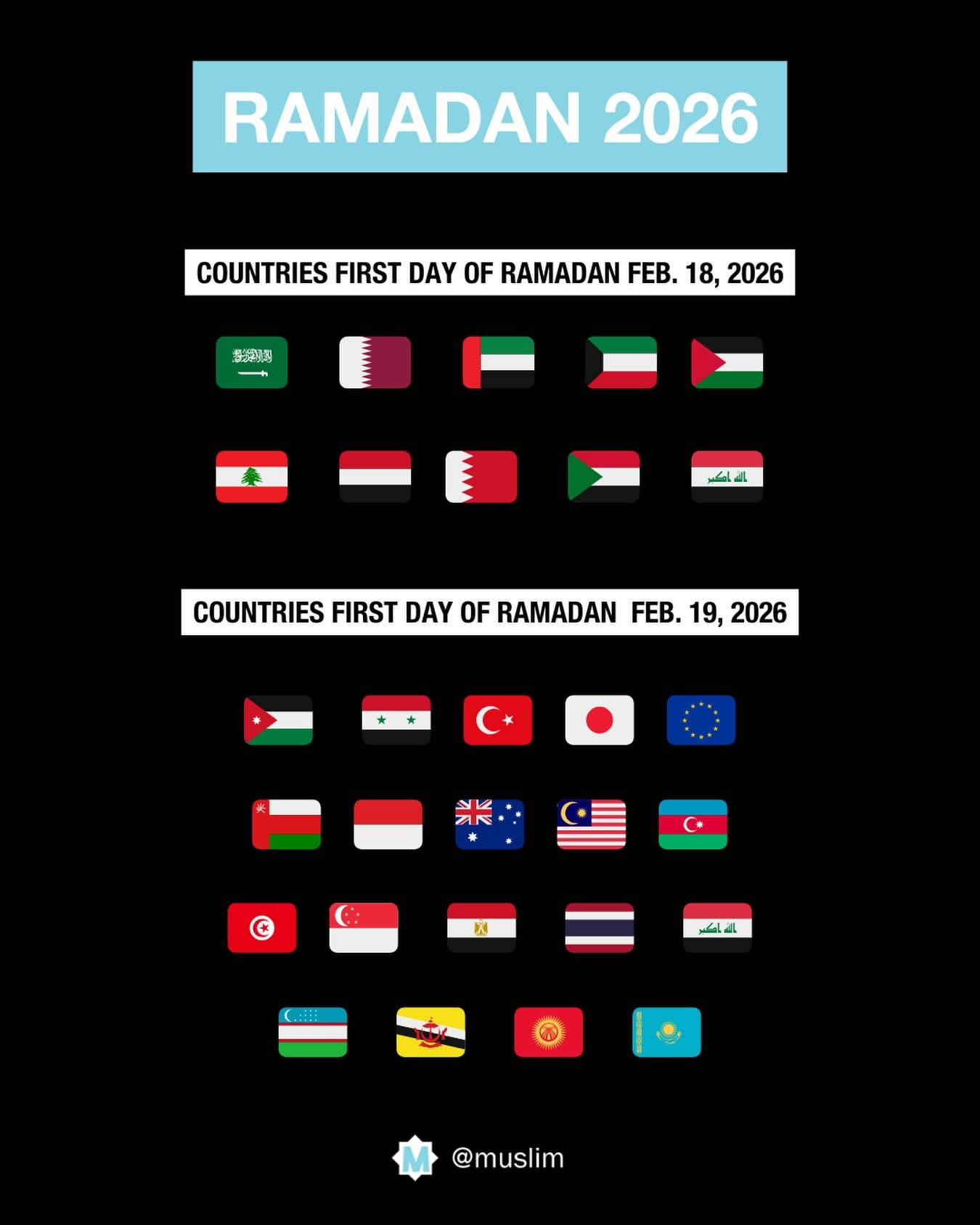
  • First day of Ramadan 1447 / 2026 announcements by countries.

    (Note: Iraq Sunnis are fasting the 18th, Iraq Shias are fasting the 19th)
    First day of Ramadan 1447 / 2026 announcements by countries. ๐ŸŒ™ (Note: Iraq Sunnis are fasting the 18th, Iraq Shias are fasting the 19th)
    0 Comments 0 Shares
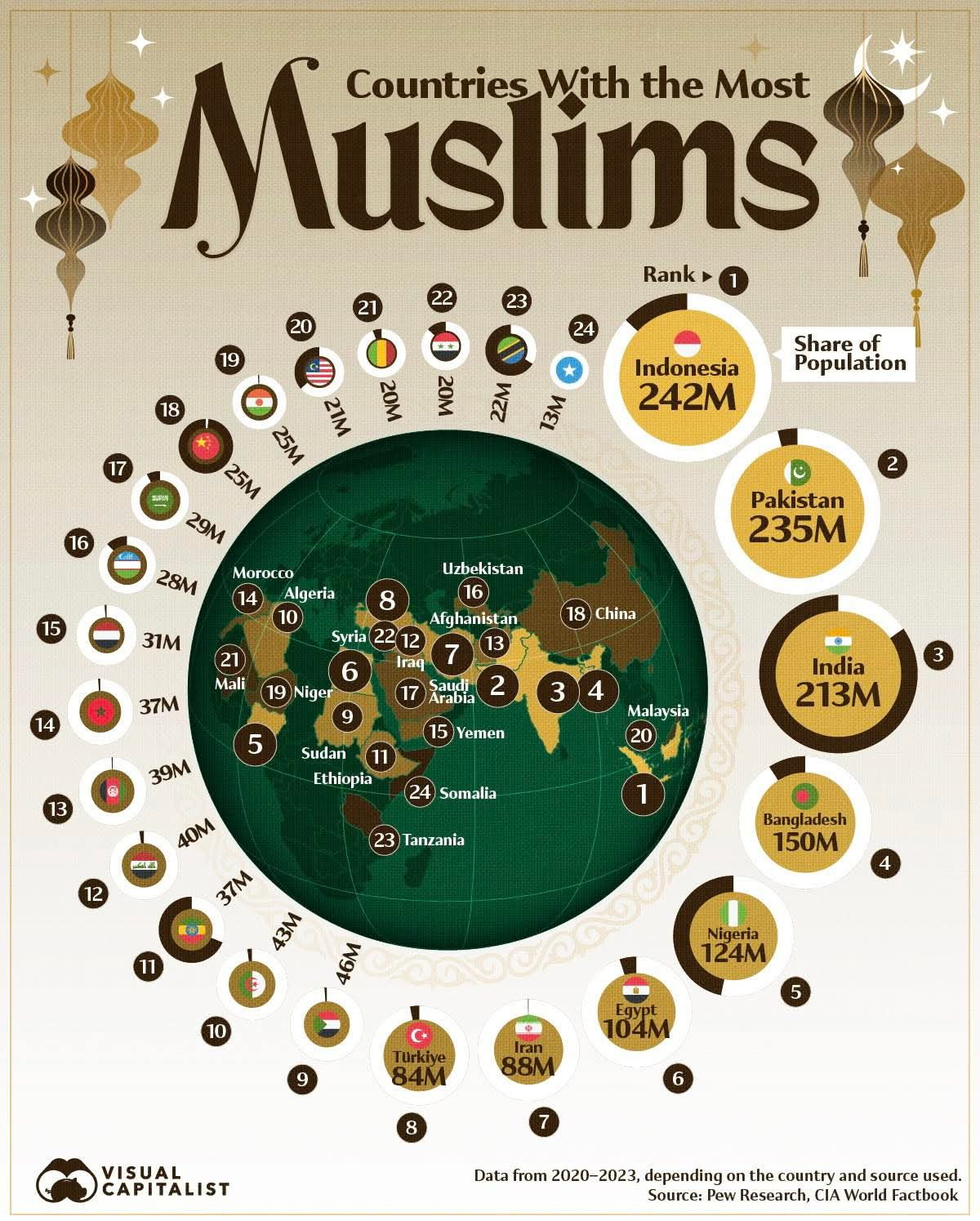
  • Countries With the Most Muslims (% Population)

    1. Indonesia - 242M (87.0%)
    2. Pakistan - 235M (96.3%)
    3. India - 213M (15.3%)
    4. Bangladesh - 150M (91.0%)
    5. Nigeria - 124M (53.5%)
    6. Egypt - 104M (95%)
    7. Iran - 88M (99.8%)
    8. Turkey - 84M (97%)
    9. Sudan - 46M (99%)
    10. Algeria - 43M (98.0%)
    11. Iraq - 40M (98%)
    12. Afghanistan - 39M (99.7%)
    13. Ethiopia - 37M (31.3%)
    14. Morocco - 37M (99.0%)
    15. Yemen - 31M (99.1%)
    16. Saudi Arabia - 29M (92.7%)
    17. Uzbekistan - 28M (88.0%)
    18. China - 25M (1.4%)
    19. Nigér - 25M (99.3%)
    20. Tanzania - 22M (34.1%)
    21. Malaysia - 21M (63.5%)
    22. Mali - 20M (93.9%)
    23. Syria - 20M (87.0%)
    24. Somalia - 13M (99.8%)

    The data comes from two complementary sources: Pew Research, which tracks global religious affiliation, and the CIA World Factbook, which publishes national demographic splits.

    Countries With the Largest Muslim Populations: Islam is the world’s second-largest religion, with 1.8 billion Muslims dispersed across every continent. Due to data constraints, the most recent figures between 2020–2023 have been utilized, depending on availability per country. Africa is home to some of the fastest-growing Muslim populations. Nigeria, already the continent’s most populous country, now counts over 124 million Muslims, comprising more than half its citizens. In North Africa, Egypt and Algeria each report that roughly 95-98% of their inhabitants identify as Muslim, reflecting centuries-old cultural and religious continuity.
    ๐Ÿ•Œ Countries With the Most Muslims (% Population) 1. ๐Ÿ‡ฎ๐Ÿ‡ฉ Indonesia - 242M (87.0%) 2. ๐Ÿ‡ต๐Ÿ‡ฐ Pakistan - 235M (96.3%) 3. ๐Ÿ‡ฎ๐Ÿ‡ณ India - 213M (15.3%) 4. ๐Ÿ‡ง๐Ÿ‡ฉ Bangladesh - 150M (91.0%) 5. ๐Ÿ‡ณ๐Ÿ‡ฌ Nigeria - 124M (53.5%) 6. ๐Ÿ‡ช๐Ÿ‡ฌ Egypt - 104M (95%) 7. ๐Ÿ‡ฎ๐Ÿ‡ท Iran - 88M (99.8%) 8. ๐Ÿ‡น๐Ÿ‡ท Turkey - 84M (97%) 9. ๐Ÿ‡ธ๐Ÿ‡ฉ Sudan - 46M (99%) 10. ๐Ÿ‡ฉ๐Ÿ‡ฟ Algeria - 43M (98.0%) 11. ๐Ÿ‡ฎ๐Ÿ‡ถ Iraq - 40M (98%) 12. ๐Ÿ‡ฆ๐Ÿ‡ซ Afghanistan - 39M (99.7%) 13. ๐Ÿ‡ช๐Ÿ‡น Ethiopia - 37M (31.3%) 14. ๐Ÿ‡ฒ๐Ÿ‡ฆ Morocco - 37M (99.0%) 15. ๐Ÿ‡พ๐Ÿ‡ช Yemen - 31M (99.1%) 16. ๐Ÿ‡ธ๐Ÿ‡ฆ Saudi Arabia - 29M (92.7%) 17. ๐Ÿ‡บ๐Ÿ‡ฟ Uzbekistan - 28M (88.0%) 18. ๐Ÿ‡จ๐Ÿ‡ณ China - 25M (1.4%) 19. ๐Ÿ‡ณ๐Ÿ‡ช Nigér - 25M (99.3%) 20. ๐Ÿ‡น๐Ÿ‡ฟ Tanzania - 22M (34.1%) 21. ๐Ÿ‡ฒ๐Ÿ‡พ Malaysia - 21M (63.5%) 22. ๐Ÿ‡ฒ๐Ÿ‡ฑ Mali - 20M (93.9%) 23. ๐Ÿ‡ธ๐Ÿ‡พ Syria - 20M (87.0%) 24. ๐Ÿ‡ธ๐Ÿ‡ด Somalia - 13M (99.8%) ๐Ÿ“Œ The data comes from two complementary sources: Pew Research, which tracks global religious affiliation, and the CIA World Factbook, which publishes national demographic splits. Countries With the Largest Muslim Populations: Islam is the world’s second-largest religion, with 1.8 billion Muslims dispersed across every continent. Due to data constraints, the most recent figures between 2020–2023 have been utilized, depending on availability per country. Africa is home to some of the fastest-growing Muslim populations. Nigeria, already the continent’s most populous country, now counts over 124 million Muslims, comprising more than half its citizens. In North Africa, Egypt and Algeria each report that roughly 95-98% of their inhabitants identify as Muslim, reflecting centuries-old cultural and religious continuity.
    0 Comments 0 Shares
  • Diabetes rates around the world:

    1. Pakistan: 30.8%
    2. Kuwait: 24.9%
    8. Egypt: 20.9%
    10. Qatar: 19.5%
    12. Malaysia: 19%
    14. Saudi Arabia: 18.7%
    17. Mexico: 16.9%
    26. Turkey: 14.5%
    27. Bangladesh: 14.2%
    48. Sri Lanka: 11.3%
    53. South Africa: 10.8%
    54. Iraq: 10.7%
    55. United States: 10.7%
    56. Indonesia: 10.6%
    57. China: 10.6%
    60. Spain: 10.3%
    63. Thailand: 9.7%
    64. India: 9.6%
    71. Iran: 9.1%
    74. Portugal: 9.1%
    78. Brazil: 8.8%
    83. Nepal: 8.7%
    86. North Korea: 8.6%
    96. Canada: 7.7%
    107. Philippines: 7.1%
    113. South Korea: 6.8%
    116. Japan: 6.6%
    127. Australia: 6.4%
    129. Italy: 6.4%
    132. United Kingdom: 6.3%
    135. New Zealand: 6.2%
    139. Vietnam: 6.1%
    153. Russia: 5.6%
    162. Argentina: 5.4%
    165. France: 5.3%
    169. Ethiopia: 5%
    183. Kenya: 4%
    186. Nigeria: 3.6%

    Percentage of people age 20-79 who have type 1 or type 2 diabetes
    Diabetes rates around the world: 1. ๐Ÿ‡ต๐Ÿ‡ฐPakistan: 30.8% 2. ๐Ÿ‡ฐ๐Ÿ‡ผKuwait: 24.9% 8. ๐Ÿ‡ช๐Ÿ‡ฌEgypt: 20.9% 10. ๐Ÿ‡ถ๐Ÿ‡ฆQatar: 19.5% 12. ๐Ÿ‡ฒ๐Ÿ‡พMalaysia: 19% 14. ๐Ÿ‡ธ๐Ÿ‡ฆSaudi Arabia: 18.7% 17. ๐Ÿ‡ฒ๐Ÿ‡ฝMexico: 16.9% 26. ๐Ÿ‡น๐Ÿ‡ทTurkey: 14.5% 27. ๐Ÿ‡ง๐Ÿ‡ฉBangladesh: 14.2% 48. ๐Ÿ‡ฑ๐Ÿ‡ฐSri Lanka: 11.3% 53. ๐Ÿ‡ฟ๐Ÿ‡ฆSouth Africa: 10.8% 54. ๐Ÿ‡ฎ๐Ÿ‡ถIraq: 10.7% 55. ๐Ÿ‡บ๐Ÿ‡ธUnited States: 10.7% 56. ๐Ÿ‡ฎ๐Ÿ‡ฉIndonesia: 10.6% 57. ๐Ÿ‡จ๐Ÿ‡ณChina: 10.6% 60. ๐Ÿ‡ช๐Ÿ‡ธSpain: 10.3% 63. ๐Ÿ‡น๐Ÿ‡ญThailand: 9.7% 64. ๐Ÿ‡ฎ๐Ÿ‡ณIndia: 9.6% 71. ๐Ÿ‡ฎ๐Ÿ‡ทIran: 9.1% 74. ๐Ÿ‡ต๐Ÿ‡นPortugal: 9.1% 78. ๐Ÿ‡ง๐Ÿ‡ทBrazil: 8.8% 83. ๐Ÿ‡ณ๐Ÿ‡ตNepal: 8.7% 86. ๐Ÿ‡ฐ๐Ÿ‡ตNorth Korea: 8.6% 96. ๐Ÿ‡จ๐Ÿ‡ฆCanada: 7.7% 107. ๐Ÿ‡ต๐Ÿ‡ญPhilippines: 7.1% 113. ๐Ÿ‡ฐ๐Ÿ‡ทSouth Korea: 6.8% 116. ๐Ÿ‡ฏ๐Ÿ‡ตJapan: 6.6% 127. ๐Ÿ‡ฆ๐Ÿ‡บAustralia: 6.4% 129. ๐Ÿ‡ฎ๐Ÿ‡นItaly: 6.4% 132. ๐Ÿ‡ฌ๐Ÿ‡งUnited Kingdom: 6.3% 135. ๐Ÿ‡ณ๐Ÿ‡ฟNew Zealand: 6.2% 139. ๐Ÿ‡ป๐Ÿ‡ณVietnam: 6.1% 153. ๐Ÿ‡ท๐Ÿ‡บRussia: 5.6% 162. ๐Ÿ‡ฆ๐Ÿ‡ทArgentina: 5.4% 165. ๐Ÿ‡ซ๐Ÿ‡ทFrance: 5.3% 169. ๐Ÿ‡ช๐Ÿ‡นEthiopia: 5% 183. ๐Ÿ‡ฐ๐Ÿ‡ชKenya: 4% 186. ๐Ÿ‡ณ๐Ÿ‡ฌNigeria: 3.6% ๐Ÿ“Œ Percentage of people age 20-79 who have type 1 or type 2 diabetes
    0 Comments 0 Shares
  • Most Populous Countries in The World (August 2025)

    1. India - 1,465,677,586 (1.47B)
    2. China - 1,415,623,588 (1.42B)
    3. United States - 347,538,693 (348M)
    4. Indonesia - 286,035,530 (286M)
    5. Pakistan - 255,219,554 (255M)
    6. Nigeria - 238,251,907 (238M)
    7. Brazil - 212,932,800 (213M)
    8. Bangladesh - 176,002,683 (176M)
    9. Russia - 143,876,305 (144M)
    10. Ethiopia - 135,983,125 (136M)
    11. Mexico - 132,107,942 (132M)
    12. Japan - 123,007,892 (123M)
    13. Egypt - 118,638,206 (119M)
    14. Philippines - 116,926,846 (117M)
    15. DR Congo - 113,367,106 (113M)
    16. Vietnam - 101,689,007 (102M)
    17. Iran - 92,543,805 (92M)
    18. Turkey - 87,716,710 (88M)
    19. Germany - 84,004,876 (84M)
    20. Thailand - 71,612,755 (72M)
    21. Tanzania - 70,801,979 (71M)
    22. United Kingdom - 69,609,918 (70M)
    23. France - 66,665,565 (67M)
    24. South Africa - 64,849,940 (65M)
    25. Italy - 59,117,339 (59M)
    26. Kenya - 57,680,076 (58M)
    27. Myanmar - 54,900,269 (55M)
    28. Colombia - 53,500,821 (54M)
    29. South Korea - 51,659,659 (52M)
    30. Sudan - 51,821,910 (52M)
    31. Uganda - 51,562,757 (52M)
    32. Spain - 47,886,966 (48M)
    33. Algeria - 47,520,822 (48M)
    34. Iraq - 47,151,180 (47M)
    35. Argentina - 45,873,616 (46M)
    36. Afghanistan - 43,999,045 (44M)
    37. Yemen - 41,927,208 (42M)
    38. Canada - 40,180,416 (40M)
    39. Angola - 39,187,953 (39M)
    40. Morocco - 38,479,712 (38M)
    41. Poland - 38,080,709 (38M)
    42. Uzbekistan - 37,146,431 (37M)
    43. Malaysia - 36,036,035 (36M)
    44. Mozambique - 35,760,667 (36M)
    45. Ghana - 35,150,102 (35M)
    46. Peru - 34,626,633 (35M)
    47. Saudi Arabia - 34,647,916 (35M)
    48. Madagascar - 32,842,738 (33M)
    49. ๐Ÿ‡จ๐Ÿ‡ฎ Côte d'Ivoire - 32,813,785 (33M)
    50. Cameroon - 29,978,049 (30M)
    Most Populous Countries in The World (August 2025) 1. ๐Ÿ‡ฎ๐Ÿ‡ณ India - 1,465,677,586 (1.47B) 2. ๐Ÿ‡จ๐Ÿ‡ณ China - 1,415,623,588 (1.42B) 3. ๐Ÿ‡บ๐Ÿ‡ธ United States - 347,538,693 (348M) 4. ๐Ÿ‡ฎ๐Ÿ‡ฉ Indonesia - 286,035,530 (286M) 5. ๐Ÿ‡ต๐Ÿ‡ฐ Pakistan - 255,219,554 (255M) 6. ๐Ÿ‡ณ๐Ÿ‡ฌ Nigeria - 238,251,907 (238M) 7. ๐Ÿ‡ง๐Ÿ‡ท Brazil - 212,932,800 (213M) 8. ๐Ÿ‡ง๐Ÿ‡ฉ Bangladesh - 176,002,683 (176M) 9. ๐Ÿ‡ท๐Ÿ‡บ Russia - 143,876,305 (144M) 10. ๐Ÿ‡ช๐Ÿ‡น Ethiopia - 135,983,125 (136M) 11. ๐Ÿ‡ฒ๐Ÿ‡ฝ Mexico - 132,107,942 (132M) 12. ๐Ÿ‡ฏ๐Ÿ‡ต Japan - 123,007,892 (123M) 13. ๐Ÿ‡ช๐Ÿ‡ฌ Egypt - 118,638,206 (119M) 14. ๐Ÿ‡ต๐Ÿ‡ญ Philippines - 116,926,846 (117M) 15. ๐Ÿ‡จ๐Ÿ‡ฉ DR Congo - 113,367,106 (113M) 16. ๐Ÿ‡ป๐Ÿ‡ณ Vietnam - 101,689,007 (102M) 17. ๐Ÿ‡ฎ๐Ÿ‡ท Iran - 92,543,805 (92M) 18. ๐Ÿ‡น๐Ÿ‡ท Turkey - 87,716,710 (88M) 19. ๐Ÿ‡ฉ๐Ÿ‡ช Germany - 84,004,876 (84M) 20. ๐Ÿ‡น๐Ÿ‡ญ Thailand - 71,612,755 (72M) 21. ๐Ÿ‡น๐Ÿ‡ฟ Tanzania - 70,801,979 (71M) 22. ๐Ÿ‡ฌ๐Ÿ‡ง United Kingdom - 69,609,918 (70M) 23. ๐Ÿ‡ซ๐Ÿ‡ท France - 66,665,565 (67M) 24. ๐Ÿ‡ฟ๐Ÿ‡ฆ South Africa - 64,849,940 (65M) 25. ๐Ÿ‡ฎ๐Ÿ‡น Italy - 59,117,339 (59M) 26. ๐Ÿ‡ฐ๐Ÿ‡ช Kenya - 57,680,076 (58M) 27. ๐Ÿ‡ฒ๐Ÿ‡ฒ Myanmar - 54,900,269 (55M) 28. ๐Ÿ‡จ๐Ÿ‡ด Colombia - 53,500,821 (54M) 29. ๐Ÿ‡ฐ๐Ÿ‡ท South Korea - 51,659,659 (52M) 30. ๐Ÿ‡ธ๐Ÿ‡ฉ Sudan - 51,821,910 (52M) 31. ๐Ÿ‡บ๐Ÿ‡ฌ Uganda - 51,562,757 (52M) 32. ๐Ÿ‡ช๐Ÿ‡ธ Spain - 47,886,966 (48M) 33. ๐Ÿ‡ฉ๐Ÿ‡ฟ Algeria - 47,520,822 (48M) 34. ๐Ÿ‡ฎ๐Ÿ‡ถ Iraq - 47,151,180 (47M) 35. ๐Ÿ‡ฆ๐Ÿ‡ท Argentina - 45,873,616 (46M) 36. ๐Ÿ‡ฆ๐Ÿ‡ซ Afghanistan - 43,999,045 (44M) 37. ๐Ÿ‡พ๐Ÿ‡ช Yemen - 41,927,208 (42M) 38. ๐Ÿ‡จ๐Ÿ‡ฆ Canada - 40,180,416 (40M) 39. ๐Ÿ‡ฆ๐Ÿ‡ด Angola - 39,187,953 (39M) 40. ๐Ÿ‡ฒ๐Ÿ‡ฆ Morocco - 38,479,712 (38M) 41. ๐Ÿ‡ต๐Ÿ‡ฑ Poland - 38,080,709 (38M) 42. ๐Ÿ‡บ๐Ÿ‡ฟ Uzbekistan - 37,146,431 (37M) 43. ๐Ÿ‡ฒ๐Ÿ‡พ Malaysia - 36,036,035 (36M) 44. ๐Ÿ‡ฒ๐Ÿ‡ฟ Mozambique - 35,760,667 (36M) 45. ๐Ÿ‡ฌ๐Ÿ‡ญ Ghana - 35,150,102 (35M) 46. ๐Ÿ‡ต๐Ÿ‡ช Peru - 34,626,633 (35M) 47. ๐Ÿ‡ธ๐Ÿ‡ฆ Saudi Arabia - 34,647,916 (35M) 48. ๐Ÿ‡ฒ๐Ÿ‡ฌ Madagascar - 32,842,738 (33M) 49. ๐Ÿ‡จ๐Ÿ‡ฎ Côte d'Ivoire - 32,813,785 (33M) 50. ๐Ÿ‡จ๐Ÿ‡ฒ Cameroon - 29,978,049 (30M)
    0 Comments 0 Shares
  • #Turkey is located at the crossroads of Asia and Europe. It is bordered by Greece and Bulgaria to the northwest, the Black Sea to the north, Georgia to the northeast, Armenia, the Azerbaijani exclave of Nakhchivan, and Iran to the east, Iraq to the southeast, Syria and the Mediterranean Sea to the south, and the Aegean Sea to the west.
    Area: 783,562 square kilometers.
    Topography: Includes the Taurus Mountains in the south, the Pontic Mountains in the north, fertile plains like the Anatolian Plain, and the Central Anatolian Plateau, along with lakes such as Lake Van.
    Water Bodies: Borders four major seas: the Black Sea, the Sea of Marmara, the Aegean Sea, and the Mediterranean Sea.
    2. Climate:
    Coastal Areas:
    Mediterranean and Aegean Coasts: Mediterranean climate with hot, dry summers and mild, wet winters.
    Black Sea Coast: Moderate and humid climate year-round.
    Inland Regions: Continental climate with hot, dry summers and very cold, snowy winters.
    Climate Change: Turkey faces challenges like drought and rising temperatures due to climate change.
    3. Population:
    Population Size: Approximately 84.5 million (2021).
    Population Distribution: Istanbul is the largest city with over 15.5 million residents. Ankara is the second largest, followed by Izmir, Bursa, and Antalya.
    Ethnic Diversity: Predominantly Turks, with a significant Kurdish minority, and smaller Armenian, Arab, and Greek communities.
    Population Growth: About 1.2% annually.
    4. Economy:
    GDP: Approximately $7.209 trillion in 2021.
    Exports: Includes agricultural products, automobiles, textiles, and electronics, valued at $225 billion.
    Imports: Mainly energy and raw materials, totaling $271 billion.
    Unemployment Rate: Around 10.3%.
    Agriculture and Industry: Notable for wheat, hazelnuts, and olives, as well as being a leading producer of automobiles and steel.
    5. Currency:
    The official currency is the Turkish Lira (TRY), which experiences fluctuations in value against foreign currencies.
    6. Tourism:
    Visitor Numbers: Turkey welcomed around 30 million tourists in 2021.
    Revenue: Approximately $24.5 billion.
    Top Destinations:
    Istanbul: Iconic landmarks like Hagia Sophia, the Blue Mosque, and Topkapi Palace.
    Antalya: A hub for coastal tourism.
    Cappadocia: Known for its unique landscapes and hot air balloons.
    Historical Sites: Ephesus and Troy.
    7. History:
    Civilizations: Turkey has been home to various civilizations, including the Hittites, Persians, Romans, and Byzantines.
    Ottoman Era: Spanned from the 14th century to the early 20th century.
    Modern Republic: Established in 1923 under Mustafa Kemal Atatürk, who moved the capital to Ankara and initiated widespread reforms.
    8. Education:
    Education System: Mandatory for 12 years (6 years primary, 3 years middle, 3 years secondary).
    Higher Education: Home to numerous universities, including Istanbul University and Middle East Technical University.
    Literacy Rate: Approximately 96%.
    9. Healthcare:
    Healthcare System: Turkey has a well-developed healthcare system encompassing public and private sectors.
    Medical Tourism: A popular destination for medical and cosmetic treatments, attracting thousands of patients annually.
    Hospitals: Equipped with state-of-the-art medical technology.
    10. Culture:
    Official Language: Turkish.
    Religion: Islam is the predominant religion, with Christian and Jewish minorities.
    Traditions: A blend of Eastern and Western cultural influences.
    Turkey serves as a bridge between East and West, with a rich history and modern development.
    #Turkey is located at the crossroads of Asia and Europe. It is bordered by Greece and Bulgaria to the northwest, the Black Sea to the north, Georgia to the northeast, Armenia, the Azerbaijani exclave of Nakhchivan, and Iran to the east, Iraq to the southeast, Syria and the Mediterranean Sea to the south, and the Aegean Sea to the west. Area: 783,562 square kilometers. Topography: Includes the Taurus Mountains in the south, the Pontic Mountains in the north, fertile plains like the Anatolian Plain, and the Central Anatolian Plateau, along with lakes such as Lake Van. Water Bodies: Borders four major seas: the Black Sea, the Sea of Marmara, the Aegean Sea, and the Mediterranean Sea. ๐ŸŒ 2. Climate: Coastal Areas: Mediterranean and Aegean Coasts: Mediterranean climate with hot, dry summers and mild, wet winters. Black Sea Coast: Moderate and humid climate year-round. Inland Regions: Continental climate with hot, dry summers and very cold, snowy winters. Climate Change: Turkey faces challenges like drought and rising temperatures due to climate change. ๐ŸŒ 3. Population: Population Size: Approximately 84.5 million (2021). Population Distribution: Istanbul is the largest city with over 15.5 million residents. Ankara is the second largest, followed by Izmir, Bursa, and Antalya. Ethnic Diversity: Predominantly Turks, with a significant Kurdish minority, and smaller Armenian, Arab, and Greek communities. Population Growth: About 1.2% annually. ๐ŸŒ 4. Economy: GDP: Approximately $7.209 trillion in 2021. Exports: Includes agricultural products, automobiles, textiles, and electronics, valued at $225 billion. Imports: Mainly energy and raw materials, totaling $271 billion. Unemployment Rate: Around 10.3%. Agriculture and Industry: Notable for wheat, hazelnuts, and olives, as well as being a leading producer of automobiles and steel. ๐ŸŒ 5. Currency: The official currency is the Turkish Lira (TRY), which experiences fluctuations in value against foreign currencies. ๐ŸŒ 6. Tourism: Visitor Numbers: Turkey welcomed around 30 million tourists in 2021. Revenue: Approximately $24.5 billion. Top Destinations: Istanbul: Iconic landmarks like Hagia Sophia, the Blue Mosque, and Topkapi Palace. Antalya: A hub for coastal tourism. Cappadocia: Known for its unique landscapes and hot air balloons. Historical Sites: Ephesus and Troy. ๐ŸŒ 7. History: Civilizations: Turkey has been home to various civilizations, including the Hittites, Persians, Romans, and Byzantines. Ottoman Era: Spanned from the 14th century to the early 20th century. Modern Republic: Established in 1923 under Mustafa Kemal Atatürk, who moved the capital to Ankara and initiated widespread reforms. ๐ŸŒ 8. Education: Education System: Mandatory for 12 years (6 years primary, 3 years middle, 3 years secondary). Higher Education: Home to numerous universities, including Istanbul University and Middle East Technical University. Literacy Rate: Approximately 96%. ๐ŸŒ 9. Healthcare: Healthcare System: Turkey has a well-developed healthcare system encompassing public and private sectors. Medical Tourism: A popular destination for medical and cosmetic treatments, attracting thousands of patients annually. Hospitals: Equipped with state-of-the-art medical technology. ๐ŸŒ 10. Culture: Official Language: Turkish. Religion: Islam is the predominant religion, with Christian and Jewish minorities. Traditions: A blend of Eastern and Western cultural influences. Turkey serves as a bridge between East and West, with a rich history and modern development.
    0 Comments 0 Shares
More Results