• İstanbul’un tarihi kalbinde, Osmanlı İmparatorluğu’nun asırlar boyunca yönetildiği **Topkapı Sarayı** ve sarayın görkemli ana girişi olan **Babüsselam (Selam Kapısı)**, gün batımının altın ve kızıl tonları altında muazzam bir manzara sunuyor. İki heybetli kule arasında yükselen şanlı bayrağımız, çiçeklerle bezenmiş bakımlı saray bahçeleri ve ortasındaki zarif fıskiye; imparatorluğun o köklü ihtişamını gözler önüne seriyor. Akşam güneşinin tarihi taş surlara ve bahçedeki renklere dokunduğu bu büyüleyici atmosferde bulunmak, insanı tarihin altın sayfalarında masalsı bir yolculuğa çıkarıyor. Bence dünyanın en güzel yeri burası.

    ---

    Standing at the historical heart of Istanbul, **Topkapı Palace** and its majestic monumental entrance, **Babüsselam (The Gate of Salutation)**, present a magnificent view beneath the golden and crimson hues of sunset. The proud national flag fluttering between two imposing towers, manicured palace gardens filled with vibrant flowers, and an elegant stone fountain highlight the deep-rooted grandeur of the Ottoman Empire. Experiencing this enchanting atmosphere as evening sunlight gently touches the historic ramparts offers a deeply inspiring journey through history.
    İstanbul’un tarihi kalbinde, Osmanlı İmparatorluğu’nun asırlar boyunca yönetildiği **Topkapı Sarayı** ve sarayın görkemli ana girişi olan **Babüsselam (Selam Kapısı)**, gün batımının altın ve kızıl tonları altında muazzam bir manzara sunuyor. İki heybetli kule arasında yükselen şanlı bayrağımız, çiçeklerle bezenmiş bakımlı saray bahçeleri ve ortasındaki zarif fıskiye; imparatorluğun o köklü ihtişamını gözler önüne seriyor. Akşam güneşinin tarihi taş surlara ve bahçedeki renklere dokunduğu bu büyüleyici atmosferde bulunmak, insanı tarihin altın sayfalarında masalsı bir yolculuğa çıkarıyor. Bence dünyanın en güzel yeri burası. 🇹🇷 --- 🇬🇧 Standing at the historical heart of Istanbul, **Topkapı Palace** and its majestic monumental entrance, **Babüsselam (The Gate of Salutation)**, present a magnificent view beneath the golden and crimson hues of sunset. The proud national flag fluttering between two imposing towers, manicured palace gardens filled with vibrant flowers, and an elegant stone fountain highlight the deep-rooted grandeur of the Ottoman Empire. Experiencing this enchanting atmosphere as evening sunlight gently touches the historic ramparts offers a deeply inspiring journey through history.
    0 Kommentare 0 Anteile
  • IN 1890, A JAPANESE FISHING VILLAGE SAVED 69 TURKISH SAILORS. 95 YEARS LATER, TURKEY PAID IT BACK

    September 1890. An Ottoman warship called the Ertugrul was heading home from Japan when a typhoon threw it onto the rocks near Kushimoto, at the southern tip of Japan's main island.

    More than 500 sailors died.

    The people of the small island nearby ran down to the water in the storm and pulled survivors out. By many accounts, they had very little food themselves, and gave the sailors what they had. 69 men survived. Japan sent them home on two of its own warships.

    Japan mostly forgot. Turkey didn't. Generations of Turkish kids learned the story at school.

    March 1985. War between Iran and Iraq. Iraq announced it would shoot down any plane over Iran after a deadline. More than 200 Japanese were stuck in Tehran, and under Japan's laws at the time, its own military planes could not go and get them.

    Turkey sent two Turkish Airlines planes. They flew 215 Japanese out before the deadline.

    When people later asked why, the answer from Turkey kept coming back to one word. Ertugrul.

    Today, Kushimoto still holds a memorial for the sailors, and Turkey still sends people to stand there.
    IN 1890, A JAPANESE FISHING VILLAGE SAVED 69 TURKISH SAILORS. 95 YEARS LATER, TURKEY PAID IT BACK 🇯🇵🇹🇷 September 1890. An Ottoman warship called the Ertugrul was heading home from Japan when a typhoon threw it onto the rocks near Kushimoto, at the southern tip of Japan's main island. More than 500 sailors died. The people of the small island nearby ran down to the water in the storm and pulled survivors out. By many accounts, they had very little food themselves, and gave the sailors what they had. 69 men survived. Japan sent them home on two of its own warships. Japan mostly forgot. Turkey didn't. Generations of Turkish kids learned the story at school. March 1985. War between Iran and Iraq. Iraq announced it would shoot down any plane over Iran after a deadline. More than 200 Japanese were stuck in Tehran, and under Japan's laws at the time, its own military planes could not go and get them. Turkey sent two Turkish Airlines planes. They flew 215 Japanese out before the deadline. When people later asked why, the answer from Turkey kept coming back to one word. Ertugrul. Today, Kushimoto still holds a memorial for the sailors, and Turkey still sends people to stand there.
    0 Kommentare 0 Anteile
  • The Ottoman Empire at Its Greatest Extent

    At its height, the Ottoman Empire was one of the most powerful states in world history, spanning large parts of Southeastern Europe, Western Asia, and North Africa.

    A Transcontinental Empire

    The empire controlled territories surrounding much of the Mediterranean, Black Sea, and Red Sea, creating a strategic bridge between Europe, Asia, and Africa.

    Major Regions Under Ottoman Rule

    Anatolia — the Ottoman heartland
    The Balkans — extensive territories across Southeastern Europe
    Greece — much of the region was incorporated into the empire at different periods
    The Levant — including Syria and surrounding territories
    Mesopotamia — major Ottoman territories in present-day Iraq
    Egypt — an important economic and strategic province
    North Africa — Ottoman territories along much of the southern Mediterranean
    The Arabian Peninsula — including the Hejaz and other regions
    The Caucasus — areas contested and controlled at different times

    Key Facts

    Istanbul (Constantinople) became the imperial capital after the Ottoman conquest of 1453.
    At its height, the empire controlled territories across three continents.
    The Mediterranean Sea, Black Sea, Red Sea, and major land routes were strategically important to Ottoman power.
    The empire ruled over a remarkable diversity of peoples, languages, religions, and cultures.
    Ottoman influence lasted for more than six centuries, from its foundation around the end of the 13th century until its dissolution in the early 20th century.

    From a Frontier State to a Global Power

    What began as a small Anatolian principality developed into a vast empire that became a major political and military power between Europe, Asia, and Africa.

    The Ottoman Empire was not simply a European or Asian empire—it was a truly transcontinental power.

    #OttomanEmpire #OttomanHistory #History #Geography #WorldHistory
    🕌 The Ottoman Empire at Its Greatest Extent At its height, the Ottoman Empire was one of the most powerful states in world history, spanning large parts of Southeastern Europe, Western Asia, and North Africa. 🌍 A Transcontinental Empire The empire controlled territories surrounding much of the Mediterranean, Black Sea, and Red Sea, creating a strategic bridge between Europe, Asia, and Africa. 🗺️ Major Regions Under Ottoman Rule 🇹🇷 Anatolia — the Ottoman heartland 🌍 The Balkans — extensive territories across Southeastern Europe 🇬🇷 Greece — much of the region was incorporated into the empire at different periods 🇸🇾 The Levant — including Syria and surrounding territories 🇮🇶 Mesopotamia — major Ottoman territories in present-day Iraq 🇪🇬 Egypt — an important economic and strategic province 🌍 North Africa — Ottoman territories along much of the southern Mediterranean 🕌 The Arabian Peninsula — including the Hejaz and other regions ⛰️ The Caucasus — areas contested and controlled at different times ⚔️ Key Facts 🔹 Istanbul (Constantinople) became the imperial capital after the Ottoman conquest of 1453. 🔹 At its height, the empire controlled territories across three continents. 🔹 The Mediterranean Sea, Black Sea, Red Sea, and major land routes were strategically important to Ottoman power. 🔹 The empire ruled over a remarkable diversity of peoples, languages, religions, and cultures. 🔹 Ottoman influence lasted for more than six centuries, from its foundation around the end of the 13th century until its dissolution in the early 20th century. 🏛️ From a Frontier State to a Global Power What began as a small Anatolian principality developed into a vast empire that became a major political and military power between Europe, Asia, and Africa. The Ottoman Empire was not simply a European or Asian empire—it was a truly transcontinental power. #OttomanEmpire #OttomanHistory #History #Geography #WorldHistory
    0 Kommentare 0 Anteile
  • ISTANBUL TURKEY
    WHERE TWO CONTINENTS MEET

    Few cities connect worlds quite like Istanbul. The Bosphorus divides the city between Europe and Asia, creating one of the most remarkable urban landscapes on Earth.

    From Hagia Sophia and the Blue Mosque to Topkapı Palace, Galata Tower and the centuries-old Grand Bazaar, Istanbul blends Roman, Byzantine and Ottoman heritage with a vibrant modern metropolis.
    One city. Two continents. Thousands of years of history
    ISTANBUL TURKEY 🇹🇷 WHERE TWO CONTINENTS MEET 🌍 Few cities connect worlds quite like Istanbul. The Bosphorus divides the city between Europe and Asia, creating one of the most remarkable urban landscapes on Earth. 🌊⛴️ From Hagia Sophia and the Blue Mosque to Topkapı Palace, Galata Tower and the centuries-old Grand Bazaar, Istanbul blends Roman, Byzantine and Ottoman heritage with a vibrant modern metropolis. 🕌✨ One city. Two continents. Thousands of years of history❤️
    0 Kommentare 0 Anteile
  • Keepsake Photograph of a Group of Ottoman Students, 1890s

    (Colorized Photo)
    📷 Keepsake Photograph of a Group of Ottoman Students, 1890s (Colorized Photo)
    0 Kommentare 0 Anteile
  • İstanbul’un ve Boğaz’ın en zarif simgelerinden biri olan Ortaköy Camii (Büyük Mecidiye Camii), gün batımının altın ve kızıl tonlarıyla birleşerek büyüleyici bir manzara sunuyor. 1853 yılında Sultan Abdülmecid tarafından Nigoğos Balyan’a yaptırılan bu zarif eser, Barok mimarisinin Osmanlı estetiğiyle buluştuğu en görkemli örneklerden biridir. Geniş pencerelerinden süzülen ışıkla Boğaz’ın sularına yansıyan silueti, hemen arkasında uzanan 15 Temmuz Şehitler Köprüsü ile kentin tarihi ve modern yüzünü aynı karede birleştirir. Ortaköy sahilinde yürüyüş yapmak, Boğaz esintisi eşliğinde çay yudumlamak ve bu eşsiz gün batımı manzarasını seyretmek, İstanbul’da yaşanacak en unutulmaz deneyimlerden biridir.

    Standing as one of the most elegant landmarks of Istanbul and the Bosphorus, the historic Ortaköy Mosque (Grand Mecidiye Mosque) presents a breathtaking view beneath the golden hues of sunset. Built in 1853 by Sultan Abdülmecid and designed by architect Nigoğos Balyan, this masterpiece is one of the finest examples of Ottoman Baroque architecture. Its ornate facade and tall windows reflect beautifully upon the waters of the Bosphorus, perfectly framed alongside the iconic Bosphorus Bridge. Strolling along the Ortaköy pier, enjoying a warm cup of tea by the waterfront, and watching the sunset over the strait remain among the most unforgettable experiences to enjoy in Istanbul.
    İstanbul’un ve Boğaz’ın en zarif simgelerinden biri olan Ortaköy Camii (Büyük Mecidiye Camii), gün batımının altın ve kızıl tonlarıyla birleşerek büyüleyici bir manzara sunuyor. 1853 yılında Sultan Abdülmecid tarafından Nigoğos Balyan’a yaptırılan bu zarif eser, Barok mimarisinin Osmanlı estetiğiyle buluştuğu en görkemli örneklerden biridir. Geniş pencerelerinden süzülen ışıkla Boğaz’ın sularına yansıyan silueti, hemen arkasında uzanan 15 Temmuz Şehitler Köprüsü ile kentin tarihi ve modern yüzünü aynı karede birleştirir. Ortaköy sahilinde yürüyüş yapmak, Boğaz esintisi eşliğinde çay yudumlamak ve bu eşsiz gün batımı manzarasını seyretmek, İstanbul’da yaşanacak en unutulmaz deneyimlerden biridir. 🇹🇷 🇬🇧 Standing as one of the most elegant landmarks of Istanbul and the Bosphorus, the historic Ortaköy Mosque (Grand Mecidiye Mosque) presents a breathtaking view beneath the golden hues of sunset. Built in 1853 by Sultan Abdülmecid and designed by architect Nigoğos Balyan, this masterpiece is one of the finest examples of Ottoman Baroque architecture. Its ornate facade and tall windows reflect beautifully upon the waters of the Bosphorus, perfectly framed alongside the iconic Bosphorus Bridge. Strolling along the Ortaköy pier, enjoying a warm cup of tea by the waterfront, and watching the sunset over the strait remain among the most unforgettable experiences to enjoy in Istanbul.
    0 Kommentare 0 Anteile
  • Ottoman Railway Bridge at Kilometer 454 of the Hejaz Railway, 1900s

    (Colorized Photo)
    📷 Ottoman Railway Bridge at Kilometer 454 of the Hejaz Railway, 1900s (Colorized Photo)
    0 Kommentare 0 Anteile
  • Otoman küresel bir bayrağı modern kırmızı bayrağa eşlik eden, Türk devletleriyle ilişkilendirilen sembollar yüzyıllar boyunca gelişmiştir. Bu kronoloji, farklı insanlara ait sembollere, khaganat'lara, sultana ve devletlere ait sembollere bir araya getirir, daha sonra daha net olarak Otoman bayraklarının ve ardından Türkiye Cumhuriyeti'nin dönüşümlerini takip eder. Küresel ve yıldız nihayetinde mevcut Türk bayrağının sembolik unsurları haline gelir, ki şekli şimdi hemen tanınır.

    #Turquie #Drapeaux #Histoire #EmpireOttoman #Géographie
    🇹🇷 Otoman küresel bir bayrağı modern kırmızı bayrağa eşlik eden, Türk devletleriyle ilişkilendirilen sembollar yüzyıllar boyunca gelişmiştir. Bu kronoloji, farklı insanlara ait sembollere, khaganat'lara, sultana ve devletlere ait sembollere bir araya getirir, daha sonra daha net olarak Otoman bayraklarının ve ardından Türkiye Cumhuriyeti'nin dönüşümlerini takip eder. 🌙 Küresel ve yıldız nihayetinde mevcut Türk bayrağının sembolik unsurları haline gelir, ki şekli şimdi hemen tanınır. #Turquie #Drapeaux #Histoire #EmpireOttoman #Géographie
    0 Kommentare 0 Anteile
  • THE OTTOMAN EMPIRE

    The Ottoman Empire was one of the longest-lasting and most influential empires in world history, existing for more than 600 years, from 1299 to 1922.

    Origins: Founded by Osman I in the late 13th century, it began as a small principality in Anatolia and gradually expanded into a powerful empire.

    Greatest Expansion: At its height, the empire controlled vast territories across Southeastern Europe, Western Asia, the Middle East and North Africa, connecting three continents.

    Capital: After the conquest of Constantinople in 1453, the city became the political and cultural center of the empire. It is known today as Istanbul.

    Strategic Position: Ottoman territories surrounded major waterways and trade routes, including the Mediterranean Sea, Black Sea and Red Sea, giving the empire enormous geopolitical importance.

    Legacy: The Ottoman Empire left a lasting impact on architecture, culture, cuisine, art, politics and the history of numerous countries across Europe, Asia and Africa.

    From a small Anatolian principality to a vast transcontinental empire, the Ottoman Empire played a major role in shaping the history of three continents.

    #OttomanEmpire #WorldHistory #HistoryFacts #HistoricalMaps #Geography #Empire #Istanbul #History
    🏛️ THE OTTOMAN EMPIRE The Ottoman Empire was one of the longest-lasting and most influential empires in world history, existing for more than 600 years, from 1299 to 1922. 🔹 Origins: Founded by Osman I in the late 13th century, it began as a small principality in Anatolia and gradually expanded into a powerful empire. 🔹 Greatest Expansion: At its height, the empire controlled vast territories across Southeastern Europe, Western Asia, the Middle East and North Africa, connecting three continents. 🔹 Capital: After the conquest of Constantinople in 1453, the city became the political and cultural center of the empire. It is known today as Istanbul. 🔹 Strategic Position: Ottoman territories surrounded major waterways and trade routes, including the Mediterranean Sea, Black Sea and Red Sea, giving the empire enormous geopolitical importance. 🔹 Legacy: The Ottoman Empire left a lasting impact on architecture, culture, cuisine, art, politics and the history of numerous countries across Europe, Asia and Africa. 🌍 From a small Anatolian principality to a vast transcontinental empire, the Ottoman Empire played a major role in shaping the history of three continents. #OttomanEmpire #WorldHistory #HistoryFacts #HistoricalMaps #Geography #Empire #Istanbul #History
    0 Kommentare 0 Anteile

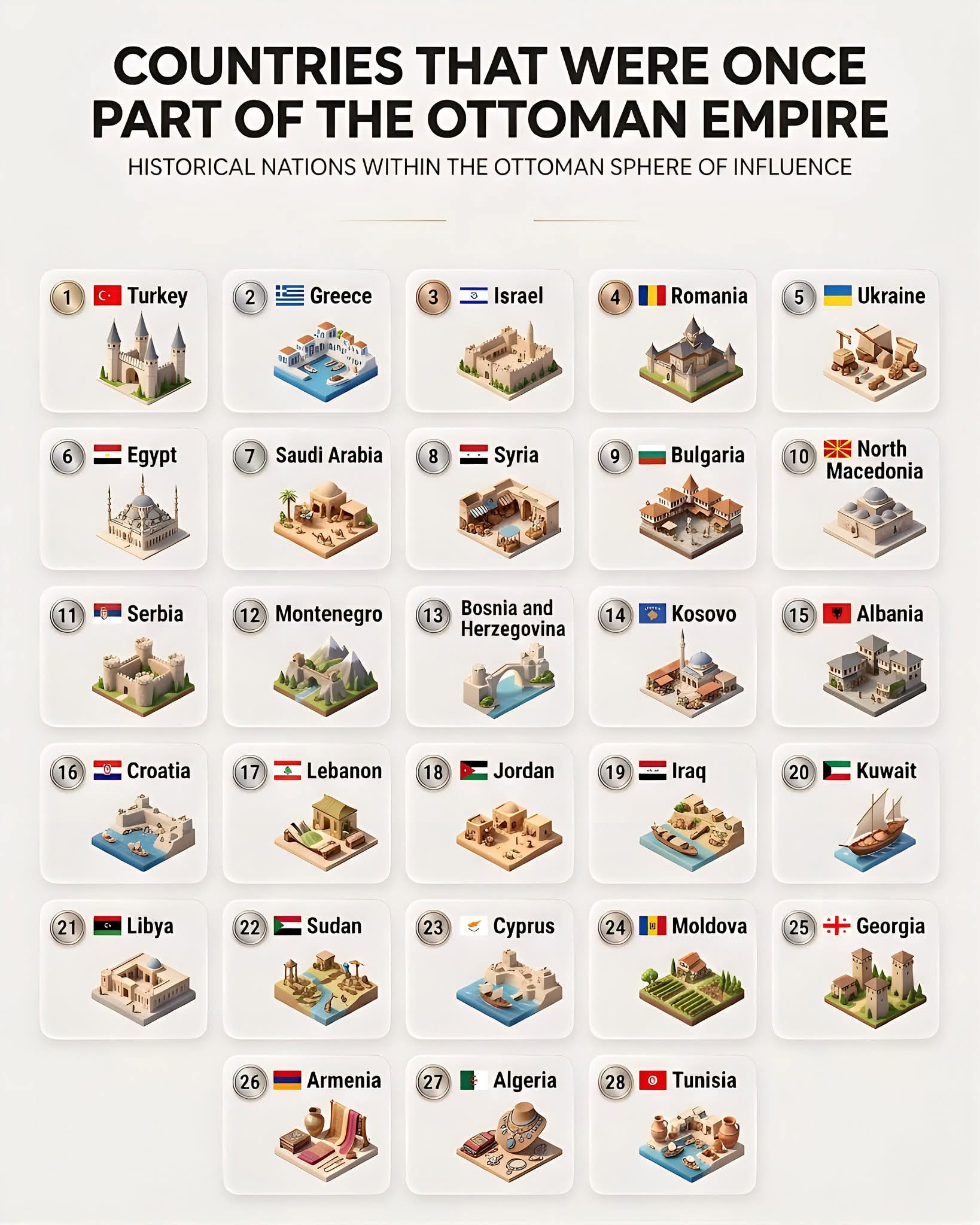
  • Countries That Were Once Part of the Ottoman Empire..
    🐺🦅🤘 Countries That Were Once Part of the Ottoman Empire..🇹🇷
    0 Kommentare 0 Anteile
Suchergebnis