• The Ottoman Empire at Its Peak – 1683

    In 1683, the Ottoman Empire stood as one of the world’s most powerful states, stretching across three continents.

    Territory – From Hungary in the heart of Europe to the Arabian deserts, from North Africa to the Caucasus, the empire spanned 6-7 million square kilometers.

    Capital – Istanbul, once Constantinople, was a global hub of trade, culture, and politics.

    Diversity – The empire united Turks, Arabs, Kurds, Greeks, Armenians, Slavs, Jews, and many more under a vast administrative system.

    Military Power – The Janissaries and navy projected influence across the Mediterranean, Red Sea, and beyond.

    1683 Vienna Campaign – Marked the high tide of Ottoman expansion into Europe, though the failed siege of Vienna also signaled the turning point of imperial fortunes.

    The Ottoman Empire in 1683 was not just a political force — it was a cultural mosaic and a major player in global history.

    A true ISLAMIC UNITY is not only the only solution to provide Peace, Tranquility, and Security today — just as the Ottoman State ensured for 600 years — but also the only path for the economic development of poor Islamic countries.
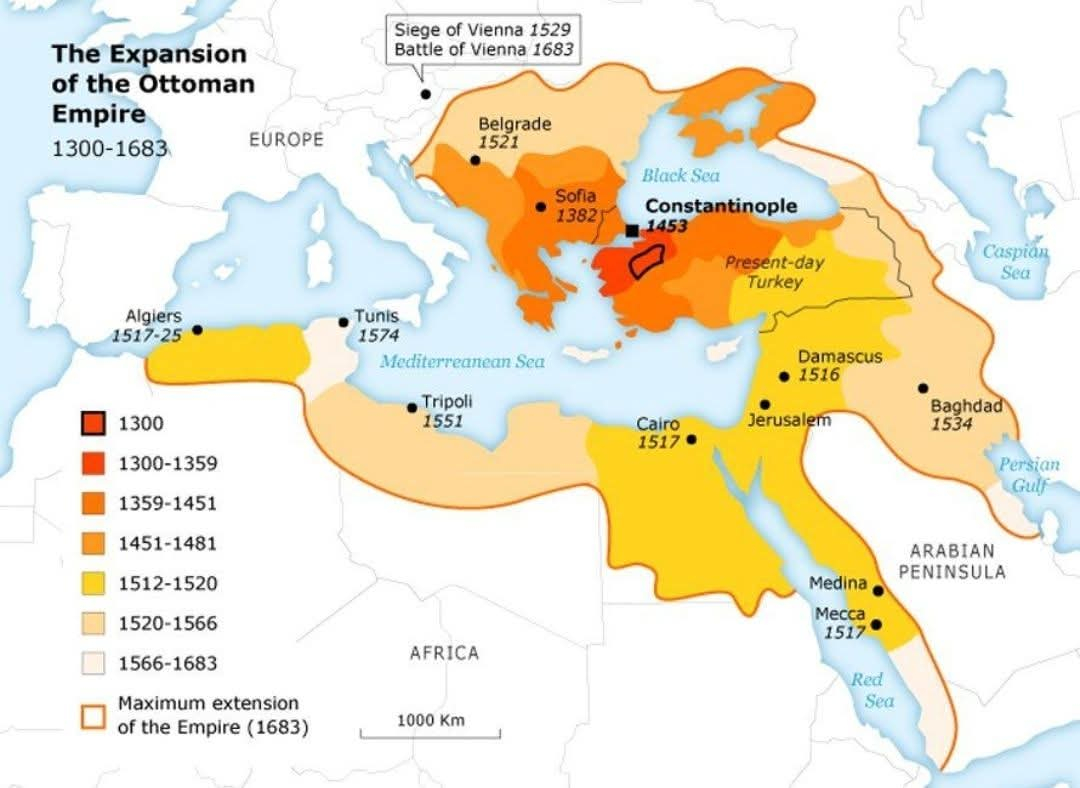
    The Ottoman Empire at Its Peak – 1683 In 1683, the Ottoman Empire stood as one of the world’s most powerful states, stretching across three continents. 🔹 Territory – From Hungary in the heart of Europe to the Arabian deserts, from North Africa to the Caucasus, the empire spanned 6-7 million square kilometers. 🔹 Capital – Istanbul, once Constantinople, was a global hub of trade, culture, and politics. 🔹 Diversity – The empire united Turks, Arabs, Kurds, Greeks, Armenians, Slavs, Jews, and many more under a vast administrative system. 🔹 Military Power – The Janissaries and navy projected influence across the Mediterranean, Red Sea, and beyond. 🔹 1683 Vienna Campaign – Marked the high tide of Ottoman expansion into Europe, though the failed siege of Vienna also signaled the turning point of imperial fortunes. The Ottoman Empire in 1683 was not just a political force — it was a cultural mosaic and a major player in global history. A true ISLAMIC UNITY is not only the only solution to provide Peace, Tranquility, and Security today — just as the Ottoman State ensured for 600 years — but also the only path for the economic development of poor Islamic countries.
    0 Комментарии 0 Поделились
  • #Turkey is located at the crossroads of Asia and Europe. It is bordered by Greece and Bulgaria to the northwest, the Black Sea to the north, Georgia to the northeast, Armenia, the Azerbaijani exclave of Nakhchivan, and Iran to the east, Iraq to the southeast, Syria and the Mediterranean Sea to the south, and the Aegean Sea to the west.
    Area: 783,562 square kilometers.
    Topography: Includes the Taurus Mountains in the south, the Pontic Mountains in the north, fertile plains like the Anatolian Plain, and the Central Anatolian Plateau, along with lakes such as Lake Van.
    Water Bodies: Borders four major seas: the Black Sea, the Sea of Marmara, the Aegean Sea, and the Mediterranean Sea.
    2. Climate:
    Coastal Areas:
    Mediterranean and Aegean Coasts: Mediterranean climate with hot, dry summers and mild, wet winters.
    Black Sea Coast: Moderate and humid climate year-round.
    Inland Regions: Continental climate with hot, dry summers and very cold, snowy winters.
    Climate Change: Turkey faces challenges like drought and rising temperatures due to climate change.
    3. Population:
    Population Size: Approximately 84.5 million (2021).
    Population Distribution: Istanbul is the largest city with over 15.5 million residents. Ankara is the second largest, followed by Izmir, Bursa, and Antalya.
    Ethnic Diversity: Predominantly Turks, with a significant Kurdish minority, and smaller Armenian, Arab, and Greek communities.
    Population Growth: About 1.2% annually.
    4. Economy:
    GDP: Approximately $7.209 trillion in 2021.
    Exports: Includes agricultural products, automobiles, textiles, and electronics, valued at $225 billion.
    Imports: Mainly energy and raw materials, totaling $271 billion.
    Unemployment Rate: Around 10.3%.
    Agriculture and Industry: Notable for wheat, hazelnuts, and olives, as well as being a leading producer of automobiles and steel.
    5. Currency:
    The official currency is the Turkish Lira (TRY), which experiences fluctuations in value against foreign currencies.
    6. Tourism:
    Visitor Numbers: Turkey welcomed around 30 million tourists in 2021.
    Revenue: Approximately $24.5 billion.
    Top Destinations:
    Istanbul: Iconic landmarks like Hagia Sophia, the Blue Mosque, and Topkapi Palace.
    Antalya: A hub for coastal tourism.
    Cappadocia: Known for its unique landscapes and hot air balloons.
    Historical Sites: Ephesus and Troy.
    7. History:
    Civilizations: Turkey has been home to various civilizations, including the Hittites, Persians, Romans, and Byzantines.
    Ottoman Era: Spanned from the 14th century to the early 20th century.
    Modern Republic: Established in 1923 under Mustafa Kemal Atatürk, who moved the capital to Ankara and initiated widespread reforms.
    8. Education:
    Education System: Mandatory for 12 years (6 years primary, 3 years middle, 3 years secondary).
    Higher Education: Home to numerous universities, including Istanbul University and Middle East Technical University.
    Literacy Rate: Approximately 96%.
    9. Healthcare:
    Healthcare System: Turkey has a well-developed healthcare system encompassing public and private sectors.
    Medical Tourism: A popular destination for medical and cosmetic treatments, attracting thousands of patients annually.
    Hospitals: Equipped with state-of-the-art medical technology.
    10. Culture:
    Official Language: Turkish.
    Religion: Islam is the predominant religion, with Christian and Jewish minorities.
    Traditions: A blend of Eastern and Western cultural influences.
    Turkey serves as a bridge between East and West, with a rich history and modern development.
    #Turkey is located at the crossroads of Asia and Europe. It is bordered by Greece and Bulgaria to the northwest, the Black Sea to the north, Georgia to the northeast, Armenia, the Azerbaijani exclave of Nakhchivan, and Iran to the east, Iraq to the southeast, Syria and the Mediterranean Sea to the south, and the Aegean Sea to the west. Area: 783,562 square kilometers. Topography: Includes the Taurus Mountains in the south, the Pontic Mountains in the north, fertile plains like the Anatolian Plain, and the Central Anatolian Plateau, along with lakes such as Lake Van. Water Bodies: Borders four major seas: the Black Sea, the Sea of Marmara, the Aegean Sea, and the Mediterranean Sea. 🌐 2. Climate: Coastal Areas: Mediterranean and Aegean Coasts: Mediterranean climate with hot, dry summers and mild, wet winters. Black Sea Coast: Moderate and humid climate year-round. Inland Regions: Continental climate with hot, dry summers and very cold, snowy winters. Climate Change: Turkey faces challenges like drought and rising temperatures due to climate change. 🌐 3. Population: Population Size: Approximately 84.5 million (2021). Population Distribution: Istanbul is the largest city with over 15.5 million residents. Ankara is the second largest, followed by Izmir, Bursa, and Antalya. Ethnic Diversity: Predominantly Turks, with a significant Kurdish minority, and smaller Armenian, Arab, and Greek communities. Population Growth: About 1.2% annually. 🌐 4. Economy: GDP: Approximately $7.209 trillion in 2021. Exports: Includes agricultural products, automobiles, textiles, and electronics, valued at $225 billion. Imports: Mainly energy and raw materials, totaling $271 billion. Unemployment Rate: Around 10.3%. Agriculture and Industry: Notable for wheat, hazelnuts, and olives, as well as being a leading producer of automobiles and steel. 🌐 5. Currency: The official currency is the Turkish Lira (TRY), which experiences fluctuations in value against foreign currencies. 🌐 6. Tourism: Visitor Numbers: Turkey welcomed around 30 million tourists in 2021. Revenue: Approximately $24.5 billion. Top Destinations: Istanbul: Iconic landmarks like Hagia Sophia, the Blue Mosque, and Topkapi Palace. Antalya: A hub for coastal tourism. Cappadocia: Known for its unique landscapes and hot air balloons. Historical Sites: Ephesus and Troy. 🌐 7. History: Civilizations: Turkey has been home to various civilizations, including the Hittites, Persians, Romans, and Byzantines. Ottoman Era: Spanned from the 14th century to the early 20th century. Modern Republic: Established in 1923 under Mustafa Kemal Atatürk, who moved the capital to Ankara and initiated widespread reforms. 🌐 8. Education: Education System: Mandatory for 12 years (6 years primary, 3 years middle, 3 years secondary). Higher Education: Home to numerous universities, including Istanbul University and Middle East Technical University. Literacy Rate: Approximately 96%. 🌐 9. Healthcare: Healthcare System: Turkey has a well-developed healthcare system encompassing public and private sectors. Medical Tourism: A popular destination for medical and cosmetic treatments, attracting thousands of patients annually. Hospitals: Equipped with state-of-the-art medical technology. 🌐 10. Culture: Official Language: Turkish. Religion: Islam is the predominant religion, with Christian and Jewish minorities. Traditions: A blend of Eastern and Western cultural influences. Turkey serves as a bridge between East and West, with a rich history and modern development.
    0 Комментарии 0 Поделились
  • The Linguistic Structure of Iran
    Iran is a highly diverse country with many languages spoken across its regions. The most prominent language is Persian (Farsi), which serves as the official language. However, there are several other major languages, often categorized into distinct linguistic groups:
    1. Indo-Iranian Group
    • Persian (Farsi) – Official and widely spoken across Iran.
    • Kurdish – Mainly spoken in western regions.
    • Baluchi – Spoken in southeastern Iran.
    2. Turkic Group
    • Azerbaijani (Azeri) – Predominantly spoken in the northwest.
    • Turkmen – Spoken in the northeastern provinces.
    • Qashqai (Kashkai) is a Turkic language spoken by the Qashqai people, a semi-nomadic pastoralist group primarily living in the southwestern region of Iran, particularly in Fars province. It belongs to the Oghuz branch of the Turkic language family, which includes Azerbaijani, Turkish, and Turkmen. Qashqai is closely related to Azerbaijani, and many speakers are bilingual, also fluent in Persian (Farsi). The Qashqai people have a rich cultural heritage and maintain their own distinct traditions, including their language, despite the dominance of Persian in the region.
    •
    3. Semitic Group
    • Arabic – Spoken in the southwestern regions, particularly Khuzestan.
    4. Caucasian and Other Minority Languages
    • Gilaki and Mazandarani – Spoken along the Caspian Sea coast.
    • Armenian – Spoken by the Armenian minority in various cities.
    Hashtags:
    #LinguisticDiversity #IranLanguages #PersianLanguage #CulturalDiversity #Iran #Linguistics
    The Linguistic Structure of Iran 🇮🇷 Iran is a highly diverse country with many languages spoken across its regions. The most prominent language is Persian (Farsi), which serves as the official language. However, there are several other major languages, often categorized into distinct linguistic groups: 1. Indo-Iranian Group • Persian (Farsi) – Official and widely spoken across Iran. • Kurdish – Mainly spoken in western regions. • Baluchi – Spoken in southeastern Iran. 2. Turkic Group • Azerbaijani (Azeri) – Predominantly spoken in the northwest. • Turkmen – Spoken in the northeastern provinces. • Qashqai (Kashkai) is a Turkic language spoken by the Qashqai people, a semi-nomadic pastoralist group primarily living in the southwestern region of Iran, particularly in Fars province. It belongs to the Oghuz branch of the Turkic language family, which includes Azerbaijani, Turkish, and Turkmen. Qashqai is closely related to Azerbaijani, and many speakers are bilingual, also fluent in Persian (Farsi). The Qashqai people have a rich cultural heritage and maintain their own distinct traditions, including their language, despite the dominance of Persian in the region. • 3. Semitic Group • Arabic – Spoken in the southwestern regions, particularly Khuzestan. 4. Caucasian and Other Minority Languages • Gilaki and Mazandarani – Spoken along the Caspian Sea coast. • Armenian – Spoken by the Armenian minority in various cities. Hashtags: #LinguisticDiversity #IranLanguages #PersianLanguage #CulturalDiversity #Iran #Linguistics
    0 Комментарии 0 Поделились
  • The Dolmabahçe Mosque is a baroque waterside mosque in Kabataş in the Beyoğlu district of Istanbul, Turkey, close to the Dolmabahçe Palace. It was commissioned by Queen Mother Bezmialem Valide Sultan and designed by the Turkish Armenian architect, Garabet Balyan in 1855. After his mother's death, Sultan Abdülmecid saw the building work through to completion.
    The Dolmabahçe Mosque is a baroque waterside mosque in Kabataş in the Beyoğlu district of Istanbul, Turkey, close to the Dolmabahçe Palace. It was commissioned by Queen Mother Bezmialem Valide Sultan and designed by the Turkish Armenian architect, Garabet Balyan in 1855. After his mother's death, Sultan Abdülmecid saw the building work through to completion.
    0 Комментарии 0 Поделились
  • Photo by Ara Guler (born August 16, 1928 in Beyoglu, Istanbul, Turkey) a Turkish Armenian photojournalist, nicknamed “the Eye of Istanbul” or “the Photographer of Istanbul”
    Photo by Ara Guler (born August 16, 1928 in Beyoglu, Istanbul, Turkey) a Turkish Armenian photojournalist, nicknamed “the Eye of Istanbul” or “the Photographer of Istanbul”
    0 Комментарии 0 Поделились
  • Ortaköy Camii - Ortaköy Mosque

    officially the Büyük Mecidiye Camii (Grand Imperial Mosque of Sultan Abdülmecid) in Beşiktaş, Istanbul, Turkey, is situated at the waterside of the Ortaköy pier square, one of the most popular locations on the Bosphorus. This structure is symbolic of the district of Ortaköy as it has a distinctive view of the Bosphorus Strait of Istanbul and the Bosphorus Bridge. The mosque can be viewed from the Bosphorus Cruise that is famous among tourists, to go from the Asian side of Istanbul to the European side on a ferry boat.

    History
    Located on the site of the present-day Ortaköy Mosque, there previously was a small masjid. Built in 1720, it was ruined during the Patrona Halil Uprising in 1731. The current mosque, which was erected in its place, was ordered by the Ottoman sultan Abdülmecid and built between 1854 and 1856, on the ruins of the Cantemir Palace. Its architects were Armenian father and son Garabet Amira Balyan and Nigoğayos Balyan (who also designed the nearby Dolmabahçe Palace and the Dolmabahçe Mosque), who designed it in the Neo-Baroque style.

    The single dome of the mosque was originally built using bricks. However, the dome developed cracks throughout time and was ready to collapse, so a new dome was reconstructed using concrete. In 1894, there was an earthquake that damaged the mosque, and it also suffered a minor fire in 1984. Thus, the structure has undergone a number of repair and restoration work in its time. Today, it is in fair shape.

    Features
    It consists of a two-story "sultan apartment" which has a "U shaped" plan, a main venue with a square plan which is covered with one dome. The "sliced facades" with mounting columns are "enriched" by carvings as well as relief, giving the mosque a "dynamic appearance". There are two rows of windows providing the main venue a "good illumination"

    The mosque is "pint-sized" in comparison to other mosques "on the other side of the golden horn". The mosque was built in Neo-baroque style. In terms of the interior space, this mosque is modest in scale, though the inside is quite spacious with its wide, "high bay windows" which refract its reflection in water as well as daylight. Floral patterned frescoes adorn the inside of the singular dome, along with "niche-like" windows bordered by imitation curtains. Materials like marble were used to build the mihrab and minbar, pink mosaics were also used to decorate the Mihrab. The reconstructed dome was built from concrete, while stone was used to build the two, slim minarets.

    There are also several panels of calligraphy executed by Abdülmecid I himself, as he was a calligrapher along with being a sultan.
    Ortaköy Camii - Ortaköy Mosque officially the Büyük Mecidiye Camii (Grand Imperial Mosque of Sultan Abdülmecid) in Beşiktaş, Istanbul, Turkey, is situated at the waterside of the Ortaköy pier square, one of the most popular locations on the Bosphorus. This structure is symbolic of the district of Ortaköy as it has a distinctive view of the Bosphorus Strait of Istanbul and the Bosphorus Bridge. The mosque can be viewed from the Bosphorus Cruise that is famous among tourists, to go from the Asian side of Istanbul to the European side on a ferry boat. History Located on the site of the present-day Ortaköy Mosque, there previously was a small masjid. Built in 1720, it was ruined during the Patrona Halil Uprising in 1731. The current mosque, which was erected in its place, was ordered by the Ottoman sultan Abdülmecid and built between 1854 and 1856, on the ruins of the Cantemir Palace. Its architects were Armenian father and son Garabet Amira Balyan and Nigoğayos Balyan (who also designed the nearby Dolmabahçe Palace and the Dolmabahçe Mosque), who designed it in the Neo-Baroque style. The single dome of the mosque was originally built using bricks. However, the dome developed cracks throughout time and was ready to collapse, so a new dome was reconstructed using concrete. In 1894, there was an earthquake that damaged the mosque, and it also suffered a minor fire in 1984. Thus, the structure has undergone a number of repair and restoration work in its time. Today, it is in fair shape. Features It consists of a two-story "sultan apartment" which has a "U shaped" plan, a main venue with a square plan which is covered with one dome. The "sliced facades" with mounting columns are "enriched" by carvings as well as relief, giving the mosque a "dynamic appearance". There are two rows of windows providing the main venue a "good illumination" The mosque is "pint-sized" in comparison to other mosques "on the other side of the golden horn". The mosque was built in Neo-baroque style. In terms of the interior space, this mosque is modest in scale, though the inside is quite spacious with its wide, "high bay windows" which refract its reflection in water as well as daylight. Floral patterned frescoes adorn the inside of the singular dome, along with "niche-like" windows bordered by imitation curtains. Materials like marble were used to build the mihrab and minbar, pink mosaics were also used to decorate the Mihrab. The reconstructed dome was built from concrete, while stone was used to build the two, slim minarets. There are also several panels of calligraphy executed by Abdülmecid I himself, as he was a calligrapher along with being a sultan.
    0 Комментарии 0 Поделились
  • Rumkale (Roman Castle), Urfa which was home to many civilizations throughout history and an important center for early Christianity as it is known to be a place where the copies of the Bible were reproduced is open to tourism.

    Rumkale, which straddles the boundary between the southeastern provinces of Gaziantep’s Nizip and Yavuzeli districts and Şanlıurfa’s Birecik and Halfeti districts, is located on a hill surrounded with rocks in the region where Merzimen Stream flows into the Euphrates. It is home to structures from the Urartu, Babylon, Sumerian, Seljuk and Ottoman eras.

    The castle and its vicinity also draw tourists thanks to its natural beauties along the banks of the Euphrates River, particularly in spring months.

    Johannes, one of the apostles of Jesus Christ, is said to have settled in Rumkale during the Roman era and reproduced copies of the Bible in a rock-carved room.

    The area was occupied by various Byzantine and Armenian warlords during the Middle Ages. The castle served as the seat of an Armenian patriarch in the 12th century.

    From 1203 to 1293, it was the residence of the supreme head (Catholicos) of the reunified Armenian Church. In 1293, it was captured by the Mamluks of Egypt, following a protracted siege.

    Restoration works that have been carried out by the Culture and Tourism Ministry have come to an end in the eastern and western walls of the castle as well as in the Barşavma Monastery, which was built in the 13th century in the north of the castle.

    #best0fturkiye #bestoftheday #best #fyp #turkiye #türkiye #travel #traveling #antep #natureview #travelphotography #discover #tourists #keşfet #exciting #rumkale #photography #photooftheday #touristspot #naturalbeauty #turkey #exploretheworld #tbt #tour #tourism #touring #tourist #adventure #church #naturephotography
    Rumkale (Roman Castle), Urfa 🇹🇷 which was home to many civilizations throughout history and an important center for early Christianity as it is known to be a place where the copies of the Bible were reproduced is open to tourism. Rumkale, which straddles the boundary between the southeastern provinces of Gaziantep’s Nizip and Yavuzeli districts and Şanlıurfa’s Birecik and Halfeti districts, is located on a hill surrounded with rocks in the region where Merzimen Stream flows into the Euphrates. It is home to structures from the Urartu, Babylon, Sumerian, Seljuk and Ottoman eras. The castle and its vicinity also draw tourists thanks to its natural beauties along the banks of the Euphrates River, particularly in spring months. Johannes, one of the apostles of Jesus Christ, is said to have settled in Rumkale during the Roman era and reproduced copies of the Bible in a rock-carved room. The area was occupied by various Byzantine and Armenian warlords during the Middle Ages. The castle served as the seat of an Armenian patriarch in the 12th century. From 1203 to 1293, it was the residence of the supreme head (Catholicos) of the reunified Armenian Church. In 1293, it was captured by the Mamluks of Egypt, following a protracted siege. Restoration works that have been carried out by the Culture and Tourism Ministry have come to an end in the eastern and western walls of the castle as well as in the Barşavma Monastery, which was built in the 13th century in the north of the castle. #best0fturkiye 🇹🇷 #bestoftheday #best #fyp #turkiye #türkiye #travel #traveling #antep #natureview #travelphotography #discover #tourists #keşfet #exciting #rumkale #photography #photooftheday #touristspot #naturalbeauty #turkey #exploretheworld #tbt #tour #tourism #touring #tourist #adventure #church #naturephotography
    0 Комментарии 0 Поделились
  • The Only Banknote in the World Printed in 5 Languages; ''Ottoman Turkish, Arabic, Armenian, Greek, French'', 1880
    The Only Banknote in the World Printed in 5 Languages; ''Ottoman Turkish, Arabic, Armenian, Greek, French'', 1880
    0 Комментарии 0 Поделились
  • A multilingual Ottoman calendar page from 1911:

    The upper left shows the Rumi date in Ottoman Turkish: year 1327, Nisan 7

    The same Julian date (7 April) and day (Thursday) appears below in Greek with the AD year 1911

    Next to that is the Gregorian date (20 April) and day in French

    Above these two is the number 30 (twice, purpose unclear), the month April and day (Thursday) in Bulgarian

    Under the Greek text is the Armenian one.

    The upper right shows the Islamic date 21 Rebiülahir 1329

    The Hebrew date 22 Nisan 5671 appears at the bottom.
    A multilingual Ottoman 🇹🇷 calendar page from 1911: The upper left shows the Rumi date in Ottoman Turkish: year 1327, Nisan 7 The same Julian date (7 April) and day (Thursday) appears below in Greek with the AD year 1911 Next to that is the Gregorian date (20 April) and day in French Above these two is the number 30 (twice, purpose unclear), the month April and day (Thursday) in Bulgarian Under the Greek text is the Armenian one. The upper right shows the Islamic date 21 Rebiülahir 1329 The Hebrew date 22 Nisan 5671 appears at the bottom.
    0 Комментарии 0 Поделились
  • On March 31, Azerbaijan honors memory of victims of mass massacre committed by Armenians and Bolsheviks in March 1918 http://v.aa.com.tr/2860216
    On March 31, Azerbaijan honors memory of victims of mass massacre committed by Armenians and Bolsheviks in March 1918 http://v.aa.com.tr/2860216
    0 Комментарии 0 Поделились
Расширенные страницы