• The United States has a growing Muslim community and thousands of mosques spread across the country. According to research by the Institute for Social Policy and Understanding, there are approximately 2,700 to 3,000 mosques in America today. These mosques serve as places for daily prayers, Friday congregational prayers, Islamic education, and community activities. Over the past few decades, the number of mosques has increased significantly due to the rising Muslim population and immigration from different parts of the world.
    The Muslim population in the United States is estimated to be around 3.5 million people. Muslims in America come from diverse ethnic backgrounds including Arabs, South Asians, African Americans, Turks, and Africans. Because of this diversity, many mosques also function as cultural and community centers where people gather for religious learning, charity work, and social support.
    One of the largest and most well-known mosques in the country is the Islamic Center of America, located in Dearborn, Michigan. This mosque is famous for its beautiful architecture, large central dome, and tall minarets. It can accommodate more than 3,000 worshippers at a time and is considered one of the biggest Islamic centers in North America.
    Major cities such as New York City, Chicago, Houston, and Los Angeles have many mosques because they have large Muslim populations. These mosques play an important role in maintaining religious identity, promoting community unity, and supporting charitable and educational activities throughout the United States.
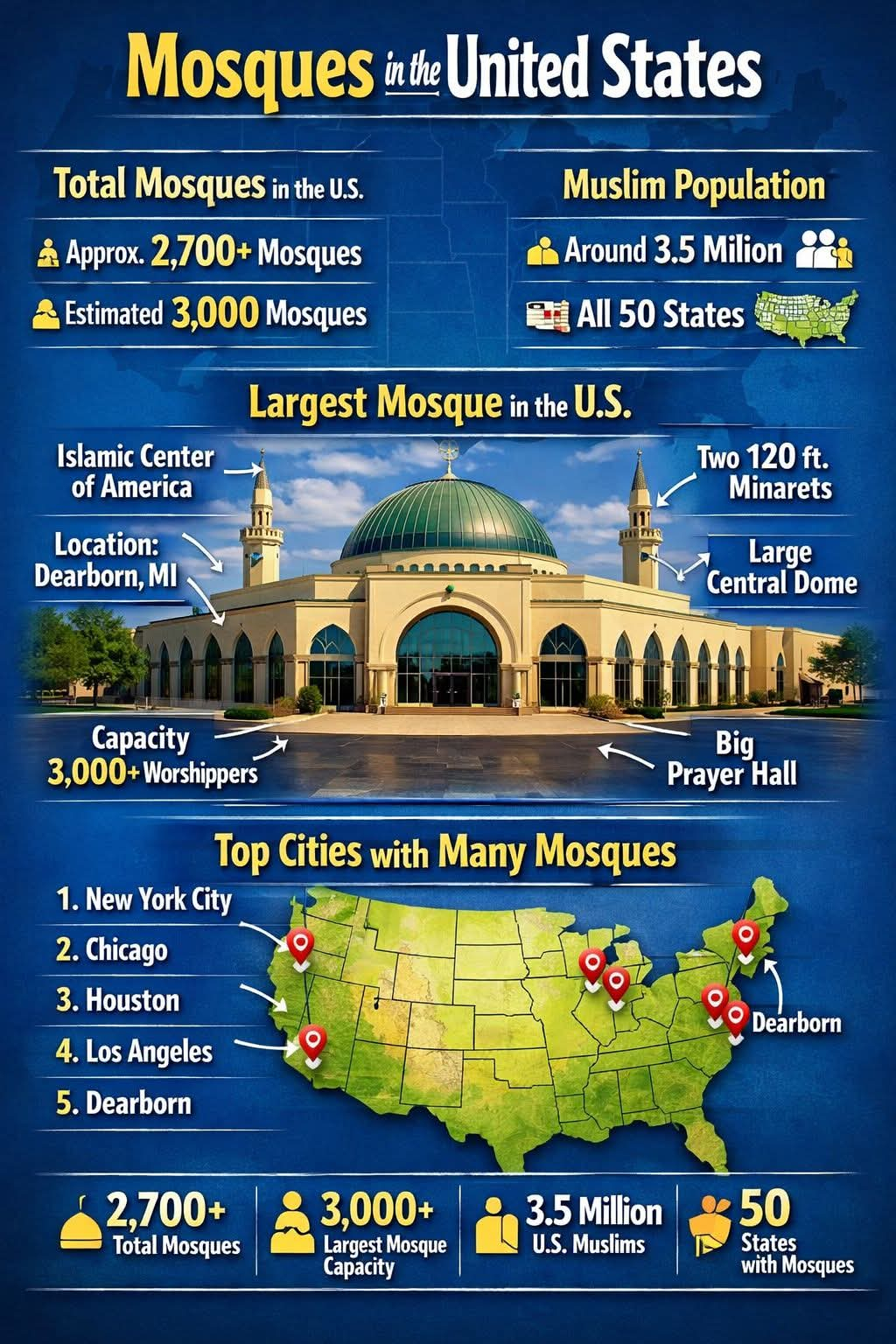
    The United States has a growing Muslim community and thousands of mosques spread across the country. According to research by the Institute for Social Policy and Understanding, there are approximately 2,700 to 3,000 mosques in America today. These mosques serve as places for daily prayers, Friday congregational prayers, Islamic education, and community activities. Over the past few decades, the number of mosques has increased significantly due to the rising Muslim population and immigration from different parts of the world. The Muslim population in the United States is estimated to be around 3.5 million people. Muslims in America come from diverse ethnic backgrounds including Arabs, South Asians, African Americans, Turks, and Africans. Because of this diversity, many mosques also function as cultural and community centers where people gather for religious learning, charity work, and social support. One of the largest and most well-known mosques in the country is the Islamic Center of America, located in Dearborn, Michigan. This mosque is famous for its beautiful architecture, large central dome, and tall minarets. It can accommodate more than 3,000 worshippers at a time and is considered one of the biggest Islamic centers in North America. Major cities such as New York City, Chicago, Houston, and Los Angeles have many mosques because they have large Muslim populations. These mosques play an important role in maintaining religious identity, promoting community unity, and supporting charitable and educational activities throughout the United States.
    0 Reacties 0 aandelen
  • Africa stands at the heart of the world’s camel population, holding a clear lead in global numbers and reaffirming its deep agricultural and pastoral heritage. Of the more than 40 million camels worldwide, over 80% are found across the African continent, according to the Food and Agriculture Organization (FAO).

    These resilient animals remain vital to food security, transport, and tourism, serving as livelihoods for millions of people. Here are the top 10 camel-rich countries in the world.
    Africa stands at the heart of the world’s camel population, holding a clear lead in global numbers and reaffirming its deep agricultural and pastoral heritage. Of the more than 40 million camels worldwide, over 80% are found across the African continent, according to the Food and Agriculture Organization (FAO). These resilient animals remain vital to food security, transport, and tourism, serving as livelihoods for millions of people. Here are the top 10 camel-rich countries in the world.
    0 Reacties 0 aandelen
  • Thousands of people gathered on Istanbul’s Galata Bridge to demonstrate solidarity with the Palestinian people.

    The protest came as Gaza faces a deepening humanitarian crisis, with most of its healthcare system destroyed and families exposed to cold weather and flooding.

    Despite an October ceasefire, conditions remain dire and aid deliveries have fallen far short of agreed levels due to Israeli restrictions.
    Thousands of people gathered on Istanbul’s Galata Bridge to demonstrate solidarity with the Palestinian people. The protest came as Gaza faces a deepening humanitarian crisis, with most of its healthcare system destroyed and families exposed to cold weather and flooding. Despite an October ceasefire, conditions remain dire and aid deliveries have fallen far short of agreed levels due to Israeli restrictions.
    0 Reacties 0 aandelen
  • Balıklıgöl is a culturally and spiritually significant site that reflects the rich heritage of Şanlıurfa.
    With its peaceful setting and centuries-old symbolism, it remains a place of reflection and respect.

    Learn more at:
    sanliurfa.goturkiye.com

    IG: arifbiradam

    #GoTürkiye #GoŞanlıurfa #Balıklıgöl #Şanlıurfa #GoSustainable
    Balıklıgöl is a culturally and spiritually significant site that reflects the rich heritage of Şanlıurfa. With its peaceful setting and centuries-old symbolism, it remains a place of reflection and respect. Learn more at: sanliurfa.goturkiye.com 📸 IG: arifbiradam #GoTürkiye #GoŞanlıurfa #Balıklıgöl #Şanlıurfa #GoSustainable
    0 Reacties 0 aandelen
  • Abbasi Halifeliği: Rönesans'ı Ateşleyen Bir Devrim

    M.Ö. 750 yılında Abbasiler İslam'ın Altın Çağı'na öncülük ederek Umayadları devirdiler. İkonik Bağdat'taki "Yuvarlak Şehir"inden İslam dünyasını bilgi, kültür ve yenilikçi bir fenerine dönüştürdüler.

    *Bağdat'ta Yeni Bir Çağ*
    M.Ö. 762 yılında Halife Mansur tarafından kurulan Bağdat, Arapları, Farsları, Türkleri ve daha fazlasını canlı bir İslami kimlik altında birleştirerek küresel bir ticaret, diplomasi ve aklın merkezi haline geldi.

    *Öğrenmenin Altın Çağı*
    Harun el-Reşid ve el-Ma'mun gibi halifeler kültürel bir patlamayı körükledi:
    *Bilgelik Evi* Yunanca, Farsça ve Hint metinlerini tercüme etti.
    Harezmi cebiri icat etti, El-Razi tıbbı devrim yaptı ve İbn Sina'nın *Tıp Kanonu* küresel sağlık hizmetini şekillendirdi.
    El-Hasan ibn el-Heysem optiğe öncülük etti, bilimsel yöntemin temelini attı.

    *Sanat ve Felsefe gelişti*
    El-Mutanabbi gibi şairler, Sufi mistikleri ve El-Farabi gibi filozoflar Yunan rasyonalizmini İslam düşüncesiyle harmanlamışlardır. Abbasi mahkemesi ipek, müzik ve kütüphanelerle göz kamaştırdı.

    *Dini Çeşitlilik*
    Abbasiler Sünni İslam'ı teşvik ederken Şii, Haricit ve İsmail düşüncelerinin yükselişini gördüler ve ilahiyat okullarının zengin bir duvar halısını beslediler.

    *Reddet ve Miras*
    10. yüzyıla kadar, parçalanma başladı. 1258 yılında Bağdat'ın Moğol çuvallaması ve vilayet hanedanları Altın Çağ'ı sonlandırdı. Ancak Abbasilerin mirası 1517 yılına kadar Kahire'nin sembolik halifeliğinde yaşadı.

    *Bir Medeni Güç*
    Abbasiler antik bilgeliği, kaynaşmış kültürleri ve Avrupa Rönesansına ilham vermişlerdir. Hikayeleri kalemin kılıçtan daha güçlü olduğunu kanıtlıyor.

    #AbbasidCaliphate #IslamicGoldenAge #HouseOfWisdom #Baghdad #IslamicHistory #HistoryMatters #ScienceAndCulture #MedievalHistory #ZaneHistoryBuff #theinsidehistory
    🏛️ Abbasi Halifeliği: Rönesans'ı Ateşleyen Bir Devrim 🌟 M.Ö. 750 yılında Abbasiler İslam'ın Altın Çağı'na öncülük ederek Umayadları devirdiler. İkonik Bağdat'taki "Yuvarlak Şehir"inden İslam dünyasını bilgi, kültür ve yenilikçi bir fenerine dönüştürdüler. 🕌✨ 🌍 *Bağdat'ta Yeni Bir Çağ* M.Ö. 762 yılında Halife Mansur tarafından kurulan Bağdat, Arapları, Farsları, Türkleri ve daha fazlasını canlı bir İslami kimlik altında birleştirerek küresel bir ticaret, diplomasi ve aklın merkezi haline geldi. 💡 *Öğrenmenin Altın Çağı* Harun el-Reşid ve el-Ma'mun gibi halifeler kültürel bir patlamayı körükledi: 🧠 *Bilgelik Evi* Yunanca, Farsça ve Hint metinlerini tercüme etti. 📚 Harezmi cebiri icat etti, El-Razi tıbbı devrim yaptı ve İbn Sina'nın *Tıp Kanonu* küresel sağlık hizmetini şekillendirdi. 🔬 El-Hasan ibn el-Heysem optiğe öncülük etti, bilimsel yöntemin temelini attı. 🎭 *Sanat ve Felsefe gelişti* El-Mutanabbi gibi şairler, Sufi mistikleri ve El-Farabi gibi filozoflar Yunan rasyonalizmini İslam düşüncesiyle harmanlamışlardır. Abbasi mahkemesi ipek, müzik ve kütüphanelerle göz kamaştırdı. 🎵🎶 🕌 *Dini Çeşitlilik* Abbasiler Sünni İslam'ı teşvik ederken Şii, Haricit ve İsmail düşüncelerinin yükselişini gördüler ve ilahiyat okullarının zengin bir duvar halısını beslediler. 🗣️ *Reddet ve Miras* 10. yüzyıla kadar, parçalanma başladı. 1258 yılında Bağdat'ın Moğol çuvallaması ve vilayet hanedanları Altın Çağ'ı sonlandırdı. Ancak Abbasilerin mirası 1517 yılına kadar Kahire'nin sembolik halifeliğinde yaşadı. 🌙 *Bir Medeni Güç* Abbasiler antik bilgeliği, kaynaşmış kültürleri ve Avrupa Rönesansına ilham vermişlerdir. Hikayeleri kalemin kılıçtan daha güçlü olduğunu kanıtlıyor. ✍️ 💡 #AbbasidCaliphate #IslamicGoldenAge #HouseOfWisdom #Baghdad #IslamicHistory #HistoryMatters #ScienceAndCulture #MedievalHistory #ZaneHistoryBuff #theinsidehistory
    0 Reacties 0 aandelen
  • Doğum adı Ercüment Banuydu. 14 yaşında sözlenmiş, 19 yaşında sonradan Sultan olacak veliaht Şehzade ile evlenmiş ve Mümtaz Mahal adını almıştı. Birbirlerine karşı efsanevi bir aşk besliyorlardı. Bir isyanı bastırmak için ordularıyla yola koyulan kocasına, dokuz aylık hamile olmasına rağmen, her zamanki gibi eşlik ediyordu. 17 Haziran 1631 tarihinde doğum yaparken 38 yaşında vefat etti.

    Sultan beslediği aşkı uğruna, insaaşı 23 yıl sürecek olan büyük bir anıt mezar yaptırdı. Yapının 2 mimarından biri Mimar Sinan'ın öğrencilerinden Muhammed İsa Çelebi, Kubbenin yapımından sorumlu kişi yine Mimar Sinan'ın talebelerinden İsmail Çelebi idi. İslam dünyasının en görkemli eserlerinden biri olmakla birlikte dünyanın 7 harikasından biri olarak kabul edilir.

    Bu efsane aşkın sahipleri Türk Babür İmparatoru Şah Cihan ve eşi Mümtaz Mahal Hanım'dır, aşklarının simgesi ise TAC MAHAL.
    Doğum adı Ercüment Banuydu. 14 yaşında sözlenmiş, 19 yaşında sonradan Sultan olacak veliaht Şehzade ile evlenmiş ve Mümtaz Mahal adını almıştı. Birbirlerine karşı efsanevi bir aşk besliyorlardı. Bir isyanı bastırmak için ordularıyla yola koyulan kocasına, dokuz aylık hamile olmasına rağmen, her zamanki gibi eşlik ediyordu. 17 Haziran 1631 tarihinde doğum yaparken 38 yaşında vefat etti. Sultan beslediği aşkı uğruna, insaaşı 23 yıl sürecek olan büyük bir anıt mezar yaptırdı. Yapının 2 mimarından biri Mimar Sinan'ın öğrencilerinden Muhammed İsa Çelebi, Kubbenin yapımından sorumlu kişi yine Mimar Sinan'ın talebelerinden İsmail Çelebi idi. İslam dünyasının en görkemli eserlerinden biri olmakla birlikte dünyanın 7 harikasından biri olarak kabul edilir. Bu efsane aşkın sahipleri Türk Babür İmparatoru Şah Cihan ve eşi Mümtaz Mahal Hanım'dır, aşklarının simgesi ise TAC MAHAL.
    0 Reacties 0 aandelen

  • Türkish Traditional Clothes-Bindallı..!
    Henna night(Kına Gecesi) is a tradition that dates back to ancient times and still maintains its popularity since the first day, held to celebrate the last night our türkic girls will spend at their homes before getting married and to say goodbye to their families.
    The most important moments of this special night are those emotional moments when the henna is applied and our loved ones sing songs around us.During these special moments, our brides wear colorful, patterned bindalli.
    🐺🦅🤘 Türkish Traditional Clothes-Bindallı..! Henna night(Kına Gecesi) is a tradition that dates back to ancient times and still maintains its popularity since the first day, held to celebrate the last night our türkic girls will spend at their homes before getting married and to say goodbye to their families. The most important moments of this special night are those emotional moments when the henna is applied and our loved ones sing songs around us.During these special moments, our brides wear colorful, patterned bindalli.
    1
    0 Reacties 0 aandelen
  • #Turkey is located at the crossroads of Asia and Europe. It is bordered by Greece and Bulgaria to the northwest, the Black Sea to the north, Georgia to the northeast, Armenia, the Azerbaijani exclave of Nakhchivan, and Iran to the east, Iraq to the southeast, Syria and the Mediterranean Sea to the south, and the Aegean Sea to the west.
    Area: 783,562 square kilometers.
    Topography: Includes the Taurus Mountains in the south, the Pontic Mountains in the north, fertile plains like the Anatolian Plain, and the Central Anatolian Plateau, along with lakes such as Lake Van.
    Water Bodies: Borders four major seas: the Black Sea, the Sea of Marmara, the Aegean Sea, and the Mediterranean Sea.
    2. Climate:
    Coastal Areas:
    Mediterranean and Aegean Coasts: Mediterranean climate with hot, dry summers and mild, wet winters.
    Black Sea Coast: Moderate and humid climate year-round.
    Inland Regions: Continental climate with hot, dry summers and very cold, snowy winters.
    Climate Change: Turkey faces challenges like drought and rising temperatures due to climate change.
    3. Population:
    Population Size: Approximately 84.5 million (2021).
    Population Distribution: Istanbul is the largest city with over 15.5 million residents. Ankara is the second largest, followed by Izmir, Bursa, and Antalya.
    Ethnic Diversity: Predominantly Turks, with a significant Kurdish minority, and smaller Armenian, Arab, and Greek communities.
    Population Growth: About 1.2% annually.
    4. Economy:
    GDP: Approximately $7.209 trillion in 2021.
    Exports: Includes agricultural products, automobiles, textiles, and electronics, valued at $225 billion.
    Imports: Mainly energy and raw materials, totaling $271 billion.
    Unemployment Rate: Around 10.3%.
    Agriculture and Industry: Notable for wheat, hazelnuts, and olives, as well as being a leading producer of automobiles and steel.
    5. Currency:
    The official currency is the Turkish Lira (TRY), which experiences fluctuations in value against foreign currencies.
    6. Tourism:
    Visitor Numbers: Turkey welcomed around 30 million tourists in 2021.
    Revenue: Approximately $24.5 billion.
    Top Destinations:
    Istanbul: Iconic landmarks like Hagia Sophia, the Blue Mosque, and Topkapi Palace.
    Antalya: A hub for coastal tourism.
    Cappadocia: Known for its unique landscapes and hot air balloons.
    Historical Sites: Ephesus and Troy.
    7. History:
    Civilizations: Turkey has been home to various civilizations, including the Hittites, Persians, Romans, and Byzantines.
    Ottoman Era: Spanned from the 14th century to the early 20th century.
    Modern Republic: Established in 1923 under Mustafa Kemal Atatürk, who moved the capital to Ankara and initiated widespread reforms.
    8. Education:
    Education System: Mandatory for 12 years (6 years primary, 3 years middle, 3 years secondary).
    Higher Education: Home to numerous universities, including Istanbul University and Middle East Technical University.
    Literacy Rate: Approximately 96%.
    9. Healthcare:
    Healthcare System: Turkey has a well-developed healthcare system encompassing public and private sectors.
    Medical Tourism: A popular destination for medical and cosmetic treatments, attracting thousands of patients annually.
    Hospitals: Equipped with state-of-the-art medical technology.
    10. Culture:
    Official Language: Turkish.
    Religion: Islam is the predominant religion, with Christian and Jewish minorities.
    Traditions: A blend of Eastern and Western cultural influences.
    Turkey serves as a bridge between East and West, with a rich history and modern development.
    #Turkey is located at the crossroads of Asia and Europe. It is bordered by Greece and Bulgaria to the northwest, the Black Sea to the north, Georgia to the northeast, Armenia, the Azerbaijani exclave of Nakhchivan, and Iran to the east, Iraq to the southeast, Syria and the Mediterranean Sea to the south, and the Aegean Sea to the west. Area: 783,562 square kilometers. Topography: Includes the Taurus Mountains in the south, the Pontic Mountains in the north, fertile plains like the Anatolian Plain, and the Central Anatolian Plateau, along with lakes such as Lake Van. Water Bodies: Borders four major seas: the Black Sea, the Sea of Marmara, the Aegean Sea, and the Mediterranean Sea. 🌐 2. Climate: Coastal Areas: Mediterranean and Aegean Coasts: Mediterranean climate with hot, dry summers and mild, wet winters. Black Sea Coast: Moderate and humid climate year-round. Inland Regions: Continental climate with hot, dry summers and very cold, snowy winters. Climate Change: Turkey faces challenges like drought and rising temperatures due to climate change. 🌐 3. Population: Population Size: Approximately 84.5 million (2021). Population Distribution: Istanbul is the largest city with over 15.5 million residents. Ankara is the second largest, followed by Izmir, Bursa, and Antalya. Ethnic Diversity: Predominantly Turks, with a significant Kurdish minority, and smaller Armenian, Arab, and Greek communities. Population Growth: About 1.2% annually. 🌐 4. Economy: GDP: Approximately $7.209 trillion in 2021. Exports: Includes agricultural products, automobiles, textiles, and electronics, valued at $225 billion. Imports: Mainly energy and raw materials, totaling $271 billion. Unemployment Rate: Around 10.3%. Agriculture and Industry: Notable for wheat, hazelnuts, and olives, as well as being a leading producer of automobiles and steel. 🌐 5. Currency: The official currency is the Turkish Lira (TRY), which experiences fluctuations in value against foreign currencies. 🌐 6. Tourism: Visitor Numbers: Turkey welcomed around 30 million tourists in 2021. Revenue: Approximately $24.5 billion. Top Destinations: Istanbul: Iconic landmarks like Hagia Sophia, the Blue Mosque, and Topkapi Palace. Antalya: A hub for coastal tourism. Cappadocia: Known for its unique landscapes and hot air balloons. Historical Sites: Ephesus and Troy. 🌐 7. History: Civilizations: Turkey has been home to various civilizations, including the Hittites, Persians, Romans, and Byzantines. Ottoman Era: Spanned from the 14th century to the early 20th century. Modern Republic: Established in 1923 under Mustafa Kemal Atatürk, who moved the capital to Ankara and initiated widespread reforms. 🌐 8. Education: Education System: Mandatory for 12 years (6 years primary, 3 years middle, 3 years secondary). Higher Education: Home to numerous universities, including Istanbul University and Middle East Technical University. Literacy Rate: Approximately 96%. 🌐 9. Healthcare: Healthcare System: Turkey has a well-developed healthcare system encompassing public and private sectors. Medical Tourism: A popular destination for medical and cosmetic treatments, attracting thousands of patients annually. Hospitals: Equipped with state-of-the-art medical technology. 🌐 10. Culture: Official Language: Turkish. Religion: Islam is the predominant religion, with Christian and Jewish minorities. Traditions: A blend of Eastern and Western cultural influences. Turkey serves as a bridge between East and West, with a rich history and modern development.
    0 Reacties 0 aandelen
  • Uzun Hasan, 1423 yılında Diyarbakır'da doğmuştur. Oğuzların Bayındır boyundan, Akkoyunlu Hanedanının kurucusu Kara Yülük Osman'ın torunu olup, babası Celâleddîn Ali Beydir.

    1453 yılında Akkoyunlu Devletinin başına , Başkentleri Diyarbakır'da geçmiştir. Karakoyunlular ve Timur’un torununu yenerek Devletinin sınırlarını güneye doğru genişletmiştir. Böylelikle Devletin yeni Başkenti Tebriz olmuştur. Uzun Hasan bügünkü İran, Irak, Azerbaycan, Ermenistan ve Türkiye'nin bir bölümünü kapsayan bir coğrafyada 1453-1478 yılları arasında hüküm sürmüştür.

    1458’de Trabzon Rum İmparatoru IV. Yuhannes'un kızı Katerina Despina ile evlenmiştir. Katerina Despina, Akkoyunlulara gelin gelince, Uzun Hasan’ı, Osmanlılar aleyhine faaliyete soktu. Uzun Hasan 11 Ağustos 1473 tarihinde Osmanlı İmparatorluğu ile yaptığı Otlukbeli Savaşı'nda yenildi.

    Uzun Hasan, tam 547 yıl önce, 6 Ocak 1478 tarihinde Tebriz’de vefat etti. Kendi yaptırdığı Nasriyye Medresesi avlusuna gömüldü.Uzun Hasan’dan sonra oğlu Halil Mirza, Akkoyunlu hükümdarı oldu. Uzun Hasan’ın ölümünden sonra ortaya çıkan taht kavgaları sonucunda Akkoyunlu Devleti ikiye bölündü.Uzun Hasan'ın kızkardeşi Halime’nin oğlu "İsmail" daha sonra "Safevi" devletinin hükümdarı Şah İsmail olacaktır.

    Uzun Hasan'ın Türkmenistan'ın Başkent'i Aşkabat'taki heykeli.

    (Alıntı)
    Uzun Hasan, 1423 yılında Diyarbakır'da doğmuştur. Oğuzların Bayındır boyundan, Akkoyunlu Hanedanının kurucusu Kara Yülük Osman'ın torunu olup, babası Celâleddîn Ali Beydir. 1453 yılında Akkoyunlu Devletinin başına , Başkentleri Diyarbakır'da geçmiştir. Karakoyunlular ve Timur’un torununu yenerek Devletinin sınırlarını güneye doğru genişletmiştir. Böylelikle Devletin yeni Başkenti Tebriz olmuştur. Uzun Hasan bügünkü İran, Irak, Azerbaycan, Ermenistan ve Türkiye'nin bir bölümünü kapsayan bir coğrafyada 1453-1478 yılları arasında hüküm sürmüştür. 1458’de Trabzon Rum İmparatoru IV. Yuhannes'un kızı Katerina Despina ile evlenmiştir. Katerina Despina, Akkoyunlulara gelin gelince, Uzun Hasan’ı, Osmanlılar aleyhine faaliyete soktu. Uzun Hasan 11 Ağustos 1473 tarihinde Osmanlı İmparatorluğu ile yaptığı Otlukbeli Savaşı'nda yenildi. Uzun Hasan, tam 547 yıl önce, 6 Ocak 1478 tarihinde Tebriz’de vefat etti. Kendi yaptırdığı Nasriyye Medresesi avlusuna gömüldü.Uzun Hasan’dan sonra oğlu Halil Mirza, Akkoyunlu hükümdarı oldu. Uzun Hasan’ın ölümünden sonra ortaya çıkan taht kavgaları sonucunda Akkoyunlu Devleti ikiye bölündü.Uzun Hasan'ın kızkardeşi Halime’nin oğlu "İsmail" daha sonra "Safevi" devletinin hükümdarı Şah İsmail olacaktır. Uzun Hasan'ın Türkmenistan'ın Başkent'i Aşkabat'taki heykeli. (Alıntı)
    0 Reacties 0 aandelen
  • Turkey: The Golden Bridge Between East and West
    1. Location & Area
    Turkey spans both Asia and Europe, with a total area of approximately 783,562 km², making it one of the largest countries in the region.

    2. Land of Geographical Diversity
    From Mediterranean coastlines to Anatolian mountains, Turkey offers rich landscapes and diverse cultures.

    3. Ottoman Heritage & Modern Civilization
    With deep roots in the Ottoman Empire, Turkey is filled with historic landmarks like Hagia Sophia and Topkapi Palace.

    4. Population
    Turkey has about 85 million people, mainly concentrated in Istanbul, Ankara, and Izmir.

    5. A Vibrant and Growing Economy
    Its economy is based on industry, tourism, and agriculture, and is considered one of the world’s leading emerging markets.

    6. A Regional Transport Hub
    Turkey acts as a key transport link between Europe and Asia, with modern airways and high-speed rail networks.

    7. A Unique Cultural Identity
    It blends modernity with Islamic traditions, offering a mix of cuisines, arts, and customs from both East and West.

    8. Sports & Entertainment
    Football is the most popular sport, with iconic clubs like Galatasaray and Fenerbahçe based in Istanbul.

    9. Advanced Education & Top Universities
    Turkey attracts international students, especially in fields like medicine, engineering, and political science.

    #Turkey #Istanbul #Anatolia
    Turkey: The Golden Bridge Between East and West 1. 🗺️📏 Location & Area Turkey spans both Asia and Europe, with a total area of approximately 783,562 km², making it one of the largest countries in the region. 2. 🇹🇷🏞️ Land of Geographical Diversity From Mediterranean coastlines to Anatolian mountains, Turkey offers rich landscapes and diverse cultures. 3. 🕌🏛️ Ottoman Heritage & Modern Civilization With deep roots in the Ottoman Empire, Turkey is filled with historic landmarks like Hagia Sophia and Topkapi Palace. 4. 👥📊 Population Turkey has about 85 million people, mainly concentrated in Istanbul, Ankara, and Izmir. 5. 💹🏗️ A Vibrant and Growing Economy Its economy is based on industry, tourism, and agriculture, and is considered one of the world’s leading emerging markets. 6. ✈️🚅 A Regional Transport Hub Turkey acts as a key transport link between Europe and Asia, with modern airways and high-speed rail networks. 7. 🕌🧕 A Unique Cultural Identity It blends modernity with Islamic traditions, offering a mix of cuisines, arts, and customs from both East and West. 8. ⚽🎭 Sports & Entertainment Football is the most popular sport, with iconic clubs like Galatasaray and Fenerbahçe based in Istanbul. 9. 🧠🎓 Advanced Education & Top Universities Turkey attracts international students, especially in fields like medicine, engineering, and political science. #Turkey #Istanbul #Anatolia
    0 Reacties 0 aandelen
Zoekresultaten