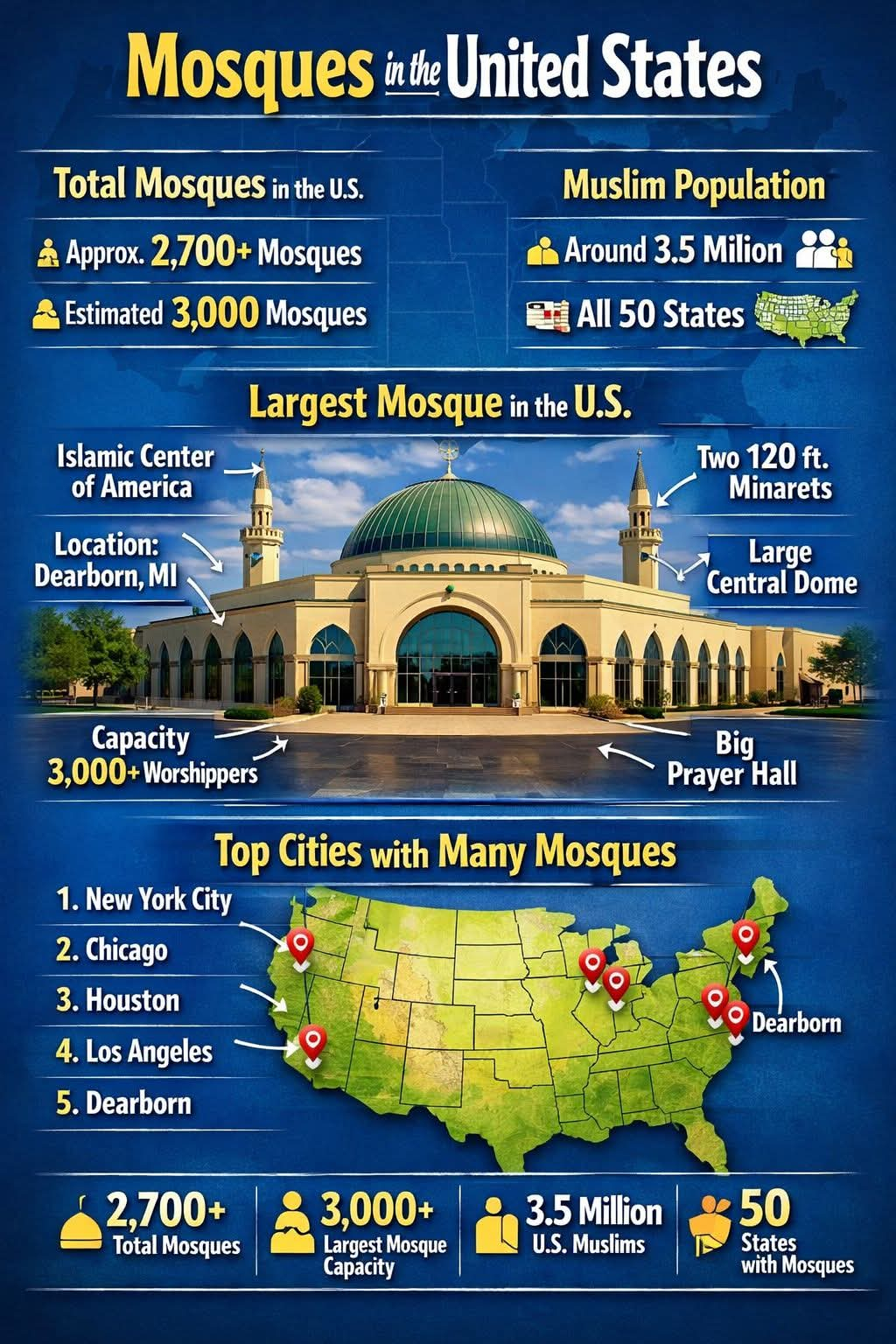
• The United States has a growing Muslim community and thousands of mosques spread across the country. According to research by the Institute for Social Policy and Understanding, there are approximately 2,700 to 3,000 mosques in America today. These mosques serve as places for daily prayers, Friday congregational prayers, Islamic education, and community activities. Over the past few decades, the number of mosques has increased significantly due to the rising Muslim population and immigration from different parts of the world.
    The Muslim population in the United States is estimated to be around 3.5 million people. Muslims in America come from diverse ethnic backgrounds including Arabs, South Asians, African Americans, Turks, and Africans. Because of this diversity, many mosques also function as cultural and community centers where people gather for religious learning, charity work, and social support.
    One of the largest and most well-known mosques in the country is the Islamic Center of America, located in Dearborn, Michigan. This mosque is famous for its beautiful architecture, large central dome, and tall minarets. It can accommodate more than 3,000 worshippers at a time and is considered one of the biggest Islamic centers in North America.
    Major cities such as New York City, Chicago, Houston, and Los Angeles have many mosques because they have large Muslim populations. These mosques play an important role in maintaining religious identity, promoting community unity, and supporting charitable and educational activities throughout the United States.
    The United States has a growing Muslim community and thousands of mosques spread across the country. According to research by the Institute for Social Policy and Understanding, there are approximately 2,700 to 3,000 mosques in America today. These mosques serve as places for daily prayers, Friday congregational prayers, Islamic education, and community activities. Over the past few decades, the number of mosques has increased significantly due to the rising Muslim population and immigration from different parts of the world. The Muslim population in the United States is estimated to be around 3.5 million people. Muslims in America come from diverse ethnic backgrounds including Arabs, South Asians, African Americans, Turks, and Africans. Because of this diversity, many mosques also function as cultural and community centers where people gather for religious learning, charity work, and social support. One of the largest and most well-known mosques in the country is the Islamic Center of America, located in Dearborn, Michigan. This mosque is famous for its beautiful architecture, large central dome, and tall minarets. It can accommodate more than 3,000 worshippers at a time and is considered one of the biggest Islamic centers in North America. Major cities such as New York City, Chicago, Houston, and Los Angeles have many mosques because they have large Muslim populations. These mosques play an important role in maintaining religious identity, promoting community unity, and supporting charitable and educational activities throughout the United States.
    0 Comments 0 Shares
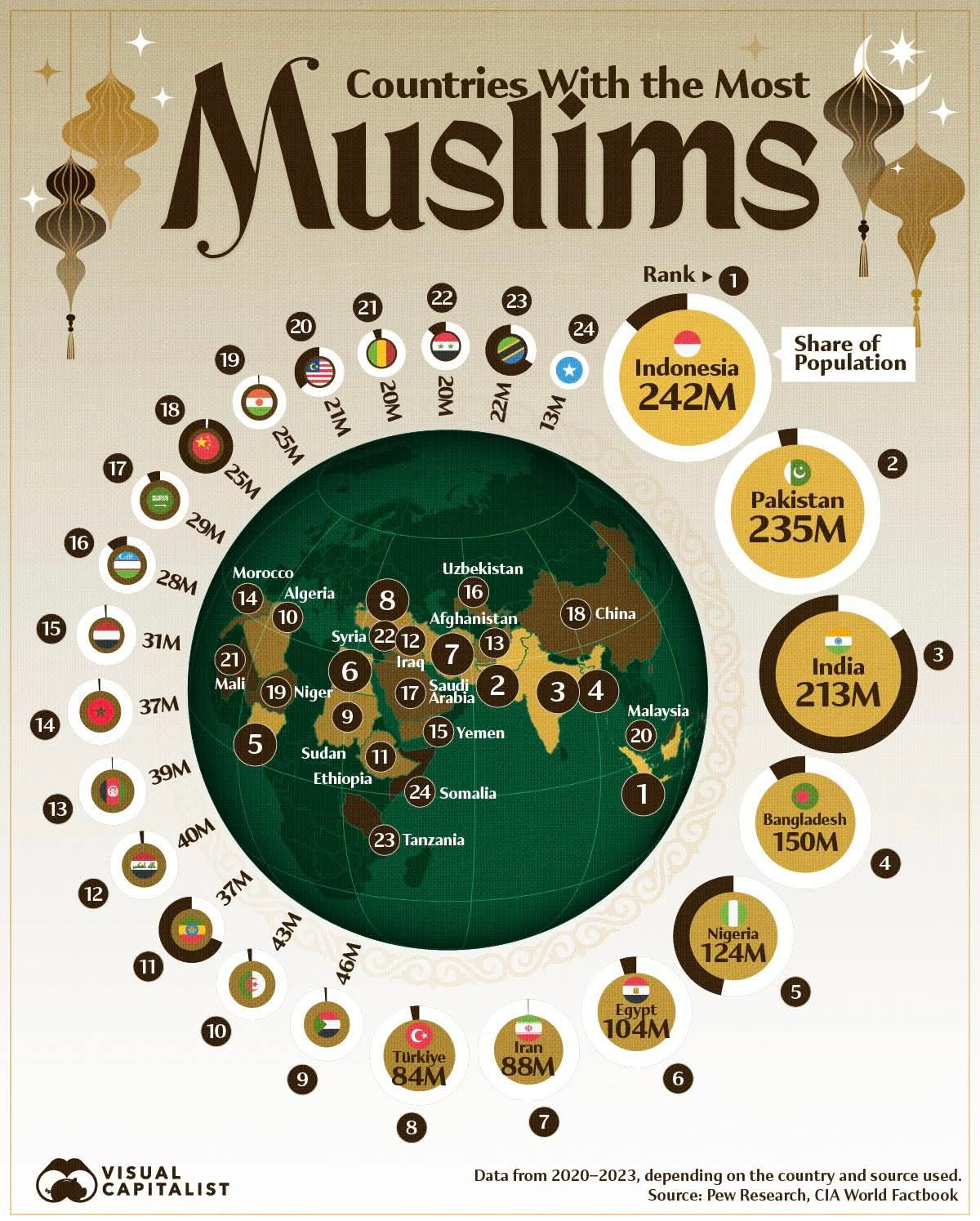
  • Countries With the Most Muslims (% Population)

    1. Indonesia - 242M (87.0%)
    2. Pakistan - 235M (96.3%)
    3. India - 213M (15.3%)
    4. Bangladesh - 150M (91.0%)
    5. Nigeria - 124M (53.5%)
    6. Egypt - 104M (95%)
    7. Iran - 88M (99.8%)
    8. Turkey - 84M (97%)
    9. Sudan - 46M (99%)
    10. Algeria - 43M (98.0%)
    11. Iraq - 40M (98%)
    12. Afghanistan - 39M (99.7%)
    13. Ethiopia - 37M (31.3%)
    14. Morocco - 37M (99.0%)
    15. Yemen - 31M (99.1%)
    16. Saudi Arabia - 29M (92.7%)
    17. Uzbekistan - 28M (88.0%)
    18. China - 25M (1.4%)
    19. Nigér - 25M (99.3%)
    20. Tanzania - 22M (34.1%)
    21. Malaysia - 21M (63.5%)
    22. Mali - 20M (93.9%)
    23. Syria - 20M (87.0%)
    24. Somalia - 13M (99.8%)

    The data comes from two complementary sources: Pew Research, which tracks global religious affiliation, and the CIA World Factbook, which publishes national demographic splits.

    Countries With the Largest Muslim Populations: Islam is the world’s second-largest religion, with 1.8 billion Muslims dispersed across every continent. Due to data constraints, the most recent figures between 2020–2023 have been utilized, depending on availability per country. Africa is home to some of the fastest-growing Muslim populations. Nigeria, already the continent’s most populous country, now counts over 124 million Muslims, comprising more than half its citizens. In North Africa, Egypt and Algeria each report that roughly 95-98% of their inhabitants identify as Muslim, reflecting centuries-old cultural and religious continuity.
    🕌 Countries With the Most Muslims (% Population) 1. 🇮🇩 Indonesia - 242M (87.0%) 2. 🇵🇰 Pakistan - 235M (96.3%) 3. 🇮🇳 India - 213M (15.3%) 4. 🇧🇩 Bangladesh - 150M (91.0%) 5. 🇳🇬 Nigeria - 124M (53.5%) 6. 🇪🇬 Egypt - 104M (95%) 7. 🇮🇷 Iran - 88M (99.8%) 8. 🇹🇷 Turkey - 84M (97%) 9. 🇸🇩 Sudan - 46M (99%) 10. 🇩🇿 Algeria - 43M (98.0%) 11. 🇮🇶 Iraq - 40M (98%) 12. 🇦🇫 Afghanistan - 39M (99.7%) 13. 🇪🇹 Ethiopia - 37M (31.3%) 14. 🇲🇦 Morocco - 37M (99.0%) 15. 🇾🇪 Yemen - 31M (99.1%) 16. 🇸🇦 Saudi Arabia - 29M (92.7%) 17. 🇺🇿 Uzbekistan - 28M (88.0%) 18. 🇨🇳 China - 25M (1.4%) 19. 🇳🇪 Nigér - 25M (99.3%) 20. 🇹🇿 Tanzania - 22M (34.1%) 21. 🇲🇾 Malaysia - 21M (63.5%) 22. 🇲🇱 Mali - 20M (93.9%) 23. 🇸🇾 Syria - 20M (87.0%) 24. 🇸🇴 Somalia - 13M (99.8%) 📌 The data comes from two complementary sources: Pew Research, which tracks global religious affiliation, and the CIA World Factbook, which publishes national demographic splits. Countries With the Largest Muslim Populations: Islam is the world’s second-largest religion, with 1.8 billion Muslims dispersed across every continent. Due to data constraints, the most recent figures between 2020–2023 have been utilized, depending on availability per country. Africa is home to some of the fastest-growing Muslim populations. Nigeria, already the continent’s most populous country, now counts over 124 million Muslims, comprising more than half its citizens. In North Africa, Egypt and Algeria each report that roughly 95-98% of their inhabitants identify as Muslim, reflecting centuries-old cultural and religious continuity.
    0 Comments 0 Shares
  • The holy month of #Ramadan kicked off on the weekend for millions of #Muslims around the world.

    Ramadan, the ninth and the holiest month in the #Islamic calendar, is one of the five pillars of Islam and is the time of the year when #religious fervour is rekindled throughout the #Muslim world.
    🕌 The holy month of #Ramadan kicked off on the weekend for millions of #Muslims around the world. 🕋 Ramadan, the ninth and the holiest month in the #Islamic calendar, is one of the five pillars of Islam and is the time of the year when #religious fervour is rekindled throughout the #Muslim world.
    0 Comments 0 Shares
  • ** "Making the Most of Ramadan: A Guide to Spiritual Enrichment" **

    To make the most of Ramadan and truly embrace its spiritual significance, consider the following practices:

    1. **Set Clear Intentions (Niyyah):** Before Ramadan begins, reflect on your goals and intentions. What do you hope to achieve spiritually, emotionally, and physically? Write them down and revisit them throughout the month.

    2. **Plan Your Day:** Structure your daily routine around your spiritual practices. Allocate specific times for prayer, Quran recitation, and reflection. Ensure you balance your daily obligations with your religious duties.

    3. **Suhoor and Iftar Preparation:** Plan nutritious and balanced meals for Suhoor and Iftar. Avoid overeating, and focus on foods that provide sustained energy and hydration.

    4. **Quran and Duas:** Dedicate time each day to reading and reflecting on the Quran. Learn new Duas (supplications) and incorporate them into your daily prayers. Aim to complete the Quran by the end of the month.

    5. **Taraweeh Prayers:** Attend Taraweeh prayers at the mosque, if possible. The communal atmosphere enhances the spiritual experience and fosters a sense of unity.

    6. **Charity and Good Deeds:** Increase your charitable activities by giving Zakat and Sadaqah. Volunteer your time and help those in need. Acts of kindness and generosity amplify the blessings of Ramadan.

    7. **Self-Reflection and Repentance:** Use the quiet moments of the day and night for self-reflection. Seek forgiveness for past mistakes, and strive to improve yourself. Ramadan is a time for spiritual renewal and personal growth.

    8. **Avoid Distractions:** Limit distractions such as excessive screen time, social media, and non-essential activities. Focus on your spiritual journey and prioritize your connection with Allah.

    9. **Family and Community:** Engage in meaningful conversations and activities with family and friends. Share knowledge, support each other, and strengthen your bonds. Participate in community events and initiatives.

    10. **Laylat al-Qadr:** Seek out and make the most of Laylat al-Qadr in the last ten nights of Ramadan. Engage in intense prayer, recitation, and supplication, as this night holds immense blessings.

    11. **Health and Wellness:** Take care of your physical health by staying hydrated, getting enough rest, and engaging in light exercise. A healthy body supports a healthy spirit.

    12. **Journaling:** Keep a journal to document your thoughts, reflections, and progress throughout Ramadan. This can be a valuable tool for self-awareness and future growth.

    By incorporating these practices into your daily routine, you can maximize the spiritual benefits of Ramadan and experience a deeper connection with your faith.

    May your Ramadan be filled with blessings

    For more Islamic content, follow my profile and stay inspired! Saien Sahab
    ** "Making the Most of Ramadan: A Guide to Spiritual Enrichment" ** To make the most of Ramadan and truly embrace its spiritual significance, consider the following practices: 1. **Set Clear Intentions (Niyyah):** Before Ramadan begins, reflect on your goals and intentions. What do you hope to achieve spiritually, emotionally, and physically? Write them down and revisit them throughout the month. 2. **Plan Your Day:** Structure your daily routine around your spiritual practices. Allocate specific times for prayer, Quran recitation, and reflection. Ensure you balance your daily obligations with your religious duties. 3. **Suhoor and Iftar Preparation:** Plan nutritious and balanced meals for Suhoor and Iftar. Avoid overeating, and focus on foods that provide sustained energy and hydration. 4. **Quran and Duas:** Dedicate time each day to reading and reflecting on the Quran. Learn new Duas (supplications) and incorporate them into your daily prayers. Aim to complete the Quran by the end of the month. 5. **Taraweeh Prayers:** Attend Taraweeh prayers at the mosque, if possible. The communal atmosphere enhances the spiritual experience and fosters a sense of unity. 6. **Charity and Good Deeds:** Increase your charitable activities by giving Zakat and Sadaqah. Volunteer your time and help those in need. Acts of kindness and generosity amplify the blessings of Ramadan. 7. **Self-Reflection and Repentance:** Use the quiet moments of the day and night for self-reflection. Seek forgiveness for past mistakes, and strive to improve yourself. Ramadan is a time for spiritual renewal and personal growth. 8. **Avoid Distractions:** Limit distractions such as excessive screen time, social media, and non-essential activities. Focus on your spiritual journey and prioritize your connection with Allah. 9. **Family and Community:** Engage in meaningful conversations and activities with family and friends. Share knowledge, support each other, and strengthen your bonds. Participate in community events and initiatives. 10. **Laylat al-Qadr:** Seek out and make the most of Laylat al-Qadr in the last ten nights of Ramadan. Engage in intense prayer, recitation, and supplication, as this night holds immense blessings. 11. **Health and Wellness:** Take care of your physical health by staying hydrated, getting enough rest, and engaging in light exercise. A healthy body supports a healthy spirit. 12. **Journaling:** Keep a journal to document your thoughts, reflections, and progress throughout Ramadan. This can be a valuable tool for self-awareness and future growth. By incorporating these practices into your daily routine, you can maximize the spiritual benefits of Ramadan and experience a deeper connection with your faith. May your Ramadan be filled with blessings🌙✨ For more Islamic content, follow my profile and stay inspired! 📿✨ Saien Sahab
    0 Comments 0 Shares
  • Günaydın! This is Balıklıgöl, located in Şanlıurfa Province in southeastern Türkiye Şanlıurfa, one of Türkiye's most mystical cities and a major center for religious tourism, is commonly associated with the birthplace of the Prophet Abraham.
    Günaydın! This is Balıklıgöl, located in Şanlıurfa Province in southeastern Türkiye Şanlıurfa, one of Türkiye's most mystical cities and a major center for religious tourism, is commonly associated with the birthplace of the Prophet Abraham.
    0 Comments 0 Shares
  • Islamic World

    The Islamic world refers to countries and regions where Islam is dominant, influencing various aspects of life, including culture, politics, law, and education. It is not just limited to the Middle East; it spans Africa, Asia, and Europe.
    Critical Aspects of the Islamic World:
    1. Geographical Spread:
    Middle East and North Africa (MENA): The heartland of Islam, including countries like Saudi Arabia, Egypt, Iran, and Turkey.
    South Asia: Countries like Pakistan, Bangladesh, and Afghanistan, where Islam plays a central role.
    Southeast Asia: Indonesia, the world's most populous Muslim-majority country, Malaysia, and Brunei.
    Sub-Saharan Africa: Countries like Nigeria, Sudan, and Somalia have significant Muslim populations.
    Europe: There are significant Muslim communities in Bosnia and Herzegovina, Albania, and growing populations in Western Europe due to migration.
    2. Cultural and Religious Practices:
    Religious Practices: The Five Pillars of Islam (Shahada, Salah, Zakat, Sawm, Hajj) are central to Islamic life.
    Islamic Law (Sharia): In many Muslim-majority countries, Sharia law influences or directly governs legal systems, covering everything from criminal law to personal status issues like marriage and inheritance.
    Language: Arabic is the liturgical language of Islam, but other languages, such as Persian, Turkish, Urdu, and Malay, are widely spoken in the Islamic world.
    3. Historical Contributions:
    The Golden Age of Islam (8th to 14th century) was a period of significant advancements in science, medicine, mathematics, and philosophy, with learning centres in cities like Baghdad, Cairo, and Cordoba.
    Architecture: Islamic architecture is renowned for its mosques, madrasas (schools), and palaces, featuring minarets, domes, and intricate geometric designs.
    4. Modern-Day Dynamics:
    Political Landscape: The Islamic world includes various governance systems, from monarchies in the Gulf States to republics in Iran and Turkey. Political Islam and movements like the Muslim Brotherhood have had significant influence in some regions.
    Economic Power: The Islamic world includes some of the world's largest oil producers, like Saudi Arabia and Iran, which play a critical role in global energy markets.
    Social Issues: The Islamic world faces diverse social challenges, from modernisation and globalisation to debates over women's rights, democracy, and the role of religion in the state.
    5. Global Influence:
    Diaspora: Significant Muslim communities in Europe, North America, and other parts of the world contribute to the global influence of Islam.
    Interfaith Relations: Islam is one of the world's major religions, with interfaith dialogue becoming increasingly important in promoting understanding and cooperation between different religious communities.
    The Islamic world is diverse and complex, with a rich history and significant impact on global culture, politics, and economics.
    Islamic World The Islamic world refers to countries and regions where Islam is dominant, influencing various aspects of life, including culture, politics, law, and education. It is not just limited to the Middle East; it spans Africa, Asia, and Europe. Critical Aspects of the Islamic World: 1. Geographical Spread: Middle East and North Africa (MENA): The heartland of Islam, including countries like Saudi Arabia, Egypt, Iran, and Turkey. South Asia: Countries like Pakistan, Bangladesh, and Afghanistan, where Islam plays a central role. Southeast Asia: Indonesia, the world's most populous Muslim-majority country, Malaysia, and Brunei. Sub-Saharan Africa: Countries like Nigeria, Sudan, and Somalia have significant Muslim populations. Europe: There are significant Muslim communities in Bosnia and Herzegovina, Albania, and growing populations in Western Europe due to migration. 2. Cultural and Religious Practices: Religious Practices: The Five Pillars of Islam (Shahada, Salah, Zakat, Sawm, Hajj) are central to Islamic life. Islamic Law (Sharia): In many Muslim-majority countries, Sharia law influences or directly governs legal systems, covering everything from criminal law to personal status issues like marriage and inheritance. Language: Arabic is the liturgical language of Islam, but other languages, such as Persian, Turkish, Urdu, and Malay, are widely spoken in the Islamic world. 3. Historical Contributions: The Golden Age of Islam (8th to 14th century) was a period of significant advancements in science, medicine, mathematics, and philosophy, with learning centres in cities like Baghdad, Cairo, and Cordoba. Architecture: Islamic architecture is renowned for its mosques, madrasas (schools), and palaces, featuring minarets, domes, and intricate geometric designs. 4. Modern-Day Dynamics: Political Landscape: The Islamic world includes various governance systems, from monarchies in the Gulf States to republics in Iran and Turkey. Political Islam and movements like the Muslim Brotherhood have had significant influence in some regions. Economic Power: The Islamic world includes some of the world's largest oil producers, like Saudi Arabia and Iran, which play a critical role in global energy markets. Social Issues: The Islamic world faces diverse social challenges, from modernisation and globalisation to debates over women's rights, democracy, and the role of religion in the state. 5. Global Influence: Diaspora: Significant Muslim communities in Europe, North America, and other parts of the world contribute to the global influence of Islam. Interfaith Relations: Islam is one of the world's major religions, with interfaith dialogue becoming increasingly important in promoting understanding and cooperation between different religious communities. The Islamic world is diverse and complex, with a rich history and significant impact on global culture, politics, and economics.
    0 Comments 0 Shares
  • In 2023, more than 1.8 million people performed Hajj, with nearly 90% of pilgrims, or 1,660,915 pilgrims, coming from outside Saudi Arabia through various ports, while the number of domestic pilgrims – including both citizens and residents – reached 184,130.

    The majority of the pilgrims were male, numbering 969,694 (52.6%), while female pilgrims totalled 875,351(47.4%).

    Saudi officials have said they expect the number of pilgrims this year to exceed 2023 numbers and approach pre-pandemic levels.

    One of the world’s largest religious gatherings, the Hajj is one of the Five Pillars of Islam. All Muslims are required to undertake it at least once in their lives if they are physically and financially able to do so.

    Here is a look at the geographic representation of pilgrims who undertook the Hajj pilgrimage in 2023.
    In 2023, more than 1.8 million people performed Hajj, with nearly 90% of pilgrims, or 1,660,915 pilgrims, coming from outside Saudi Arabia through various ports, while the number of domestic pilgrims – including both citizens and residents – reached 184,130. The majority of the pilgrims were male, numbering 969,694 (52.6%), while female pilgrims totalled 875,351(47.4%). Saudi officials have said they expect the number of pilgrims this year to exceed 2023 numbers and approach pre-pandemic levels. One of the world’s largest religious gatherings, the Hajj is one of the Five Pillars of Islam. All Muslims are required to undertake it at least once in their lives if they are physically and financially able to do so. Here is a look at the geographic representation of pilgrims who undertook the Hajj pilgrimage in 2023.
    0 Comments 0 Shares
  • A map illustrating Ibn Battuta's (Abū Abd Allāh Muḥammad ibn Abd Allāh Al-Lawātī, 1304 – c.1368) series of extraordinary journeys across the Islamic world and beyond spanning close to 75,000 miles (120,000 kilometers). A 14th-century Maghrebi explorer and Islamic scholar, he dictated an account of his journeys commonly known as The Rihla (from Arabic رحلة, Journey, Travelogue), providing invaluable insights into the medieval world, offering vivid descriptions of societies, economies, and governance structures from Marocco, Mali, and Spain to India and China. Battuta's descriptions and reflections also provide a unique window into the complexities of intercultural exchange, religious diversity, and political intrigue that characterized the medieval era. #History #Islam #IbnBattuta #Hajj
    A map illustrating Ibn Battuta's (Abū Abd Allāh Muḥammad ibn Abd Allāh Al-Lawātī, 1304 – c.1368) series of extraordinary journeys across the Islamic world and beyond spanning close to 75,000 miles (120,000 kilometers). A 14th-century Maghrebi explorer and Islamic scholar, he dictated an account of his journeys commonly known as The Rihla (from Arabic رحلة, Journey, Travelogue), providing invaluable insights into the medieval world, offering vivid descriptions of societies, economies, and governance structures from Marocco, Mali, and Spain to India and China. Battuta's descriptions and reflections also provide a unique window into the complexities of intercultural exchange, religious diversity, and political intrigue that characterized the medieval era. #History #Islam #IbnBattuta #Hajj
    0 Comments 0 Shares
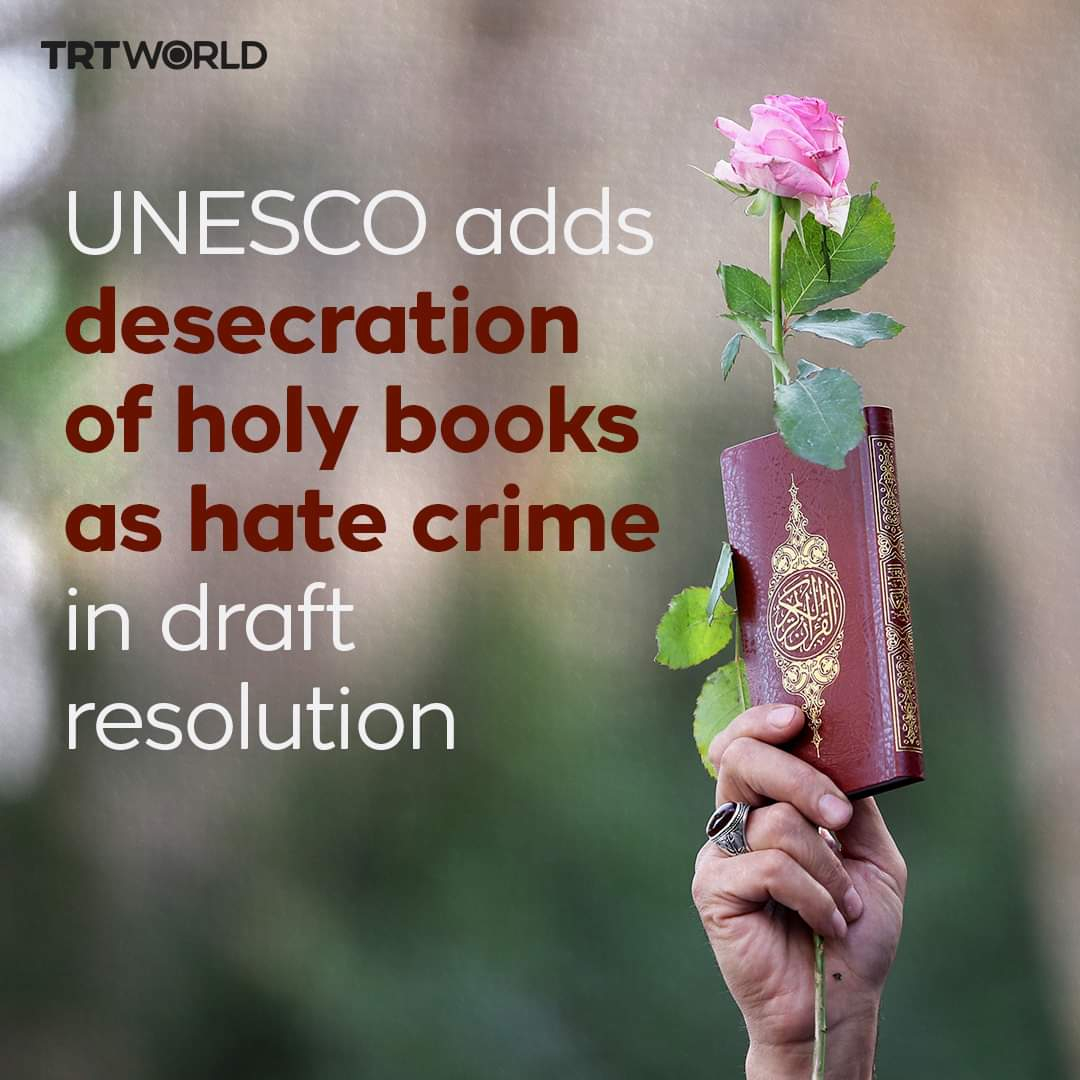
  • The UN General Assembly included the desecration of holy books, including the Quran, in a draft resolution on racism, discrimination and hate crimes, in response to a proposal submitted by Türkiye.

    Ankara’s Permanent Representative to UNESCO, Ambassador Gulnur Aybet, said that, “under Türkiye’s leadership, we added the UNGA resolution declaring crimes against holy books as violations of international law to the UNESCO decision draft.”

    “While stating our support for combatting all forms of hate crimes, I emphasised the alarming increase in crimes associated with hatred against Islam in recent years,” the envoy added.

    “I noted that UNESCO should act in line with UN resolutions in this regard. The draft resolution was accepted with the amendments we proposed. Let’s continue the fight.”

    Quran desecration acts in Europe have ignited a debate about religious tolerance and freedom of expression, prompting calls for a deeper understanding of religious sensitivities and a reconsideration of the balance between free speech and respect for religious beliefs.

    In July 2023, the UN General Assembly unanimously adopted a Morocco-sponsored resolution calling acts of violence against religious symbols, holy books, and places of worship a violation of international law.
    The UN General Assembly included the desecration of holy books, including the Quran, in a draft resolution on racism, discrimination and hate crimes, in response to a proposal submitted by Türkiye. Ankara’s Permanent Representative to UNESCO, Ambassador Gulnur Aybet, said that, “under Türkiye’s leadership, we added the UNGA resolution declaring crimes against holy books as violations of international law to the UNESCO decision draft.” “While stating our support for combatting all forms of hate crimes, I emphasised the alarming increase in crimes associated with hatred against Islam in recent years,” the envoy added. “I noted that UNESCO should act in line with UN resolutions in this regard. The draft resolution was accepted with the amendments we proposed. Let’s continue the fight.” Quran desecration acts in Europe have ignited a debate about religious tolerance and freedom of expression, prompting calls for a deeper understanding of religious sensitivities and a reconsideration of the balance between free speech and respect for religious beliefs. In July 2023, the UN General Assembly unanimously adopted a Morocco-sponsored resolution calling acts of violence against religious symbols, holy books, and places of worship a violation of international law.
    0 Comments 0 Shares
  • Indian Prime Minister Narendra Modi’s Hindu nationalist government has implemented a controversial citizenship law that has been widely criticized for excluding Muslims. Muslims in India make up a large minority that exceeds 200 million people, or 10% of the entire world’s Muslim population.

    India's Citizenship Amendment Act provides “a fast track to naturalization for Hindus, Parsis, Sikhs, Buddhists, Jains and Christians who fled to Hindu-majority India from Afghanistan, Bangladesh and Pakistan before Dec. 31, 2014”. However, the law excludes Muslims, who are a majority in all three nations.

    This is the first time that India, officially a secular state, has set religious criteria for citizenship. Previously, illegal migrants were prevented from becoming Indian citizens. The new law allows eligible migrants to apply for citizenship via an online portal.

    Amnesty International has said the law “legitimizes discrimination based on religion.” Modi’s critics have charged that he is eroding the foundation of a secular state and pushing the country towards beoming a Hindu nation. His silence on anti-Muslim violence has emboldened some of his party’s most extreme supporters and triggered frustration and protests among India’s Muslims.
    Indian Prime Minister Narendra Modi’s Hindu nationalist government has implemented a controversial citizenship law that has been widely criticized for excluding Muslims. Muslims in India make up a large minority that exceeds 200 million people, or 10% of the entire world’s Muslim population. India's Citizenship Amendment Act provides “a fast track to naturalization for Hindus, Parsis, Sikhs, Buddhists, Jains and Christians who fled to Hindu-majority India from Afghanistan, Bangladesh and Pakistan before Dec. 31, 2014”. However, the law excludes Muslims, who are a majority in all three nations. This is the first time that India, officially a secular state, has set religious criteria for citizenship. Previously, illegal migrants were prevented from becoming Indian citizens. The new law allows eligible migrants to apply for citizenship via an online portal. Amnesty International has said the law “legitimizes discrimination based on religion.” Modi’s critics have charged that he is eroding the foundation of a secular state and pushing the country towards beoming a Hindu nation. His silence on anti-Muslim violence has emboldened some of his party’s most extreme supporters and triggered frustration and protests among India’s Muslims.
    0 Comments 0 Shares
More Results