• Türkiye, Qatar, Pakistan and Indonesia have signed a defence pact named “Badr”.

    The defence ministers of Türkiye, Qatar, Pakistan and Indonesia have signed a memorandum of understanding in Doha, Qatar, establishing a defence industry cooperation pact.

    The agreement covers joint production, research and development, and technical military training, with each country contributing its own military production capabilities.

    The aim is to bring existing projects into a wider framework involving all four nations.

    The name Badr means “full moon” in Arabic and may also be a reference to the historic Battle of Badr, a battle in early Islamic history fought during the time of Prophet Muhammad ﷺ.
    Türkiye, Qatar, Pakistan and Indonesia have signed a defence pact named “Badr”. The defence ministers of Türkiye, Qatar, Pakistan and Indonesia have signed a memorandum of understanding in Doha, Qatar, establishing a defence industry cooperation pact. The agreement covers joint production, research and development, and technical military training, with each country contributing its own military production capabilities. The aim is to bring existing projects into a wider framework involving all four nations. The name Badr means “full moon” in Arabic and may also be a reference to the historic Battle of Badr, a battle in early Islamic history fought during the time of Prophet Muhammad ﷺ.
    0 Commentaires 0 parts
  • IN 1890, A JAPANESE FISHING VILLAGE SAVED 69 TURKISH SAILORS. 95 YEARS LATER, TURKEY PAID IT BACK

    September 1890. An Ottoman warship called the Ertugrul was heading home from Japan when a typhoon threw it onto the rocks near Kushimoto, at the southern tip of Japan's main island.

    More than 500 sailors died.

    The people of the small island nearby ran down to the water in the storm and pulled survivors out. By many accounts, they had very little food themselves, and gave the sailors what they had. 69 men survived. Japan sent them home on two of its own warships.

    Japan mostly forgot. Turkey didn't. Generations of Turkish kids learned the story at school.

    March 1985. War between Iran and Iraq. Iraq announced it would shoot down any plane over Iran after a deadline. More than 200 Japanese were stuck in Tehran, and under Japan's laws at the time, its own military planes could not go and get them.

    Turkey sent two Turkish Airlines planes. They flew 215 Japanese out before the deadline.

    When people later asked why, the answer from Turkey kept coming back to one word. Ertugrul.

    Today, Kushimoto still holds a memorial for the sailors, and Turkey still sends people to stand there.
    IN 1890, A JAPANESE FISHING VILLAGE SAVED 69 TURKISH SAILORS. 95 YEARS LATER, TURKEY PAID IT BACK 🇯🇵🇹🇷 September 1890. An Ottoman warship called the Ertugrul was heading home from Japan when a typhoon threw it onto the rocks near Kushimoto, at the southern tip of Japan's main island. More than 500 sailors died. The people of the small island nearby ran down to the water in the storm and pulled survivors out. By many accounts, they had very little food themselves, and gave the sailors what they had. 69 men survived. Japan sent them home on two of its own warships. Japan mostly forgot. Turkey didn't. Generations of Turkish kids learned the story at school. March 1985. War between Iran and Iraq. Iraq announced it would shoot down any plane over Iran after a deadline. More than 200 Japanese were stuck in Tehran, and under Japan's laws at the time, its own military planes could not go and get them. Turkey sent two Turkish Airlines planes. They flew 215 Japanese out before the deadline. When people later asked why, the answer from Turkey kept coming back to one word. Ertugrul. Today, Kushimoto still holds a memorial for the sailors, and Turkey still sends people to stand there.
    0 Commentaires 0 parts
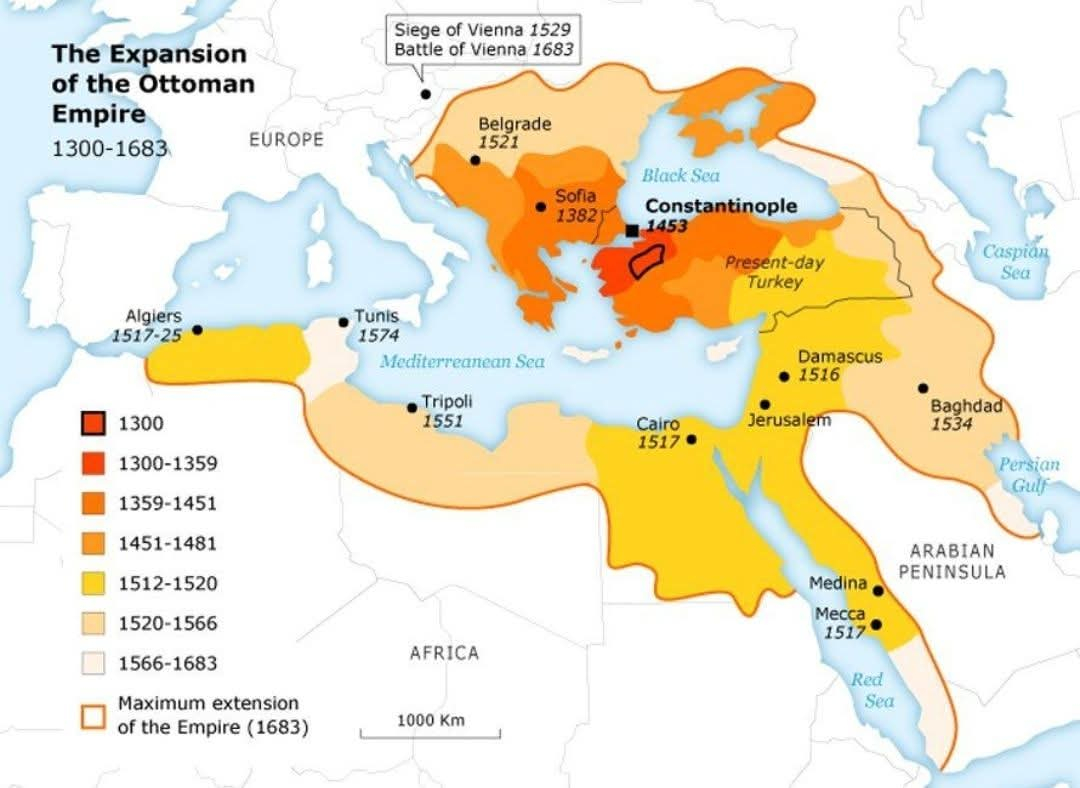
  • The Ottoman Empire at Its Greatest Extent

    At its height, the Ottoman Empire was one of the most powerful states in world history, spanning large parts of Southeastern Europe, Western Asia, and North Africa.

    A Transcontinental Empire

    The empire controlled territories surrounding much of the Mediterranean, Black Sea, and Red Sea, creating a strategic bridge between Europe, Asia, and Africa.

    Major Regions Under Ottoman Rule

    Anatolia — the Ottoman heartland
    The Balkans — extensive territories across Southeastern Europe
    Greece — much of the region was incorporated into the empire at different periods
    The Levant — including Syria and surrounding territories
    Mesopotamia — major Ottoman territories in present-day Iraq
    Egypt — an important economic and strategic province
    North Africa — Ottoman territories along much of the southern Mediterranean
    The Arabian Peninsula — including the Hejaz and other regions
    The Caucasus — areas contested and controlled at different times

    Key Facts

    Istanbul (Constantinople) became the imperial capital after the Ottoman conquest of 1453.
    At its height, the empire controlled territories across three continents.
    The Mediterranean Sea, Black Sea, Red Sea, and major land routes were strategically important to Ottoman power.
    The empire ruled over a remarkable diversity of peoples, languages, religions, and cultures.
    Ottoman influence lasted for more than six centuries, from its foundation around the end of the 13th century until its dissolution in the early 20th century.

    From a Frontier State to a Global Power

    What began as a small Anatolian principality developed into a vast empire that became a major political and military power between Europe, Asia, and Africa.

    The Ottoman Empire was not simply a European or Asian empire—it was a truly transcontinental power.

    #OttomanEmpire #OttomanHistory #History #Geography #WorldHistory
    🕌 The Ottoman Empire at Its Greatest Extent At its height, the Ottoman Empire was one of the most powerful states in world history, spanning large parts of Southeastern Europe, Western Asia, and North Africa. 🌍 A Transcontinental Empire The empire controlled territories surrounding much of the Mediterranean, Black Sea, and Red Sea, creating a strategic bridge between Europe, Asia, and Africa. 🗺️ Major Regions Under Ottoman Rule 🇹🇷 Anatolia — the Ottoman heartland 🌍 The Balkans — extensive territories across Southeastern Europe 🇬🇷 Greece — much of the region was incorporated into the empire at different periods 🇸🇾 The Levant — including Syria and surrounding territories 🇮🇶 Mesopotamia — major Ottoman territories in present-day Iraq 🇪🇬 Egypt — an important economic and strategic province 🌍 North Africa — Ottoman territories along much of the southern Mediterranean 🕌 The Arabian Peninsula — including the Hejaz and other regions ⛰️ The Caucasus — areas contested and controlled at different times ⚔️ Key Facts 🔹 Istanbul (Constantinople) became the imperial capital after the Ottoman conquest of 1453. 🔹 At its height, the empire controlled territories across three continents. 🔹 The Mediterranean Sea, Black Sea, Red Sea, and major land routes were strategically important to Ottoman power. 🔹 The empire ruled over a remarkable diversity of peoples, languages, religions, and cultures. 🔹 Ottoman influence lasted for more than six centuries, from its foundation around the end of the 13th century until its dissolution in the early 20th century. 🏛️ From a Frontier State to a Global Power What began as a small Anatolian principality developed into a vast empire that became a major political and military power between Europe, Asia, and Africa. The Ottoman Empire was not simply a European or Asian empire—it was a truly transcontinental power. #OttomanEmpire #OttomanHistory #History #Geography #WorldHistory
    0 Commentaires 0 parts
  • The Ottoman Empire at Its Peak – 1683

    In 1683, the Ottoman Empire stood as one of the world’s most powerful states, stretching across three continents.

    Territory – From Hungary in the heart of Europe to the Arabian deserts, from North Africa to the Caucasus, the empire spanned 6-7 million square kilometers.

    Capital – Istanbul, once Constantinople, was a global hub of trade, culture, and politics.

    Diversity – The empire united Turks, Arabs, Kurds, Greeks, Armenians, Slavs, Jews, and many more under a vast administrative system.

    Military Power – The Janissaries and navy projected influence across the Mediterranean, Red Sea, and beyond.

    1683 Vienna Campaign – Marked the high tide of Ottoman expansion into Europe, though the failed siege of Vienna also signaled the turning point of imperial fortunes.

    The Ottoman Empire in 1683 was not just a political force — it was a cultural mosaic and a major player in global history.

    A true ISLAMIC UNITY is not only the only solution to provide Peace, Tranquility, and Security today — just as the Ottoman State ensured for 600 years — but also the only path for the economic development of poor Islamic countries.
    The Ottoman Empire at Its Peak – 1683 In 1683, the Ottoman Empire stood as one of the world’s most powerful states, stretching across three continents. 🔹 Territory – From Hungary in the heart of Europe to the Arabian deserts, from North Africa to the Caucasus, the empire spanned 6-7 million square kilometers. 🔹 Capital – Istanbul, once Constantinople, was a global hub of trade, culture, and politics. 🔹 Diversity – The empire united Turks, Arabs, Kurds, Greeks, Armenians, Slavs, Jews, and many more under a vast administrative system. 🔹 Military Power – The Janissaries and navy projected influence across the Mediterranean, Red Sea, and beyond. 🔹 1683 Vienna Campaign – Marked the high tide of Ottoman expansion into Europe, though the failed siege of Vienna also signaled the turning point of imperial fortunes. The Ottoman Empire in 1683 was not just a political force — it was a cultural mosaic and a major player in global history. A true ISLAMIC UNITY is not only the only solution to provide Peace, Tranquility, and Security today — just as the Ottoman State ensured for 600 years — but also the only path for the economic development of poor Islamic countries.
    0 Commentaires 0 parts
  • Two years into one of the world’s deadliest — and most underreported — conflicts, Sudan is being torn apart.

    Fighting between the Sudanese army and paramilitary RSF has turned cities into graveyards. Bodies lie unburied. Hospitals are in ruins. Entire towns have been emptied.

    About 30% of Sudan’s population have fled their homes.

    Aid groups warn the real death toll could be far higher than reported — many areas are inaccessible, and communication blackouts hide the full scale of atrocities.

    The brutality is clear, but what we know may only scratch the surface.
    Two years into one of the world’s deadliest — and most underreported — conflicts, Sudan is being torn apart. Fighting between the Sudanese army and paramilitary RSF has turned cities into graveyards. Bodies lie unburied. Hospitals are in ruins. Entire towns have been emptied. About 30% of Sudan’s population have fled their homes. Aid groups warn the real death toll could be far higher than reported — many areas are inaccessible, and communication blackouts hide the full scale of atrocities. The brutality is clear, but what we know may only scratch the surface.
    1
    0 Commentaires 0 parts
  • Thousands of Palestinians from Rafah and Khan Younis were displaced on the second day of Eid al-Fitr, heading toward central Gaza and carrying only a few belongings, following “evacuation” warnings from the Israeli army.

    Israel’s military on Monday issued sweeping evacuation orders covering Rafah and nearby areas, indicating it could soon launch another major ground invasion in Gaza’s south.

    People and children along the migration route appeared worn out from exhaustion, with some travelled by foot or by bike, while others pushed makeshift carts loaded with belongings.

    Donkey-pulled carts rolled down streets next to trucks piled high with blankets, mattresses and other household items.
    Thousands of Palestinians from Rafah and Khan Younis were displaced on the second day of Eid al-Fitr, heading toward central Gaza and carrying only a few belongings, following “evacuation” warnings from the Israeli army. Israel’s military on Monday issued sweeping evacuation orders covering Rafah and nearby areas, indicating it could soon launch another major ground invasion in Gaza’s south. People and children along the migration route appeared worn out from exhaustion, with some travelled by foot or by bike, while others pushed makeshift carts loaded with belongings. Donkey-pulled carts rolled down streets next to trucks piled high with blankets, mattresses and other household items.
    0 Commentaires 0 parts
  • Over 100 people were killed, and dozens more injured, after the paramilitary Rapid Support Forces (RSF) attacked the village of Wad al Noora in Sudan’s Gezira state on June 5, officials said.

    UNICEF Executive Director Catherina Russell said in a statement that at least 35 children were killed and 20 others injured during the attacks.

    On June 6, Sudan’s Transitional Sovereignty Council accused the RSF of committing a massacre in the village and killing “a large number of innocents,” while the RSF said they attacked three camps housing elements of the army and intelligence personnel.

    Madani Resistance Committee, a local pro-democracy activists group, put the toll at “more than 104,” and accused the paramilitaries of looting Wad al Noura during the attacks.

    The war between the RSF and the Sudanese army, which broke out in April 2023, has wrecked the country as clashes spread across multiple cities and pushed its population to the brink of famine.

    More than 14,000 people have been killed and thousands more have been wounded, with hundreds of thousands displaced.
    Over 100 people were killed, and dozens more injured, after the paramilitary Rapid Support Forces (RSF) attacked the village of Wad al Noora in Sudan’s Gezira state on June 5, officials said. UNICEF Executive Director Catherina Russell said in a statement that at least 35 children were killed and 20 others injured during the attacks. On June 6, Sudan’s Transitional Sovereignty Council accused the RSF of committing a massacre in the village and killing “a large number of innocents,” while the RSF said they attacked three camps housing elements of the army and intelligence personnel. Madani Resistance Committee, a local pro-democracy activists group, put the toll at “more than 104,” and accused the paramilitaries of looting Wad al Noura during the attacks. The war between the RSF and the Sudanese army, which broke out in April 2023, has wrecked the country as clashes spread across multiple cities and pushed its population to the brink of famine. More than 14,000 people have been killed and thousands more have been wounded, with hundreds of thousands displaced.
    0 Commentaires 0 parts
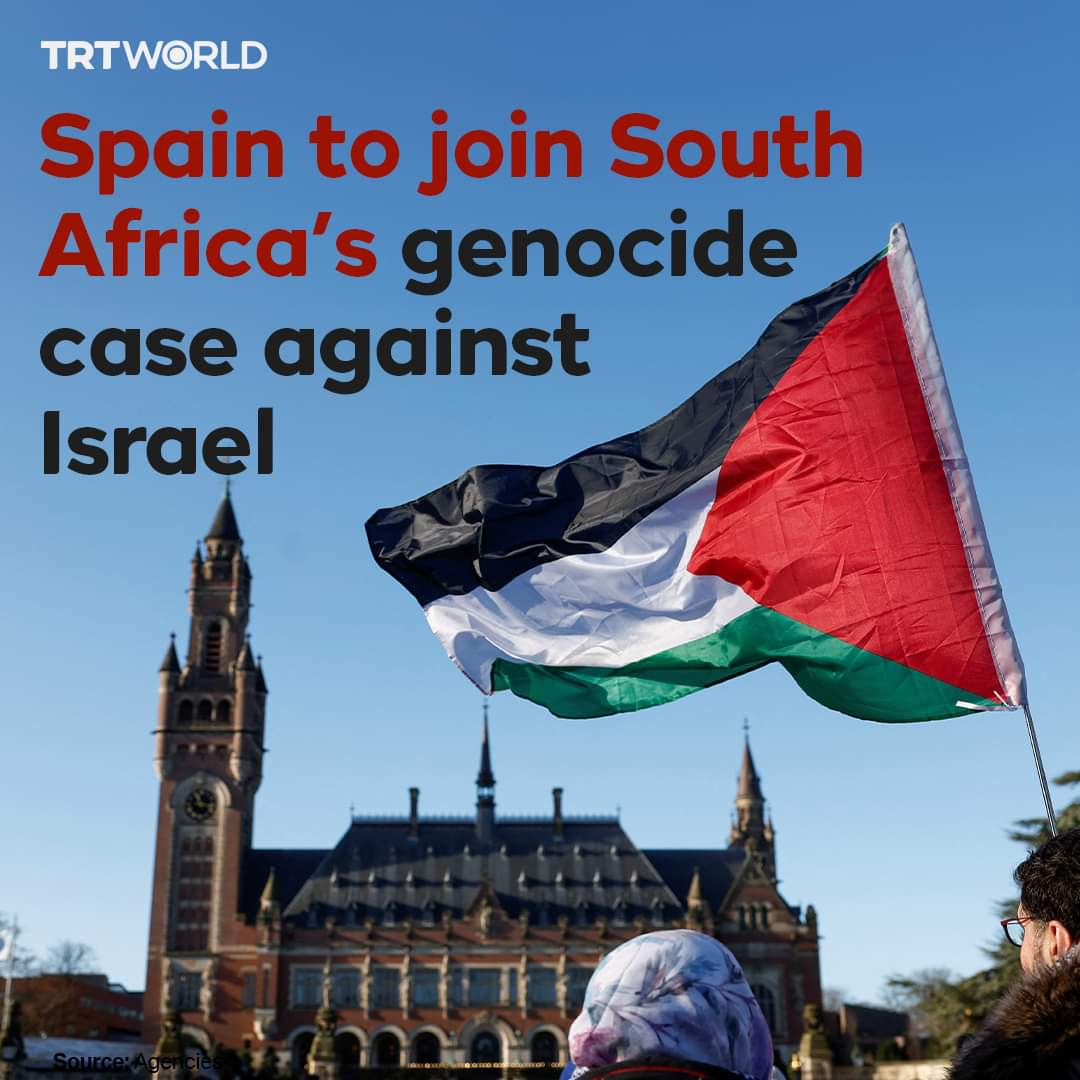
  • Spain will request to participate in South Africa’s genocide case against Israel’s actions in Palestine’s Gaza before the International Court of Justice (ICJ), the country’s Foreign Minister Jose Manuel Albares said on June 6.

    Spain is the second European nation after Ireland to join the case, which has also been joined by Chile and Mexico.

    “Our sole goal is to put an end to the war and to advance on the road of applying the two-state solution,” Albares said in a press conference held in Madrid.

    South Africa brought the case before the top court last year, alleging that Israel’s Gaza offensive breached the 1948 UN Genocide Convention — a charge Israel strongly denies.

    In a ruling on January 26, the ICJ ordered Israel to do everything it could to prevent acts of genocide during its military operations in Gaza.

    On May 24, the court ordered Israel to “immediately” halt its military offensive in the city of Rafah and keep open the key border crossing there for “unhindered” humanitarian aid.

    ICJ rulings are legally binding, but the court has no concrete means to enforce them.
    Spain will request to participate in South Africa’s genocide case against Israel’s actions in Palestine’s Gaza before the International Court of Justice (ICJ), the country’s Foreign Minister Jose Manuel Albares said on June 6. Spain is the second European nation after Ireland to join the case, which has also been joined by Chile and Mexico. “Our sole goal is to put an end to the war and to advance on the road of applying the two-state solution,” Albares said in a press conference held in Madrid. South Africa brought the case before the top court last year, alleging that Israel’s Gaza offensive breached the 1948 UN Genocide Convention — a charge Israel strongly denies. In a ruling on January 26, the ICJ ordered Israel to do everything it could to prevent acts of genocide during its military operations in Gaza. On May 24, the court ordered Israel to “immediately” halt its military offensive in the city of Rafah and keep open the key border crossing there for “unhindered” humanitarian aid. ICJ rulings are legally binding, but the court has no concrete means to enforce them.
    0 Commentaires 0 parts
  • Israeli strikes hit Palestine’s Gaza as Muslims marked the end of the Islamic holy month of Ramadan.

    Palestinians gathered for morning prayers on April 10, on the first day of the Eid al Fitr amid the ruins of Gaza, which has been devastated by more than six months of war.

    Israel has imposed a siege that has deprived Gaza's people of most food, water, fuel, medicines and other essential goods.

    Humanitarian groups have accused Israel of using starvation as a weapon of war in Gaza.

    Israel's military offensive in Gaza has killed at least 33,482 Palestinians and wounded 76,049 since October 7.
    Israeli strikes hit Palestine’s Gaza as Muslims marked the end of the Islamic holy month of Ramadan. Palestinians gathered for morning prayers on April 10, on the first day of the Eid al Fitr amid the ruins of Gaza, which has been devastated by more than six months of war. Israel has imposed a siege that has deprived Gaza's people of most food, water, fuel, medicines and other essential goods. Humanitarian groups have accused Israel of using starvation as a weapon of war in Gaza. Israel's military offensive in Gaza has killed at least 33,482 Palestinians and wounded 76,049 since October 7.
    0 Commentaires 0 parts
  • Protestors in San Sebastian, Spain performed a “die-in” demonstration in a tribute to those who have lost their lives in Gaza on Sunday, March 17. Hundreds of people lay together on the ground to call for an immediate ceasefire in Gaza as Israel’s assault enters its sixth month.

    Along La Concha beach’s esplanade in the Spanish city, many people held anti-war banners and Palestinian flags, with a huge painting inspired by world-renowned artist Pablo Picasso’s anti-war artwork “Guernica.”

    Named after another Spanish city, Guernica, the painting is a response to the 1937 bombing of the town during WWII. Guernica is the site of the first large-scale military air assault against civilians in history, causing widespread destruction.

    Artists and activists from the Gernika-Palestina collective, which organized the gathering, drew a parallel between the situation in Gaza and the historic tragedy in Guernica.

    #spain #sansebastian #antiwar #protest #Picasso #guernica
    Protestors in San Sebastian, Spain performed a “die-in” demonstration in a tribute to those who have lost their lives in Gaza on Sunday, March 17. Hundreds of people lay together on the ground to call for an immediate ceasefire in Gaza as Israel’s assault enters its sixth month. Along La Concha beach’s esplanade in the Spanish city, many people held anti-war banners and Palestinian flags, with a huge painting inspired by world-renowned artist Pablo Picasso’s anti-war artwork “Guernica.” Named after another Spanish city, Guernica, the painting is a response to the 1937 bombing of the town during WWII. Guernica is the site of the first large-scale military air assault against civilians in history, causing widespread destruction. Artists and activists from the Gernika-Palestina collective, which organized the gathering, drew a parallel between the situation in Gaza and the historic tragedy in Guernica. #spain #sansebastian #antiwar #protest #Picasso #guernica
    0 Commentaires 0 parts
Résultats de Recherche