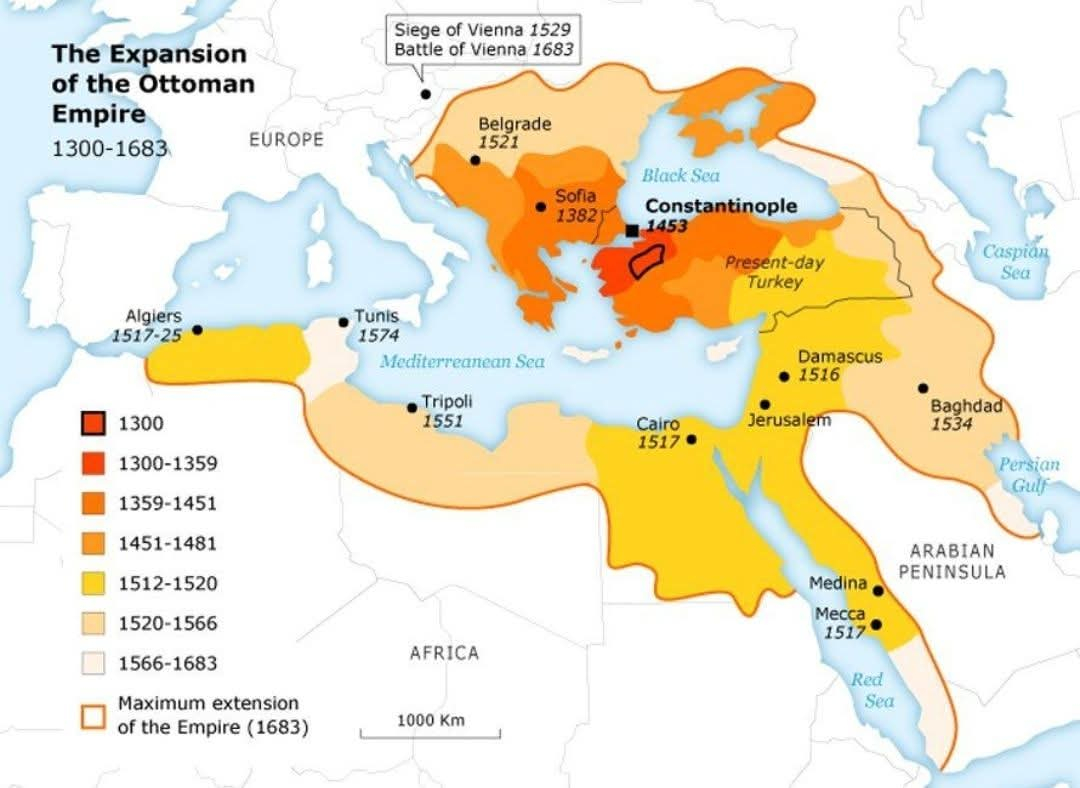
• The Ottoman Empire at Its Greatest Extent

    At its height, the Ottoman Empire was one of the most powerful states in world history, spanning large parts of Southeastern Europe, Western Asia, and North Africa.

    A Transcontinental Empire

    The empire controlled territories surrounding much of the Mediterranean, Black Sea, and Red Sea, creating a strategic bridge between Europe, Asia, and Africa.

    Major Regions Under Ottoman Rule

    Anatolia — the Ottoman heartland
    The Balkans — extensive territories across Southeastern Europe
    Greece — much of the region was incorporated into the empire at different periods
    The Levant — including Syria and surrounding territories
    Mesopotamia — major Ottoman territories in present-day Iraq
    Egypt — an important economic and strategic province
    North Africa — Ottoman territories along much of the southern Mediterranean
    The Arabian Peninsula — including the Hejaz and other regions
    The Caucasus — areas contested and controlled at different times

    Key Facts

    Istanbul (Constantinople) became the imperial capital after the Ottoman conquest of 1453.
    At its height, the empire controlled territories across three continents.
    The Mediterranean Sea, Black Sea, Red Sea, and major land routes were strategically important to Ottoman power.
    The empire ruled over a remarkable diversity of peoples, languages, religions, and cultures.
    Ottoman influence lasted for more than six centuries, from its foundation around the end of the 13th century until its dissolution in the early 20th century.

    From a Frontier State to a Global Power

    What began as a small Anatolian principality developed into a vast empire that became a major political and military power between Europe, Asia, and Africa.

    The Ottoman Empire was not simply a European or Asian empire—it was a truly transcontinental power.

    #OttomanEmpire #OttomanHistory #History #Geography #WorldHistory
    🕌 The Ottoman Empire at Its Greatest Extent At its height, the Ottoman Empire was one of the most powerful states in world history, spanning large parts of Southeastern Europe, Western Asia, and North Africa. 🌍 A Transcontinental Empire The empire controlled territories surrounding much of the Mediterranean, Black Sea, and Red Sea, creating a strategic bridge between Europe, Asia, and Africa. 🗺️ Major Regions Under Ottoman Rule 🇹🇷 Anatolia — the Ottoman heartland 🌍 The Balkans — extensive territories across Southeastern Europe 🇬🇷 Greece — much of the region was incorporated into the empire at different periods 🇸🇾 The Levant — including Syria and surrounding territories 🇮🇶 Mesopotamia — major Ottoman territories in present-day Iraq 🇪🇬 Egypt — an important economic and strategic province 🌍 North Africa — Ottoman territories along much of the southern Mediterranean 🕌 The Arabian Peninsula — including the Hejaz and other regions ⛰️ The Caucasus — areas contested and controlled at different times ⚔️ Key Facts 🔹 Istanbul (Constantinople) became the imperial capital after the Ottoman conquest of 1453. 🔹 At its height, the empire controlled territories across three continents. 🔹 The Mediterranean Sea, Black Sea, Red Sea, and major land routes were strategically important to Ottoman power. 🔹 The empire ruled over a remarkable diversity of peoples, languages, religions, and cultures. 🔹 Ottoman influence lasted for more than six centuries, from its foundation around the end of the 13th century until its dissolution in the early 20th century. 🏛️ From a Frontier State to a Global Power What began as a small Anatolian principality developed into a vast empire that became a major political and military power between Europe, Asia, and Africa. The Ottoman Empire was not simply a European or Asian empire—it was a truly transcontinental power. #OttomanEmpire #OttomanHistory #History #Geography #WorldHistory
    0 التعليقات 0 نشر
  • The Ottoman Empire at Its Peak – 1683

    In 1683, the Ottoman Empire stood as one of the world’s most powerful states, stretching across three continents.

    Territory – From Hungary in the heart of Europe to the Arabian deserts, from North Africa to the Caucasus, the empire spanned 6-7 million square kilometers.

    Capital – Istanbul, once Constantinople, was a global hub of trade, culture, and politics.

    Diversity – The empire united Turks, Arabs, Kurds, Greeks, Armenians, Slavs, Jews, and many more under a vast administrative system.

    Military Power – The Janissaries and navy projected influence across the Mediterranean, Red Sea, and beyond.

    1683 Vienna Campaign – Marked the high tide of Ottoman expansion into Europe, though the failed siege of Vienna also signaled the turning point of imperial fortunes.

    The Ottoman Empire in 1683 was not just a political force — it was a cultural mosaic and a major player in global history.

    A true ISLAMIC UNITY is not only the only solution to provide Peace, Tranquility, and Security today — just as the Ottoman State ensured for 600 years — but also the only path for the economic development of poor Islamic countries.
    The Ottoman Empire at Its Peak – 1683 In 1683, the Ottoman Empire stood as one of the world’s most powerful states, stretching across three continents. 🔹 Territory – From Hungary in the heart of Europe to the Arabian deserts, from North Africa to the Caucasus, the empire spanned 6-7 million square kilometers. 🔹 Capital – Istanbul, once Constantinople, was a global hub of trade, culture, and politics. 🔹 Diversity – The empire united Turks, Arabs, Kurds, Greeks, Armenians, Slavs, Jews, and many more under a vast administrative system. 🔹 Military Power – The Janissaries and navy projected influence across the Mediterranean, Red Sea, and beyond. 🔹 1683 Vienna Campaign – Marked the high tide of Ottoman expansion into Europe, though the failed siege of Vienna also signaled the turning point of imperial fortunes. The Ottoman Empire in 1683 was not just a political force — it was a cultural mosaic and a major player in global history. A true ISLAMIC UNITY is not only the only solution to provide Peace, Tranquility, and Security today — just as the Ottoman State ensured for 600 years — but also the only path for the economic development of poor Islamic countries.
    0 التعليقات 0 نشر
  • 17 Facts You May Not Know About Yemen:

    (1). Yemen is located in the Middle East on the southern tip of the Arabian Peninsula.
    (2). It is one of the oldest inhabited regions in the world, with a history dating back thousands of years.
    (3). Sana'a is the capital and largest city of Yemen.
    (4). Yemen has a population of over 30 million people.
    (5). Arabic is the official language, and Islam is the predominant religion.
    (6). The country is known for its rich cultural heritage, including architecture, literature, and music.
    (7). Yemen is famous for its ancient cities, including Shibam, known as the "Manhattan of the Desert" for its mud skyscrapers.
    (8). The economy is primarily based on agriculture, with qat (a mild stimulant) being a significant cash crop.
    (9). Yemen has been historically known for its coffee, with the port city of Mocha giving its name to a famous coffee variety.
    (10). The country has faced political instability and conflict in recent years, leading to humanitarian crises.
    (11). Yemen has a diverse landscape, including mountains, deserts, and coastline along the Red Sea and the Arabian Sea.
    (12). The Old City of Sana'a is a UNESCO World Heritage Site, known for its unique architecture and bustling souks.
    (13). Yemeni cuisine is flavorful and diverse, featuring dishes like mandi (slow-cooked meat and rice) and salta (a spicy stew).
    (14). The country has a rich tradition of poetry, with Yemeni poets being highly esteemed in Arab literature.
    (15). Yemeni weddings are elaborate affairs, often lasting several days and featuring traditional music, dance, and feasting.
    (16). The country has a high rate of child marriage, with many girls married off before the age of 18.
    (17). Yemen's Socotra Island is renowned for its unique biodiversity, including the iconic dragon's blood tree.

    #historicalfacts
    #middleeast
    #fareast
    17 Facts You May Not Know About Yemen:🇾🇪 (1). Yemen is located in the Middle East on the southern tip of the Arabian Peninsula. (2). It is one of the oldest inhabited regions in the world, with a history dating back thousands of years. (3). Sana'a is the capital and largest city of Yemen. (4). Yemen has a population of over 30 million people. (5). Arabic is the official language, and Islam is the predominant religion. (6). The country is known for its rich cultural heritage, including architecture, literature, and music. (7). Yemen is famous for its ancient cities, including Shibam, known as the "Manhattan of the Desert" for its mud skyscrapers. (8). The economy is primarily based on agriculture, with qat (a mild stimulant) being a significant cash crop. (9). Yemen has been historically known for its coffee, with the port city of Mocha giving its name to a famous coffee variety. (10). The country has faced political instability and conflict in recent years, leading to humanitarian crises. (11). Yemen has a diverse landscape, including mountains, deserts, and coastline along the Red Sea and the Arabian Sea. (12). The Old City of Sana'a is a UNESCO World Heritage Site, known for its unique architecture and bustling souks. (13). Yemeni cuisine is flavorful and diverse, featuring dishes like mandi (slow-cooked meat and rice) and salta (a spicy stew). (14). The country has a rich tradition of poetry, with Yemeni poets being highly esteemed in Arab literature. (15). Yemeni weddings are elaborate affairs, often lasting several days and featuring traditional music, dance, and feasting. (16). The country has a high rate of child marriage, with many girls married off before the age of 18. (17). Yemen's Socotra Island is renowned for its unique biodiversity, including the iconic dragon's blood tree. #historicalfacts #middleeast #fareast
    0 التعليقات 0 نشر
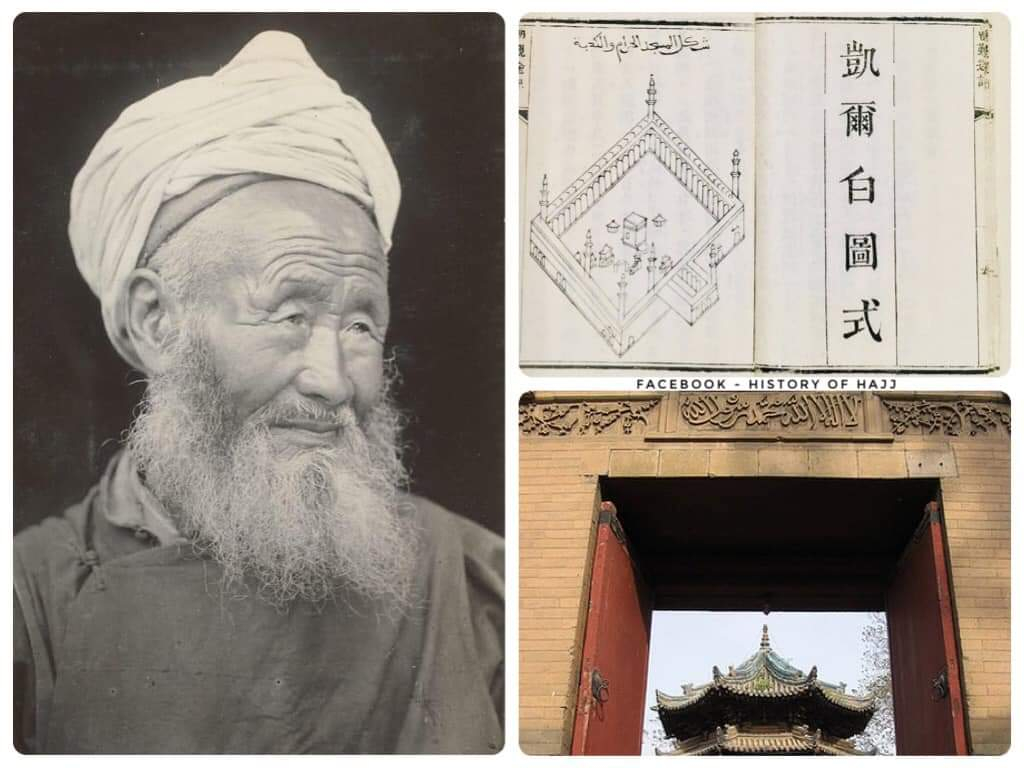
  • Yusuf Ma Dexin, a Hui Chinese Hanafi-Maturidi scholar from Yunnan, was known for his expertise in Arabic and Persian languages and profound understanding of Islam. He was also known as Ma Fuchu in Chinese.

    In 1841, Yusuf Ma embarked on the Hajj pilgrimage, his departure from China caused disruptions due to the First Opium War. He accompanied a contingent of Muslim merchants who traveled overland, crossing the Sipsong Panna and then a riverboat journey along the Irrawaddy River. They were allowed to embark on a vessel from Yangon, which took them to the Arabian Peninsula.

    After performing Hajj and visiting holy cities of Makkah and Madina, Yusuf Ma remained in the Middle East for eight years. He studied at al-Azhar University in Cairo and explored the Ottoman Empire, visiting cities like Suez, Alexandria, Jerusalem, Istanbul, Cyprus, and Rhodes. He died in 1874.

    Below is a portrait of Yusuf Ma Dexin, and a Chinese book shows - Shakl Masjid-AlHaram AlKaba.
    #ChineseMuslim #islaminchina #historyofhajj #HajjPilgrims
    Yusuf Ma Dexin, a Hui Chinese Hanafi-Maturidi scholar from Yunnan, was known for his expertise in Arabic and Persian languages and profound understanding of Islam. He was also known as Ma Fuchu in Chinese. In 1841, Yusuf Ma embarked on the Hajj pilgrimage, his departure from China caused disruptions due to the First Opium War. He accompanied a contingent of Muslim merchants who traveled overland, crossing the Sipsong Panna and then a riverboat journey along the Irrawaddy River. They were allowed to embark on a vessel from Yangon, which took them to the Arabian Peninsula. After performing Hajj and visiting holy cities of Makkah and Madina, Yusuf Ma remained in the Middle East for eight years. He studied at al-Azhar University in Cairo and explored the Ottoman Empire, visiting cities like Suez, Alexandria, Jerusalem, Istanbul, Cyprus, and Rhodes. He died in 1874. Below is a portrait of Yusuf Ma Dexin, and a Chinese book shows - Shakl Masjid-AlHaram AlKaba. #ChineseMuslim #islaminchina #historyofhajj #HajjPilgrims
    0 التعليقات 0 نشر
  • The Damascus to Medina section of the Ottoman railway network was initially intended to connect Istanbul and Hejaz, the Islamic holy city of Mecca, but construction was interrupted by World War I, reaching only Medina 400 kilometers short of Mecca. The railway aimed to improve economic and political integration of Arabian provinces into the Ottoman state and facilitate military transportation. The completed Damascus to Medina section was 1,300 kilometers (810 miles) long. The railway was a significant part of the Ottoman Empire's railway network.

    Below is an old photo of the Hejaz railways.
    The Damascus to Medina section of the Ottoman railway network was initially intended to connect Istanbul and Hejaz, the Islamic holy city of Mecca, but construction was interrupted by World War I, reaching only Medina 400 kilometers short of Mecca. The railway aimed to improve economic and political integration of Arabian provinces into the Ottoman state and facilitate military transportation. The completed Damascus to Medina section was 1,300 kilometers (810 miles) long. The railway was a significant part of the Ottoman Empire's railway network. Below is an old photo of the Hejaz railways.
    0 التعليقات 0 نشر
  • The Dar al-Hajar (Stone House" or "Rock Palace") is a former royal palace located in Wadi Dhar about 15 kilometres (9.3 mi) from Sana'a, Yemen. The palace stayed in the royal family.

    In 1974, Pier Paolo Pasolini used the palace as the home of Princess Dunya in his film The Arabian Nights.
    The Dar al-Hajar (Stone House" or "Rock Palace") is a former royal palace located in Wadi Dhar about 15 kilometres (9.3 mi) from Sana'a, Yemen. The palace stayed in the royal family. In 1974, Pier Paolo Pasolini used the palace as the home of Princess Dunya in his film The Arabian Nights.
    0 التعليقات 0 نشر
  • Brazil superstar Neymar has signed for Al Hilal from Paris Saint-Germain in one of the most high-profile transfers in Saudi Arabian football history.

    The forward, his country’s all-time joint-leading goalscorer alongside Pele, was confirmed as Hilal’s latest recruit on Tuesday night having agreed to the move from PSG.

    Neymar, who joins on a two-year contract, was presented at a signing ceremony in Paris alongside Hilal club president Fahad bin Nafel. The reported transfer fee is €90 million ($98.5m).
    Brazil superstar Neymar has signed for Al Hilal from Paris Saint-Germain in one of the most high-profile transfers in Saudi Arabian football history. The forward, his country’s all-time joint-leading goalscorer alongside Pele, was confirmed as Hilal’s latest recruit on Tuesday night having agreed to the move from PSG. Neymar, who joins on a two-year contract, was presented at a signing ceremony in Paris alongside Hilal club president Fahad bin Nafel. The reported transfer fee is €90 million ($98.5m).
    0 التعليقات 0 نشر
  • "The empire's success lay in its centralized structure as much as its territory: Control of some of the world's most lucrative trade routes led to vast wealth, while its impeccably organized military system led to military might."
    (National Geographic)

    "The Ottoman Empire was an imperial state that was founded in 1299 after growing out of the breakdown of several Turkish tribes. The empire then grew to include many areas in what is now present-day Europe. It eventually became one of the largest, most powerful and longest-lasting empires in the history of the world. At its peak, the Ottoman Empire included the areas of Turkey, Egypt, Greece, Bulgaria, Romania, Macedonia, Hungary, Israel, Jordan, Lebanon, Syria, and parts of the Arabian Peninsula and North Africa. It had a maximum area of 7.6 million square miles (19.9 million square kilometers) in 1595. The Ottoman Empire began to decline in the 18th century, but a portion of its land became what is now Turkey."
    "The empire's success lay in its centralized structure as much as its territory: Control of some of the world's most lucrative trade routes led to vast wealth, while its impeccably organized military system led to military might." (National Geographic) "The Ottoman Empire was an imperial state that was founded in 1299 after growing out of the breakdown of several Turkish tribes. The empire then grew to include many areas in what is now present-day Europe. It eventually became one of the largest, most powerful and longest-lasting empires in the history of the world. At its peak, the Ottoman Empire included the areas of Turkey, Egypt, Greece, Bulgaria, Romania, Macedonia, Hungary, Israel, Jordan, Lebanon, Syria, and parts of the Arabian Peninsula and North Africa. It had a maximum area of 7.6 million square miles (19.9 million square kilometers) in 1595. The Ottoman Empire began to decline in the 18th century, but a portion of its land became what is now Turkey."
    0 التعليقات 0 نشر
  • President Recep Tayyip Erdoğan gifts Turkiye's first domestically produced electric car 'Togg' to Saudi Arabian Crown Prince Mohammed bin Salman.
    President Recep Tayyip Erdoğan gifts Turkiye's first domestically produced electric car 'Togg' to Saudi Arabian Crown Prince Mohammed bin Salman.
    0 التعليقات 0 نشر
  • THE ABYSSINIAN PEOPLE

    The Abyssinian people are also one of the strongest warrior tribes in Africa.
    They are politically and culturally a dominated group in Ethiopia and Eritrea. They are the lingua franca of both countries. Their military history dates back to the Axum period where they conquered and colonized the southern Arabians.

    They are a powerful mountainous people and with their perfect terrain, they were able to resist most invasions successfully and have a long history of their successful warfare skills.

    #History101 Blue Print Health Ghana #africa
    THE ABYSSINIAN PEOPLE The Abyssinian people are also one of the strongest warrior tribes in Africa. They are politically and culturally a dominated group in Ethiopia and Eritrea. They are the lingua franca of both countries. Their military history dates back to the Axum period where they conquered and colonized the southern Arabians. They are a powerful mountainous people and with their perfect terrain, they were able to resist most invasions successfully and have a long history of their successful warfare skills. #History101 Blue Print Health Ghana #africa
    0 التعليقات 0 نشر
الصفحات المعززة