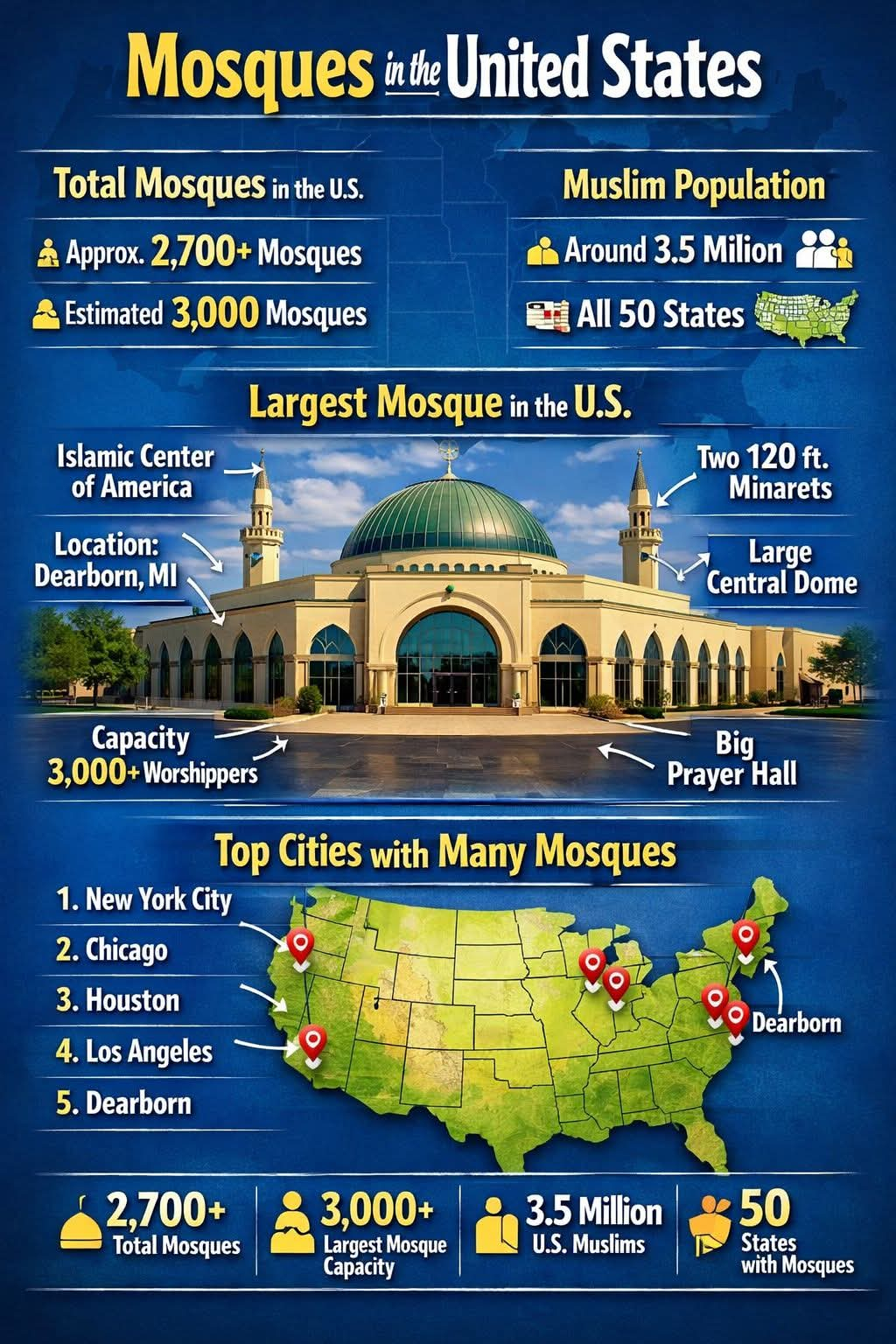
• The United States has a growing Muslim community and thousands of mosques spread across the country. According to research by the Institute for Social Policy and Understanding, there are approximately 2,700 to 3,000 mosques in America today. These mosques serve as places for daily prayers, Friday congregational prayers, Islamic education, and community activities. Over the past few decades, the number of mosques has increased significantly due to the rising Muslim population and immigration from different parts of the world.
    The Muslim population in the United States is estimated to be around 3.5 million people. Muslims in America come from diverse ethnic backgrounds including Arabs, South Asians, African Americans, Turks, and Africans. Because of this diversity, many mosques also function as cultural and community centers where people gather for religious learning, charity work, and social support.
    One of the largest and most well-known mosques in the country is the Islamic Center of America, located in Dearborn, Michigan. This mosque is famous for its beautiful architecture, large central dome, and tall minarets. It can accommodate more than 3,000 worshippers at a time and is considered one of the biggest Islamic centers in North America.
    Major cities such as New York City, Chicago, Houston, and Los Angeles have many mosques because they have large Muslim populations. These mosques play an important role in maintaining religious identity, promoting community unity, and supporting charitable and educational activities throughout the United States.
    The United States has a growing Muslim community and thousands of mosques spread across the country. According to research by the Institute for Social Policy and Understanding, there are approximately 2,700 to 3,000 mosques in America today. These mosques serve as places for daily prayers, Friday congregational prayers, Islamic education, and community activities. Over the past few decades, the number of mosques has increased significantly due to the rising Muslim population and immigration from different parts of the world. The Muslim population in the United States is estimated to be around 3.5 million people. Muslims in America come from diverse ethnic backgrounds including Arabs, South Asians, African Americans, Turks, and Africans. Because of this diversity, many mosques also function as cultural and community centers where people gather for religious learning, charity work, and social support. One of the largest and most well-known mosques in the country is the Islamic Center of America, located in Dearborn, Michigan. This mosque is famous for its beautiful architecture, large central dome, and tall minarets. It can accommodate more than 3,000 worshippers at a time and is considered one of the biggest Islamic centers in North America. Major cities such as New York City, Chicago, Houston, and Los Angeles have many mosques because they have large Muslim populations. These mosques play an important role in maintaining religious identity, promoting community unity, and supporting charitable and educational activities throughout the United States.
    0 Комментарии 0 Поделились
  • The Şemsi Pasha Mosque in Turkey features a stained glass window designed by Ottoman architect Mimar Sinan in 1581 for Grand Vizier Şemsi Pasha.
    The Şemsi Pasha Mosque in Turkey features a stained glass window designed by Ottoman architect Mimar Sinan in 1581 for Grand Vizier Şemsi Pasha.
    0 Комментарии 0 Поделились
  • A Gaza-focused meeting in New York brought together US President Donald Trump, Turkish President Recep Tayyip Erdogan, and other Muslim leaders in the region on the sidelines of the UN General Assembly.

    The closed-door talks concluded, with the details yet to be shared. Erdogan described the meeting as “very productive and positive,” Trump called it as “very successful.”

    https://trt.world/cn4h

    #PalestinesVoiceErdogan
    A Gaza-focused meeting in New York brought together US President Donald Trump, Turkish President Recep Tayyip Erdogan, and other Muslim leaders in the region on the sidelines of the UN General Assembly. The closed-door talks concluded, with the details yet to be shared. Erdogan described the meeting as “very productive and positive,” Trump called it as “very successful.” 🔗 https://trt.world/cn4h #PalestinesVoiceErdogan
    0 Комментарии 0 Поделились
  • A Journey in Abraham's Footsteps – The Way Forward – Harran, the City of Stars

    “In the twilight of time, when the stars still spoke to men and the mountains bore names, Abraham was born – he who would become the father of faith for the people who followed the Scripture, the Cross and the Crescent. His name wandered through the desert winds, carried by Turki storytellers who gathered around the hearths in the heart of Mesopotamia.

    “Listen, you who wander. For the wind of Harran carries old words, and the stars there still speak to those who dare to listen.”

    It is said that when Abraham left Urfa, it was not with a light heart. Behind him lay the miracle of fire, the fish in flames, and the wrath of King Nemrut. But before him – unknown land, and a sky that whispered.

    He wandered south, through dust and time, until he came to Harran – the city where the stars live. Here, the ancients say, he sat down on a stone by a dry well. He raised his eyes, and the night opened like a veil.

    “First he saw the sun – great and burning. ‘This must be God,’ he said. But the sun sank behind the mountains, and darkness came.”
    “Then he saw the moon – bright and gentle. ‘This must be God,’ he said. But the moon waned, and the stars took its place.”
    “Finally he saw the stars – a thousand lights, a thousand promises. And he said: ‘No… God is not the one who sets. God is the one who created all this.’”

    And the stars are said to have answered him. Not with words, but with light. They danced over Harran, and one of them fell – as a sign. Abraham stood up, knowing: The way forward was not his alone. It was for all who seek.

    Harran – where the stars still speak

    Today you can follow in Abraham’s footsteps in Harran, Turkey. See the ancient beehive houses, built like small temples to the sky. Explore the ruins of temples and towers, where the stars were once worshipped. Harran is mentioned in both the Bible and the Quran – as a place where faith took shape.

    When night falls over plains and rocks, and you stand there alone under the sky, you can hear it:
    “God is not in what sets. God is in what endures.”

    Have you visited Harran? Or is it something you dream about?
    🧵 A Journey in Abraham's Footsteps – The Way Forward – Harran, the City of Stars “In the twilight of time, when the stars still spoke to men and the mountains bore names, Abraham was born – he who would become the father of faith for the people who followed the Scripture, the Cross and the Crescent. His name wandered through the desert winds, carried by Turki storytellers who gathered around the hearths in the heart of Mesopotamia. 🔥 “Listen, you who wander. For the wind of Harran carries old words, and the stars there still speak to those who dare to listen.” It is said that when Abraham left Urfa, it was not with a light heart. Behind him lay the miracle of fire, the fish in flames, and the wrath of King Nemrut. But before him – unknown land, and a sky that whispered. He wandered south, through dust and time, until he came to Harran – the city where the stars live. Here, the ancients say, he sat down on a stone by a dry well. He raised his eyes, and the night opened like a veil. 🌌 “First he saw the sun – great and burning. ‘This must be God,’ he said. But the sun sank behind the mountains, and darkness came.” 🌙 “Then he saw the moon – bright and gentle. ‘This must be God,’ he said. But the moon waned, and the stars took its place.” ✨ “Finally he saw the stars – a thousand lights, a thousand promises. And he said: ‘No… God is not the one who sets. God is the one who created all this.’” And the stars are said to have answered him. Not with words, but with light. They danced over Harran, and one of them fell – as a sign. Abraham stood up, knowing: The way forward was not his alone. It was for all who seek. 🧭 Harran – where the stars still speak 📍 Today you can follow in Abraham’s footsteps in Harran, Turkey. See the ancient beehive houses, built like small temples to the sky. Explore the ruins of temples and towers, where the stars were once worshipped. Harran is mentioned in both the Bible and the Quran – as a place where faith took shape. When night falls over plains and rocks, and you stand there alone under the sky, you can hear it: 🌬️ “God is not in what sets. God is in what endures.” Have you visited Harran? Or is it something you dream about?
    0 Комментарии 0 Поделились
  • Balıklıgöl is a culturally and spiritually significant site that reflects the rich heritage of Şanlıurfa.
    With its peaceful setting and centuries-old symbolism, it remains a place of reflection and respect.

    Learn more at:
    sanliurfa.goturkiye.com

    IG: arifbiradam

    #GoTürkiye #GoŞanlıurfa #Balıklıgöl #Şanlıurfa #GoSustainable
    Balıklıgöl is a culturally and spiritually significant site that reflects the rich heritage of Şanlıurfa. With its peaceful setting and centuries-old symbolism, it remains a place of reflection and respect. Learn more at: sanliurfa.goturkiye.com 📸 IG: arifbiradam #GoTürkiye #GoŞanlıurfa #Balıklıgöl #Şanlıurfa #GoSustainable
    0 Комментарии 0 Поделились
  • Alhamdulillah?
    Yes… but with a heavy heart.
    These are not just pictures,these are stories of pain,survival,and resilience.

    People of Gaza carrying their lives on their shoulders,leaving behind the rubble of their homes,the graves of their loved ones,and dreams shattered by war.

    They’ve lost everything yet still say Alhamdulillah with faith that moves mountains.

    May Allah give them strength,patience,and freedom from oppression.

    We may sleep peacefully, but they walk miles for water,bread,and safety.

    Ya Allah,ease their suffering.Protect Gaza. Heal their wounds.Ameen.
    Alhamdulillah? Yes… but with a heavy heart. These are not just pictures,these are stories of pain,survival,and resilience. People of Gaza carrying their lives on their shoulders,leaving behind the rubble of their homes,the graves of their loved ones,and dreams shattered by war. 💔 They’ve lost everything yet still say Alhamdulillah with faith that moves mountains. May Allah give them strength,patience,and freedom from oppression. We may sleep peacefully, but they walk miles for water,bread,and safety. Ya Allah,ease their suffering.Protect Gaza. Heal their wounds.Ameen. 🤲
    0 Комментарии 0 Поделились
  • The Mosque of the Faculty of Theology at Marmara University
    #Türkiye
    Looking for a unique place to visit? The Marmara University Faculty of Theology Mosque fascinates visitors with its architectural details.

    The new-gen mosque is in fact a complex, composed of study rooms, exhibition areas, a book cafe, a conference hall, and more.

    The star of the show is the mosque’s marvellous dome, representing the rotating movement essential to our universe.

    Explore more on our official İstanbul page:

    #GoTürkiye #Goİstanbul #İstanbul #Mosque #FaithTürkiye #Faith #Architecture
    The Mosque of the Faculty of Theology at Marmara University 📍#Türkiye Looking for a unique place to visit? The Marmara University Faculty of Theology Mosque fascinates visitors with its architectural details. The new-gen mosque is in fact a complex, composed of study rooms, exhibition areas, a book cafe, a conference hall, and more. The star of the show is the mosque’s marvellous dome, representing the rotating movement essential to our universe. Explore more on our official İstanbul page: #GoTürkiye #Goİstanbul #İstanbul #Mosque #FaithTürkiye #Faith #Architecture
    0 Комментарии 0 Поделились
  • Eid Prayer at Fayfa Mountain.

    : https://bit.ly/3AqB8r8
    Eid Prayer at Fayfa Mountain. 📍: https://bit.ly/3AqB8r8
    0 Комментарии 0 Поделились

  • Türkish Traditional Clothes-Bindallı..!
    Henna night(Kına Gecesi) is a tradition that dates back to ancient times and still maintains its popularity since the first day, held to celebrate the last night our türkic girls will spend at their homes before getting married and to say goodbye to their families.
    The most important moments of this special night are those emotional moments when the henna is applied and our loved ones sing songs around us.During these special moments, our brides wear colorful, patterned bindalli.
    🐺🦅🤘 Türkish Traditional Clothes-Bindallı..! Henna night(Kına Gecesi) is a tradition that dates back to ancient times and still maintains its popularity since the first day, held to celebrate the last night our türkic girls will spend at their homes before getting married and to say goodbye to their families. The most important moments of this special night are those emotional moments when the henna is applied and our loved ones sing songs around us.During these special moments, our brides wear colorful, patterned bindalli.
    1
    0 Комментарии 0 Поделились
  • #Turkey is located at the crossroads of Asia and Europe. It is bordered by Greece and Bulgaria to the northwest, the Black Sea to the north, Georgia to the northeast, Armenia, the Azerbaijani exclave of Nakhchivan, and Iran to the east, Iraq to the southeast, Syria and the Mediterranean Sea to the south, and the Aegean Sea to the west.
    Area: 783,562 square kilometers.
    Topography: Includes the Taurus Mountains in the south, the Pontic Mountains in the north, fertile plains like the Anatolian Plain, and the Central Anatolian Plateau, along with lakes such as Lake Van.
    Water Bodies: Borders four major seas: the Black Sea, the Sea of Marmara, the Aegean Sea, and the Mediterranean Sea.
    2. Climate:
    Coastal Areas:
    Mediterranean and Aegean Coasts: Mediterranean climate with hot, dry summers and mild, wet winters.
    Black Sea Coast: Moderate and humid climate year-round.
    Inland Regions: Continental climate with hot, dry summers and very cold, snowy winters.
    Climate Change: Turkey faces challenges like drought and rising temperatures due to climate change.
    3. Population:
    Population Size: Approximately 84.5 million (2021).
    Population Distribution: Istanbul is the largest city with over 15.5 million residents. Ankara is the second largest, followed by Izmir, Bursa, and Antalya.
    Ethnic Diversity: Predominantly Turks, with a significant Kurdish minority, and smaller Armenian, Arab, and Greek communities.
    Population Growth: About 1.2% annually.
    4. Economy:
    GDP: Approximately $7.209 trillion in 2021.
    Exports: Includes agricultural products, automobiles, textiles, and electronics, valued at $225 billion.
    Imports: Mainly energy and raw materials, totaling $271 billion.
    Unemployment Rate: Around 10.3%.
    Agriculture and Industry: Notable for wheat, hazelnuts, and olives, as well as being a leading producer of automobiles and steel.
    5. Currency:
    The official currency is the Turkish Lira (TRY), which experiences fluctuations in value against foreign currencies.
    6. Tourism:
    Visitor Numbers: Turkey welcomed around 30 million tourists in 2021.
    Revenue: Approximately $24.5 billion.
    Top Destinations:
    Istanbul: Iconic landmarks like Hagia Sophia, the Blue Mosque, and Topkapi Palace.
    Antalya: A hub for coastal tourism.
    Cappadocia: Known for its unique landscapes and hot air balloons.
    Historical Sites: Ephesus and Troy.
    7. History:
    Civilizations: Turkey has been home to various civilizations, including the Hittites, Persians, Romans, and Byzantines.
    Ottoman Era: Spanned from the 14th century to the early 20th century.
    Modern Republic: Established in 1923 under Mustafa Kemal Atatürk, who moved the capital to Ankara and initiated widespread reforms.
    8. Education:
    Education System: Mandatory for 12 years (6 years primary, 3 years middle, 3 years secondary).
    Higher Education: Home to numerous universities, including Istanbul University and Middle East Technical University.
    Literacy Rate: Approximately 96%.
    9. Healthcare:
    Healthcare System: Turkey has a well-developed healthcare system encompassing public and private sectors.
    Medical Tourism: A popular destination for medical and cosmetic treatments, attracting thousands of patients annually.
    Hospitals: Equipped with state-of-the-art medical technology.
    10. Culture:
    Official Language: Turkish.
    Religion: Islam is the predominant religion, with Christian and Jewish minorities.
    Traditions: A blend of Eastern and Western cultural influences.
    Turkey serves as a bridge between East and West, with a rich history and modern development.
    #Turkey is located at the crossroads of Asia and Europe. It is bordered by Greece and Bulgaria to the northwest, the Black Sea to the north, Georgia to the northeast, Armenia, the Azerbaijani exclave of Nakhchivan, and Iran to the east, Iraq to the southeast, Syria and the Mediterranean Sea to the south, and the Aegean Sea to the west. Area: 783,562 square kilometers. Topography: Includes the Taurus Mountains in the south, the Pontic Mountains in the north, fertile plains like the Anatolian Plain, and the Central Anatolian Plateau, along with lakes such as Lake Van. Water Bodies: Borders four major seas: the Black Sea, the Sea of Marmara, the Aegean Sea, and the Mediterranean Sea. 🌐 2. Climate: Coastal Areas: Mediterranean and Aegean Coasts: Mediterranean climate with hot, dry summers and mild, wet winters. Black Sea Coast: Moderate and humid climate year-round. Inland Regions: Continental climate with hot, dry summers and very cold, snowy winters. Climate Change: Turkey faces challenges like drought and rising temperatures due to climate change. 🌐 3. Population: Population Size: Approximately 84.5 million (2021). Population Distribution: Istanbul is the largest city with over 15.5 million residents. Ankara is the second largest, followed by Izmir, Bursa, and Antalya. Ethnic Diversity: Predominantly Turks, with a significant Kurdish minority, and smaller Armenian, Arab, and Greek communities. Population Growth: About 1.2% annually. 🌐 4. Economy: GDP: Approximately $7.209 trillion in 2021. Exports: Includes agricultural products, automobiles, textiles, and electronics, valued at $225 billion. Imports: Mainly energy and raw materials, totaling $271 billion. Unemployment Rate: Around 10.3%. Agriculture and Industry: Notable for wheat, hazelnuts, and olives, as well as being a leading producer of automobiles and steel. 🌐 5. Currency: The official currency is the Turkish Lira (TRY), which experiences fluctuations in value against foreign currencies. 🌐 6. Tourism: Visitor Numbers: Turkey welcomed around 30 million tourists in 2021. Revenue: Approximately $24.5 billion. Top Destinations: Istanbul: Iconic landmarks like Hagia Sophia, the Blue Mosque, and Topkapi Palace. Antalya: A hub for coastal tourism. Cappadocia: Known for its unique landscapes and hot air balloons. Historical Sites: Ephesus and Troy. 🌐 7. History: Civilizations: Turkey has been home to various civilizations, including the Hittites, Persians, Romans, and Byzantines. Ottoman Era: Spanned from the 14th century to the early 20th century. Modern Republic: Established in 1923 under Mustafa Kemal Atatürk, who moved the capital to Ankara and initiated widespread reforms. 🌐 8. Education: Education System: Mandatory for 12 years (6 years primary, 3 years middle, 3 years secondary). Higher Education: Home to numerous universities, including Istanbul University and Middle East Technical University. Literacy Rate: Approximately 96%. 🌐 9. Healthcare: Healthcare System: Turkey has a well-developed healthcare system encompassing public and private sectors. Medical Tourism: A popular destination for medical and cosmetic treatments, attracting thousands of patients annually. Hospitals: Equipped with state-of-the-art medical technology. 🌐 10. Culture: Official Language: Turkish. Religion: Islam is the predominant religion, with Christian and Jewish minorities. Traditions: A blend of Eastern and Western cultural influences. Turkey serves as a bridge between East and West, with a rich history and modern development.
    0 Комментарии 0 Поделились
Расширенные страницы