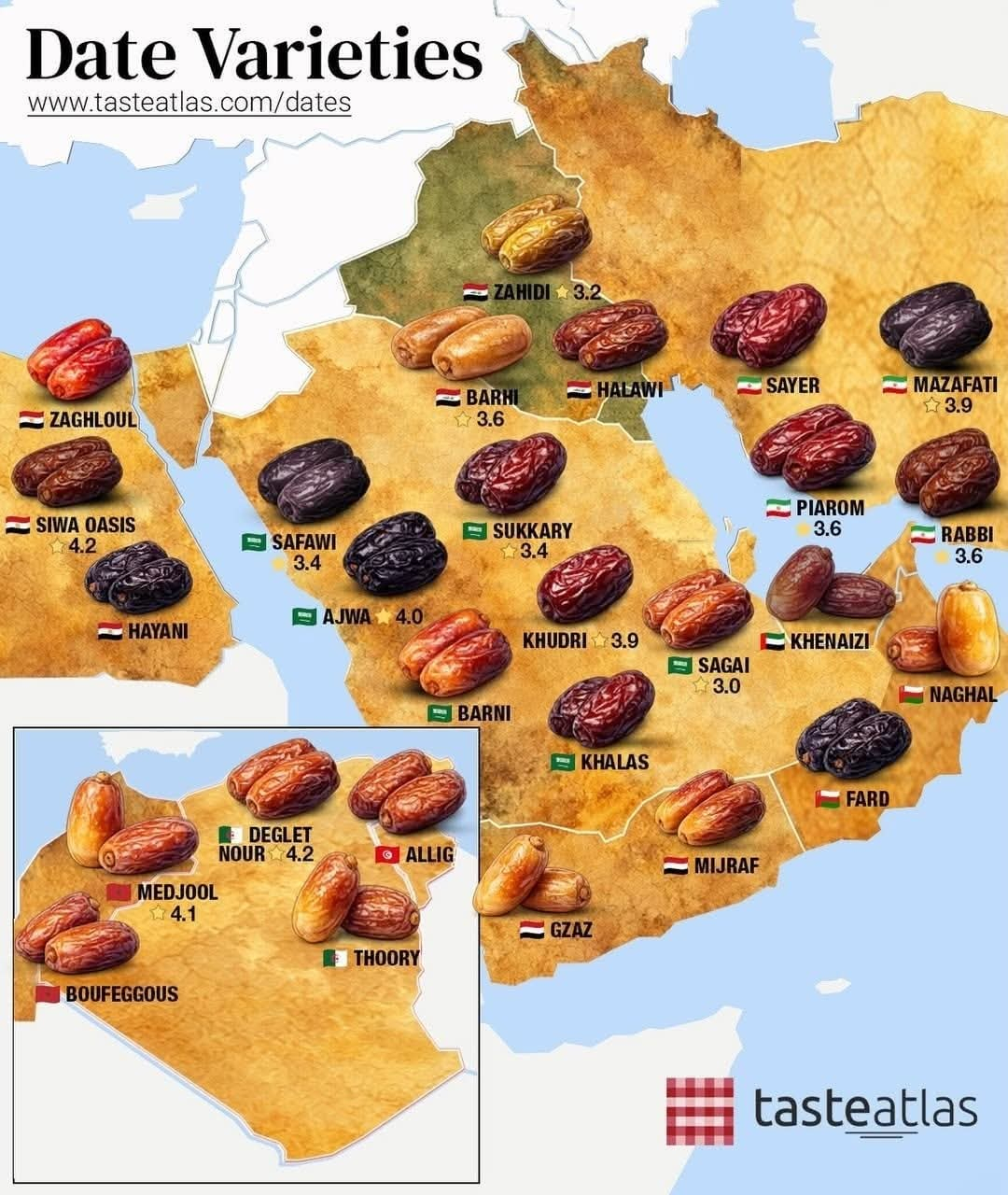
• From the plush, caramel-rich Medjool of Morocco to the firm, nutty Deglet Noor of Algeria and the dark, “holy” Ajwa of Medina, the Middle East and North Africa offer hundreds of distinct date types that vary wildly in taste and texture. From syrupy and soft to dry and bread-like, each serving a specific purpose whether enjoyed as a fresh snack, a natural sweetener in baking, or a traditional gift. More than just a superfruit, dates are a vital cultural cornerstone and a “desert staple” that have provided essential nutrition, hospitality, and spiritual significance to the region for millennia.

    Ramadan is so close. May Allah allow Us to reach it in good health
    From the plush, caramel-rich Medjool of Morocco to the firm, nutty Deglet Noor of Algeria and the dark, “holy” Ajwa of Medina, the Middle East and North Africa offer hundreds of distinct date types that vary wildly in taste and texture. From syrupy and soft to dry and bread-like, each serving a specific purpose whether enjoyed as a fresh snack, a natural sweetener in baking, or a traditional gift. More than just a superfruit, dates are a vital cultural cornerstone and a “desert staple” that have provided essential nutrition, hospitality, and spiritual significance to the region for millennia. Ramadan is so close. May Allah allow Us to reach it in good health
    0 Commenti 0 condivisioni
  • #Turkey is located at the crossroads of Asia and Europe. It is bordered by Greece and Bulgaria to the northwest, the Black Sea to the north, Georgia to the northeast, Armenia, the Azerbaijani exclave of Nakhchivan, and Iran to the east, Iraq to the southeast, Syria and the Mediterranean Sea to the south, and the Aegean Sea to the west.
    Area: 783,562 square kilometers.
    Topography: Includes the Taurus Mountains in the south, the Pontic Mountains in the north, fertile plains like the Anatolian Plain, and the Central Anatolian Plateau, along with lakes such as Lake Van.
    Water Bodies: Borders four major seas: the Black Sea, the Sea of Marmara, the Aegean Sea, and the Mediterranean Sea.
    2. Climate:
    Coastal Areas:
    Mediterranean and Aegean Coasts: Mediterranean climate with hot, dry summers and mild, wet winters.
    Black Sea Coast: Moderate and humid climate year-round.
    Inland Regions: Continental climate with hot, dry summers and very cold, snowy winters.
    Climate Change: Turkey faces challenges like drought and rising temperatures due to climate change.
    3. Population:
    Population Size: Approximately 84.5 million (2021).
    Population Distribution: Istanbul is the largest city with over 15.5 million residents. Ankara is the second largest, followed by Izmir, Bursa, and Antalya.
    Ethnic Diversity: Predominantly Turks, with a significant Kurdish minority, and smaller Armenian, Arab, and Greek communities.
    Population Growth: About 1.2% annually.
    4. Economy:
    GDP: Approximately $7.209 trillion in 2021.
    Exports: Includes agricultural products, automobiles, textiles, and electronics, valued at $225 billion.
    Imports: Mainly energy and raw materials, totaling $271 billion.
    Unemployment Rate: Around 10.3%.
    Agriculture and Industry: Notable for wheat, hazelnuts, and olives, as well as being a leading producer of automobiles and steel.
    5. Currency:
    The official currency is the Turkish Lira (TRY), which experiences fluctuations in value against foreign currencies.
    6. Tourism:
    Visitor Numbers: Turkey welcomed around 30 million tourists in 2021.
    Revenue: Approximately $24.5 billion.
    Top Destinations:
    Istanbul: Iconic landmarks like Hagia Sophia, the Blue Mosque, and Topkapi Palace.
    Antalya: A hub for coastal tourism.
    Cappadocia: Known for its unique landscapes and hot air balloons.
    Historical Sites: Ephesus and Troy.
    7. History:
    Civilizations: Turkey has been home to various civilizations, including the Hittites, Persians, Romans, and Byzantines.
    Ottoman Era: Spanned from the 14th century to the early 20th century.
    Modern Republic: Established in 1923 under Mustafa Kemal Atatürk, who moved the capital to Ankara and initiated widespread reforms.
    8. Education:
    Education System: Mandatory for 12 years (6 years primary, 3 years middle, 3 years secondary).
    Higher Education: Home to numerous universities, including Istanbul University and Middle East Technical University.
    Literacy Rate: Approximately 96%.
    9. Healthcare:
    Healthcare System: Turkey has a well-developed healthcare system encompassing public and private sectors.
    Medical Tourism: A popular destination for medical and cosmetic treatments, attracting thousands of patients annually.
    Hospitals: Equipped with state-of-the-art medical technology.
    10. Culture:
    Official Language: Turkish.
    Religion: Islam is the predominant religion, with Christian and Jewish minorities.
    Traditions: A blend of Eastern and Western cultural influences.
    Turkey serves as a bridge between East and West, with a rich history and modern development.
    #Turkey is located at the crossroads of Asia and Europe. It is bordered by Greece and Bulgaria to the northwest, the Black Sea to the north, Georgia to the northeast, Armenia, the Azerbaijani exclave of Nakhchivan, and Iran to the east, Iraq to the southeast, Syria and the Mediterranean Sea to the south, and the Aegean Sea to the west. Area: 783,562 square kilometers. Topography: Includes the Taurus Mountains in the south, the Pontic Mountains in the north, fertile plains like the Anatolian Plain, and the Central Anatolian Plateau, along with lakes such as Lake Van. Water Bodies: Borders four major seas: the Black Sea, the Sea of Marmara, the Aegean Sea, and the Mediterranean Sea. ๐ŸŒ 2. Climate: Coastal Areas: Mediterranean and Aegean Coasts: Mediterranean climate with hot, dry summers and mild, wet winters. Black Sea Coast: Moderate and humid climate year-round. Inland Regions: Continental climate with hot, dry summers and very cold, snowy winters. Climate Change: Turkey faces challenges like drought and rising temperatures due to climate change. ๐ŸŒ 3. Population: Population Size: Approximately 84.5 million (2021). Population Distribution: Istanbul is the largest city with over 15.5 million residents. Ankara is the second largest, followed by Izmir, Bursa, and Antalya. Ethnic Diversity: Predominantly Turks, with a significant Kurdish minority, and smaller Armenian, Arab, and Greek communities. Population Growth: About 1.2% annually. ๐ŸŒ 4. Economy: GDP: Approximately $7.209 trillion in 2021. Exports: Includes agricultural products, automobiles, textiles, and electronics, valued at $225 billion. Imports: Mainly energy and raw materials, totaling $271 billion. Unemployment Rate: Around 10.3%. Agriculture and Industry: Notable for wheat, hazelnuts, and olives, as well as being a leading producer of automobiles and steel. ๐ŸŒ 5. Currency: The official currency is the Turkish Lira (TRY), which experiences fluctuations in value against foreign currencies. ๐ŸŒ 6. Tourism: Visitor Numbers: Turkey welcomed around 30 million tourists in 2021. Revenue: Approximately $24.5 billion. Top Destinations: Istanbul: Iconic landmarks like Hagia Sophia, the Blue Mosque, and Topkapi Palace. Antalya: A hub for coastal tourism. Cappadocia: Known for its unique landscapes and hot air balloons. Historical Sites: Ephesus and Troy. ๐ŸŒ 7. History: Civilizations: Turkey has been home to various civilizations, including the Hittites, Persians, Romans, and Byzantines. Ottoman Era: Spanned from the 14th century to the early 20th century. Modern Republic: Established in 1923 under Mustafa Kemal Atatürk, who moved the capital to Ankara and initiated widespread reforms. ๐ŸŒ 8. Education: Education System: Mandatory for 12 years (6 years primary, 3 years middle, 3 years secondary). Higher Education: Home to numerous universities, including Istanbul University and Middle East Technical University. Literacy Rate: Approximately 96%. ๐ŸŒ 9. Healthcare: Healthcare System: Turkey has a well-developed healthcare system encompassing public and private sectors. Medical Tourism: A popular destination for medical and cosmetic treatments, attracting thousands of patients annually. Hospitals: Equipped with state-of-the-art medical technology. ๐ŸŒ 10. Culture: Official Language: Turkish. Religion: Islam is the predominant religion, with Christian and Jewish minorities. Traditions: A blend of Eastern and Western cultural influences. Turkey serves as a bridge between East and West, with a rich history and modern development.
    0 Commenti 0 condivisioni
  • Two years into one of the world’s deadliest — and most underreported — conflicts, Sudan is being torn apart.

    Fighting between the Sudanese army and paramilitary RSF has turned cities into graveyards. Bodies lie unburied. Hospitals are in ruins. Entire towns have been emptied.

    About 30% of Sudan’s population have fled their homes.

    Aid groups warn the real death toll could be far higher than reported — many areas are inaccessible, and communication blackouts hide the full scale of atrocities.

    The brutality is clear, but what we know may only scratch the surface.
    Two years into one of the world’s deadliest — and most underreported — conflicts, Sudan is being torn apart. Fighting between the Sudanese army and paramilitary RSF has turned cities into graveyards. Bodies lie unburied. Hospitals are in ruins. Entire towns have been emptied. About 30% of Sudan’s population have fled their homes. Aid groups warn the real death toll could be far higher than reported — many areas are inaccessible, and communication blackouts hide the full scale of atrocities. The brutality is clear, but what we know may only scratch the surface.
    1
    0 Commenti 0 condivisioni
  • Health ministry in Gaza says de*th toll surpasses 50,000+ k*lled by Israeli airstrikes

    Gaza is in need of immediate aid and medical supplies. @pennyappealca is working with partners on the ground to provide necessary aid and supplies to hospitals across the strip.

    Tonight is the 27th night of Ramadan and maybe Laylat Al Qadr, you can maximize your blessings with your donation today. ‍

    #muslim #islam #ramadan
    Health ministry in Gaza says de*th toll surpasses 50,000+ k*lled by Israeli airstrikes ๐Ÿ’” Gaza is in need of immediate aid and medical supplies. @pennyappealca is working with partners on the ground to provide necessary aid and supplies to hospitals across the strip. Tonight is the 27th night of Ramadan and maybe Laylat Al Qadr, you can maximize your blessings with your donation today. โค๏ธ‍๐Ÿฉน #muslim #islam #ramadan
    1
    0 Commenti 0 condivisioni
  • At least 210 Palestinians were killed and over 400 others injured by Israeli forces after they targeted the Nuseirat refugee camp in central Gaza on June 8, according to the Government Media Office in the besieged Palestinian enclave.

    The injured were transported to Al Aqsa Martyrs Hospital, which the media office said was “unable to accommodate the number of martyrs and injured due to the Israeli bombardment”.

    Eyewitnesses told Anadolu Agency that Israeli artillery and warplanes have been conducting violent and intense raids for hours on areas east of Deir al Balah, al Bureij and al Maghazi camps, as well as various locations in the centre, west, and east of the Nuseirat camp.
    At least 210 Palestinians were killed and over 400 others injured by Israeli forces after they targeted the Nuseirat refugee camp in central Gaza on June 8, according to the Government Media Office in the besieged Palestinian enclave. The injured were transported to Al Aqsa Martyrs Hospital, which the media office said was “unable to accommodate the number of martyrs and injured due to the Israeli bombardment”. Eyewitnesses told Anadolu Agency that Israeli artillery and warplanes have been conducting violent and intense raids for hours on areas east of Deir al Balah, al Bureij and al Maghazi camps, as well as various locations in the centre, west, and east of the Nuseirat camp.
    0 Commenti 0 condivisioni
  • Saudi Arabia has said that pilgrims can expect an average high temperature of 44°C (or 111 degrees Fahrenheit) in Mecca during the Hajj pilgrimage this month.

    "The expected climate for Hajj this year will witness an increase in average temperatures of one and a half to two degrees above normal in Mecca and Medina," National Meteorology Centre chief Ayman Ghulam said during a press conference on June 4.

    He noted that the forecast indicates "relative humidity of 25 percent, rain rates close to zero, and an average maximum temperature of 44 degrees."

    The Hajj, which begins on June 14, is one of Islam's five pillars and must be performed at least once by all Muslims who have the means to do so.

    Last year, more than 1.8 million Muslims took part in the Hajj, during which over 2,000 people suffered heat stress as temperatures soared to 48°C (or 118 degrees Fahrenheit), according to official Saudi figures.

    However, the actual number of heat stress cases — including heatstroke, exhaustion, cramps, and rashes — was likely much higher, as many sufferers were not admitted to hospitals or clinics.

    This year's Hajj is expected to be the last official summer Hajj in Saudi Arabia as the annual pilgrimage starts almost a fortnight earlier each year following Islamic Hijri lunar calendar, which lasts 354 days.
    Saudi Arabia has said that pilgrims can expect an average high temperature of 44°C (or 111 degrees Fahrenheit) in Mecca during the Hajj pilgrimage this month. "The expected climate for Hajj this year will witness an increase in average temperatures of one and a half to two degrees above normal in Mecca and Medina," National Meteorology Centre chief Ayman Ghulam said during a press conference on June 4. He noted that the forecast indicates "relative humidity of 25 percent, rain rates close to zero, and an average maximum temperature of 44 degrees." The Hajj, which begins on June 14, is one of Islam's five pillars and must be performed at least once by all Muslims who have the means to do so. Last year, more than 1.8 million Muslims took part in the Hajj, during which over 2,000 people suffered heat stress as temperatures soared to 48°C (or 118 degrees Fahrenheit), according to official Saudi figures. However, the actual number of heat stress cases — including heatstroke, exhaustion, cramps, and rashes — was likely much higher, as many sufferers were not admitted to hospitals or clinics. This year's Hajj is expected to be the last official summer Hajj in Saudi Arabia as the annual pilgrimage starts almost a fortnight earlier each year following Islamic Hijri lunar calendar, which lasts 354 days.
    0 Commenti 0 condivisioni
  • Turkmenistan

    Sitting on the edge of the Silk Road, Turkmenistan today is characterised by sharp contrasts, from the futuristic building projects of the capital to remote communities living among the sands.

    Offering a unique blend of ancient history, vibrant culture and stunning landscapes, explore the ruins of ancient cities like Merv, witness the surreal beauty of the Darvaza Gas Crater, and experience the hospitality of Turkmen people. It's a destination off the beaten path, promising unforgettable adventures.
    Turkmenistan ๐Ÿ‡น๐Ÿ‡ฒ Sitting on the edge of the Silk Road, Turkmenistan today is characterised by sharp contrasts, from the futuristic building projects of the capital to remote communities living among the sands. Offering a unique blend of ancient history, vibrant culture and stunning landscapes, explore the ruins of ancient cities like Merv, witness the surreal beauty of the Darvaza Gas Crater, and experience the hospitality of Turkmen people. It's a destination off the beaten path, promising unforgettable adventures.
    0 Commenti 0 condivisioni
  • The triplets of Palestinian mother Nuzha Awad face the threat of death from malnutrition and inadequate medical care, amidst Israel’s ongoing assault and blockade on the Gaza enclave.

    After her house was destroyed by an Israeli airstrike, the mother sought refuge near Al Shifa hospital with her babies. However, they were forced to flee once again to Nuseirat camp in central Gaza following Israeli forces’ siege and subsequent attacks on the hospital.

    The triplets– Malak, Khader and Mustafa Awad – are struggling to survive under exceedingly harsh humanitarian conditions. Israel’s continued blockade and onslaught of Gaza has plunged the enclave into severe food scarcity. One in three children in the region are acutely malnourished, and at least two in every 10,000 people are dying every day of starvation or malnutrition.
    The triplets of Palestinian mother Nuzha Awad face the threat of death from malnutrition and inadequate medical care, amidst Israel’s ongoing assault and blockade on the Gaza enclave. After her house was destroyed by an Israeli airstrike, the mother sought refuge near Al Shifa hospital with her babies. However, they were forced to flee once again to Nuseirat camp in central Gaza following Israeli forces’ siege and subsequent attacks on the hospital. The triplets– Malak, Khader and Mustafa Awad – are struggling to survive under exceedingly harsh humanitarian conditions. Israel’s continued blockade and onslaught of Gaza has plunged the enclave into severe food scarcity. One in three children in the region are acutely malnourished, and at least two in every 10,000 people are dying every day of starvation or malnutrition.
    0 Commenti 0 condivisioni
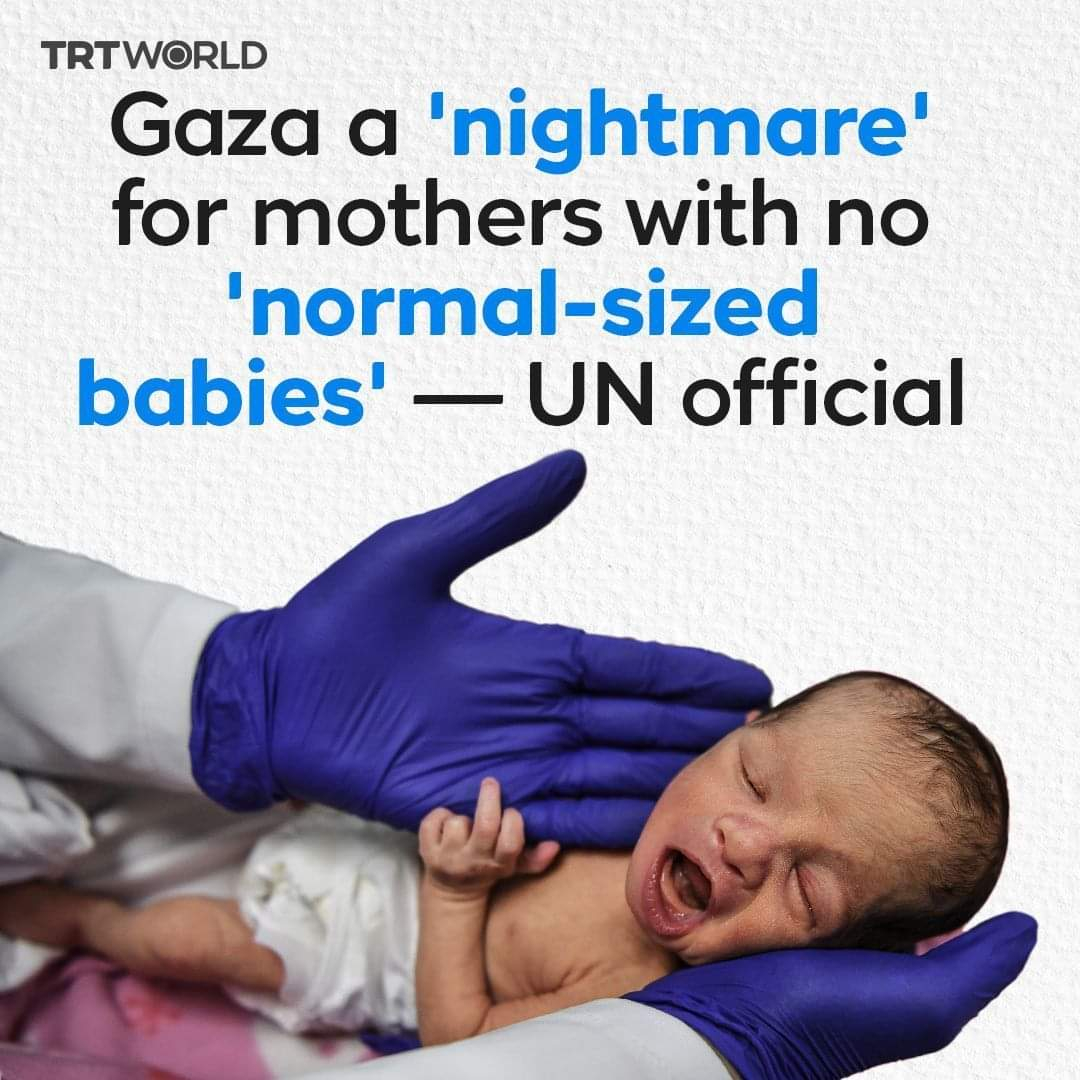
  • "Mothers should be wrapping their arms around their children. Those children should not be wrapped in a body bag."

    The humanitarian situation in Palestine’s besieged Gaza is a complete "nightmare" for mothers and babies, with doctors reporting small and sickly newborns, stillbirths and women forced to undergo C-sections without adequate anaesthesia, a UN official has said.

    "I'm personally leaving Gaza this week terrified for the one million women and girls of Gaza ... and most especially for the 180 women who are giving birth every single day," Dominic Allen, UN Population Fund representative for Palestine, said on March 15.

    "Doctors are reporting that they no longer see normal-sized babies," Allen said after visiting hospitals in northern Gaza. "What they do see, though, tragically, is more stillborn births ... and more neonatal deaths, caused in part by malnutrition, dehydration and complications."

    The numbers of complicated deliveries are roughly twice what they were before Israel launched its war — with mothers stressed, fearful, underfed and exhausted — and caregivers often lacking necessary supplies.

    "It's a nightmare which is much more than a humanitarian crisis," he said. "It is a crisis of humanity ... beyond catastrophic."
    "Mothers should be wrapping their arms around their children. Those children should not be wrapped in a body bag." The humanitarian situation in Palestine’s besieged Gaza is a complete "nightmare" for mothers and babies, with doctors reporting small and sickly newborns, stillbirths and women forced to undergo C-sections without adequate anaesthesia, a UN official has said. "I'm personally leaving Gaza this week terrified for the one million women and girls of Gaza ... and most especially for the 180 women who are giving birth every single day," Dominic Allen, UN Population Fund representative for Palestine, said on March 15. "Doctors are reporting that they no longer see normal-sized babies," Allen said after visiting hospitals in northern Gaza. "What they do see, though, tragically, is more stillborn births ... and more neonatal deaths, caused in part by malnutrition, dehydration and complications." The numbers of complicated deliveries are roughly twice what they were before Israel launched its war — with mothers stressed, fearful, underfed and exhausted — and caregivers often lacking necessary supplies. "It's a nightmare which is much more than a humanitarian crisis," he said. "It is a crisis of humanity ... beyond catastrophic."
    0 Commenti 0 condivisioni
  • As Israel continues to bombard Gaza, targeting the last remaining hospitals, a university and refugee camps this past week, it has killed at least 24,620 Palestinians, mostly women and children, since October 7.

    The mounting and unprecedented “human catastrophe” of the onslaught, in numbers
    As Israel continues to bombard Gaza, targeting the last remaining hospitals, a university and refugee camps this past week, it has killed at least 24,620 Palestinians, mostly women and children, since October 7. The mounting and unprecedented “human catastrophe” of the onslaught, in numbers ๐Ÿ‘‡
    0 Commenti 0 condivisioni
Pagine in Evidenza